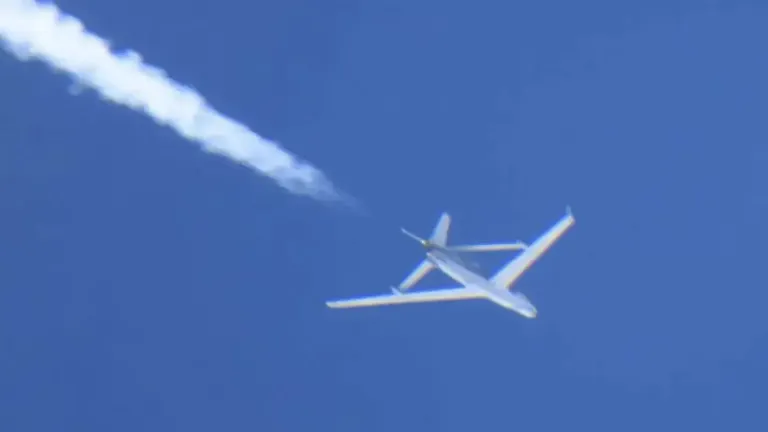
China’s Jiutian high-altitude drone, designed to act as a mothership for drone swarms and perform a variety of missions, has completed its first flight, marking a major step in the country’s expanding uncrewed aviation capabilities.
China’s jet-powered Jiutian drone has completed its first flight, marking a major step for the platform. Designed to serve as a mothership for swarms of smaller uncrewed aerial systems, the drone has also been demonstrated with various air-to-surface and air-to-air munitions, and could support missions such as airborne signal relay and logistics.
The drone’s manufacturer, the state-run Aviation Industry Corporation of China (AVIC), confirmed the flight took place today in Pucheng County, Shaanxi Province. Publicly unveiled at the 2024 Zhuhai Airshow, the Jiutian—also referred to as the SS-UAV—draws its name from traditional Chinese mythology, meaning “The Ninth Heaven” or, more commonly, “High Sky.”
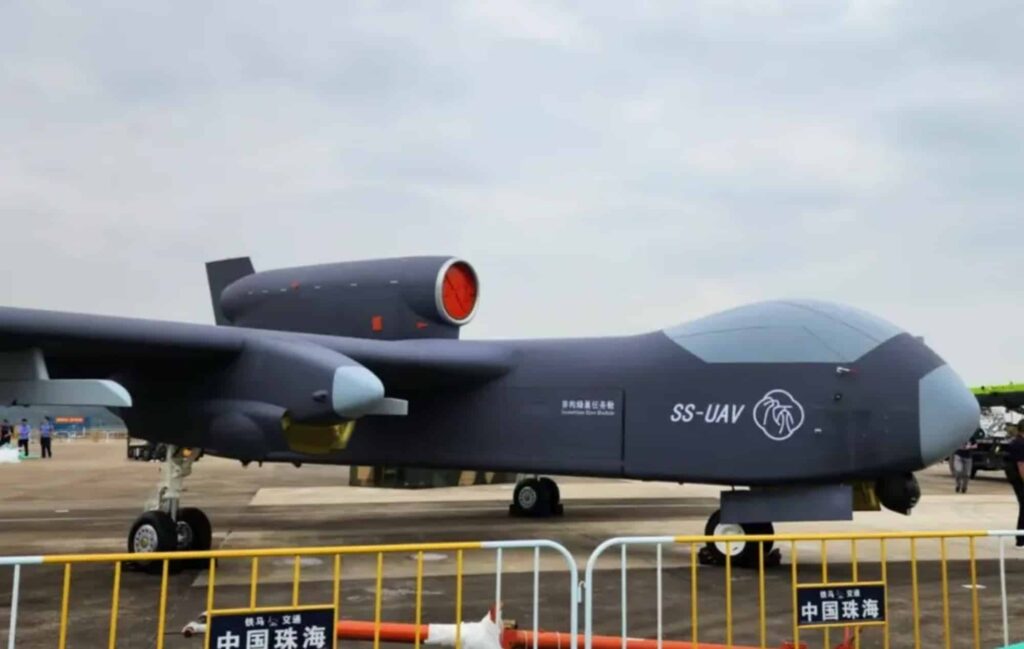
The Jiutian drone measures about 53.6 feet (16.35 meters) in length with an 82-foot (25-meter) wingspan. AVIC reports a maximum payload capacity of nearly 13,228 pounds (6,000 kilograms), a ferry range of roughly 4,349.5 miles (7,000 kilometers), and an endurance of up to 12 hours. It can operate at altitudes up to 49,212.5 feet (15,000 meters) and fly at speeds ranging from 108 to 378 knots.
The drone features a high-mounted wing with minimal sweep and small winglets, paired with an H-shaped tail. A single jet engine sits in a nacelle atop the rear fuselage, and its tricycle landing gear retracts into wing-mounted sponsons. Its overall design evokes a blend of the A-10 Warthog and OV-10 Bronco, with rugged landing gear reminiscent of De Havilland aircraft, suggesting it could operate from rough or improvised airfields.
The Jiutian is significantly larger than many other armed uncrewed aircraft currently in service. For comparison, China’s jet-powered Wing Loong-10 (WZ-10) from AVIC’s Chengdu Aircraft Industry Group (CAIG) is far smaller, as is the Wing Loong 3 pusher-propeller drone, the largest in its family. Similarly, newer extended-range versions of the U.S. MQ-9 Reaper remain noticeably smaller overall.
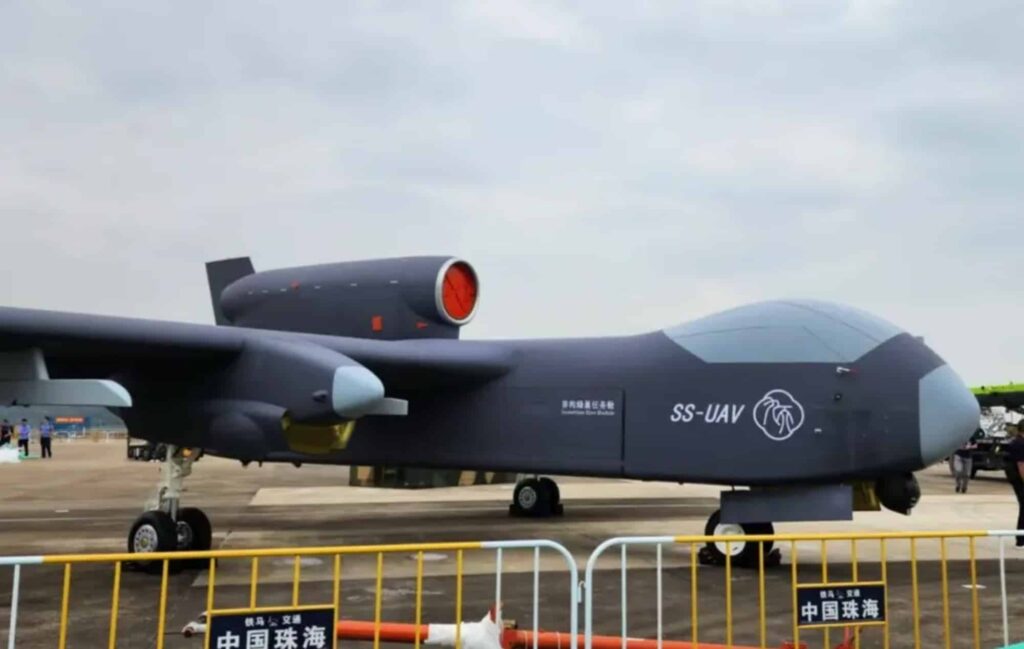
AVIC has described the Jiutian as a “general purpose” platform capable of a wide variety of missions, with particular attention on its modular payload section. At the 2024 Zhuhai Airshow, the module featured Chinese text translated as “ascension of the beehive mission module” and an English label reading “Isomerism Hive Module,” which was likely a mistranslation. While “isomerism” is a chemistry term describing molecules with the same formula but different arrangements, AVIC later clarified via Chinese state media that the reference was intended to highlight the drone’s capability to launch swarms of smaller unmanned systems.
China has shown long-standing interest in swarm-enabled capabilities and in deploying them from a variety of platforms, including high‑altitude balloons. Swarms offer major military advantages, such as rapidly dispersing over wide areas to conduct missions like intelligence, surveillance, reconnaissance (ISR), electronic warfare, and kinetic strikes. Individual drones within the swarm can carry different payloads, giving the collective group a true multi‑mission profile. Large numbers of closely coordinated uncrewed systems also create serious challenges for defenders, who can be overwhelmed or struggle to determine how best to counter the incoming threats.
Launching drone swarms from another airborne platform greatly extends their reach while reducing risk to crewed aircraft. A system capable of deploying a swarm hundreds of miles from its intended target area would provide significant advantages, especially when striking ships at sea, remote island positions, or widely distributed defenses. Modern warships worldwide still have limited ability to fend off dense, simultaneous drone attacks, underscoring the disruptive potential of swarm tactics.
Beyond swarm-launch roles, the Jiutian has also been shown with four underwing pylons per side carrying various weapons, including PL‑12 radar-guided air‑to‑air missiles, TL‑17 land‑attack cruise missiles, and precision‑guided bombs.
Jiutian features a sensor turret beneath its nose, typically housing electro‑optical and infrared cameras, and potentially a laser designator for guiding compatible munitions.
A dome atop the nose aligns with a beyond‑line‑of‑sight communications system, alongside a radome indicating provisions for an onboard radar. Such a radar could support target detection, engagement of aerial threats with weapons like the PL‑12, improved navigation, and enhanced situational awareness. This would allow Jiutian to use air‑to‑air weapons for self‑defense or to actively engage airborne targets.
Its modular payload bay is large enough to support numerous additional roles, including hosting sensors like a side‑looking airborne radar (SLAR), electronic warfare equipment, and advanced communications systems. With its ability to fly at high altitudes, remain airborne for long durations, and operate effectively at lower speeds, Jiutian is well‑suited for broad surveillance and reconnaissance missions, as well as functioning as an airborne communications relay. China’s People’s Liberation Army has been steadily expanding its high‑altitude, long‑endurance drone fleet for routine overland and maritime surveillance, though most existing designs cannot match Jiutian’s carrying capacity or mission flexibility.
AVIC has emphasized that Jiutian’s internal space could be used to carry cargo, making it a potential asset for logistics support to remote or hard-to-reach locations. This capability could address the PLA’s needs at strategic sites such as island outposts in the South China Sea and bases along the Himalayan Plateau near its disputed border with India. Jiutian’s robust landing gear suggests it could operate from locations with limited infrastructure while carrying out these missions.
Uncrewed platforms like Jiutian could also provide cost advantages over traditional crewed cargo aircraft for routine resupply operations in such areas, where crewed aircraft may face operational constraints. However, cargo delivery appears likely to be a secondary role for Jiutian, as AVIC and other Chinese aviation companies are developing a separate range of drones specifically for logistics purposes.
The platform has also been promoted for non-military applications. According to the China Military Bugle, its modular payload system allows for a variety of roles, including precise cargo deliveries to remote regions, emergency communications and disaster relief, as well as geographic surveying and resource mapping.
More broadly, Jiutian highlights China’s growing global influence in uncrewed aviation. AVIC and other Chinese firms have steadily introduced new designs, both large and small, many reaching at least first flight in recent years. This year alone has seen the emergence of multiple new Chinese uncrewed aircraft with flying wing configurations, an area of particular focus. Last month, the PLA announced that its first flying wing uncrewed combat air vehicle (UCAV), the GJ-11, had entered operational service. Chinese military aviation overall has experienced a notable surge in development since last year, including the introduction of new crewed platforms such as the J-36 and J-XDS stealth fighters.
AVIC’s emphasis on non-military applications for Jiutian also reflects the significant overlap between China’s military and commercial aerospace sectors, as well as the involvement of ostensibly civilian research institutions in defense-related projects. Dual-use relationships of this kind are common across China’s technology and industrial landscape.
With Jiutian now in flight testing, further details on its capabilities and potential roles are expected to emerge.
About The Author