The USS Cincinnati (LCS-20) arrived in Batam on December 9, 2025, marking the start of the harbor phase of ASEAN-U.S. Maritime Exercise 2025, where U.S. and ASEAN navies will coordinate ashore before shifting to combined maritime operations in the Riau Islands region.
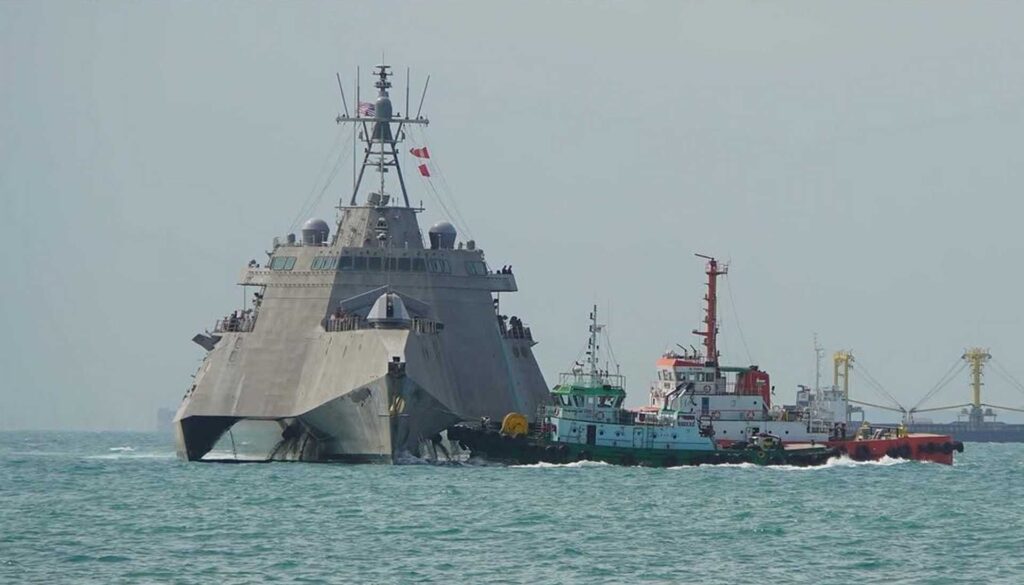
On December 10, 2025, Indonesia’s Naval Regional Command IV announced the arrival of the U.S. Navy’s USS Cincinnati (LCS-20) in Batam on December 9 as part of the ASEAN-U.S. Maritime Exercise 2025 (AUMX 2025). The visit launches the harbor phase of the exercise, during which participating ASEAN and U.S. naval units conduct shore-based coordination before shifting to combined operations in the Riau Islands region. AUMX 2025 is the second iteration of the exercise under its current format, designed to integrate ASEAN partner navies—such as Indonesia and Vietnam—with the United States in a unified training structure. The exercise uses a two-phase approach, combining port coordination and follow-on operations at sea to streamline communications, procedures, and command relationships.
During the Batam phase, naval units carry out harbor-phase preparations ahead of the sea phase. Activities include command-level coordination meetings, technical exchanges on ship operations, and logistical planning required for sustained maritime activity. Crews receive briefings on navigation, safety, communication standards, and exercise sequencing, while conducting final checks before moving to open-water operations. The subsequent sea phase will take place in the waters surrounding the Riau Islands, forming the core operational component of AUMX 2025.
The Independence-class Littoral Combat Ships were developed in the early 2000s to provide the U.S. Navy with fast, agile surface combatants optimized for operations in coastal and near-shore environments. The class features a distinctive trimaran hull designed by Austal and constructed by Austal USA, emphasizing speed, stability, and internal volume over traditional destroyer-level survivability. Initially designed for modular mission packages—including surface warfare, anti-submarine warfare, and mine countermeasures—the LCS program later shifted toward more stable mission configurations based on operational experience.
USS Cincinnati (LCS-20), one of the later ships in the class, was built under expanded block-buy contracts awarded to Austal USA. Its keel was laid in April 2017, launched in May 2018, and commissioned in October 2019. Homeported in San Diego under Littoral Combat Ship Squadron One, the ship has operated extensively across the Pacific region, including missions near Hawaii, Guam, and the South China Sea, along with port visits and exercises involving Singapore, Malaysia, the Philippines, Timor-Leste, Brunei, and Indonesia.
The vessel features a 127.4-meter trimaran hull with a 31.6-meter beam and a draft of about 4.27 meters. It displaces approximately 2,307 tons light and 3,104 tons at full load. Propulsion is provided by gas turbines and diesel engines driving four waterjets, supported by a retractable azimuth thruster and four diesel generators. The ship can exceed 40 knots, reach sprint speeds of up to 47 knots, and travel around 4,300 nautical miles at 20 knots. A core crew of about 40 sailors operates the ship, with space for up to 35 mission or aviation personnel.
USS Cincinnati’s armament includes a 57 mm Mk 110 naval gun and four .50 cal machine guns, while air and missile defense is provided by an 11-cell SeaRAM launcher. Its sensors include the Sea Giraffe 3D radar, BridgeMaster-E navigational radar, and AN/KAX-2 EO/IR system. Electronic warfare systems include the ES-3601 suite and Mk 36 SRBOC decoy launchers. The flight deck and hangar support MH-60R/S Seahawk helicopters and accommodate MQ-8 Fire Scout unmanned aerial vehicles, enhancing the ship’s surveillance and operational flexibility—a capability set that will be fully employed during AUMX 2025.
About The Author