China’s CH-7 stealth unmanned combat aerial vehicle has completed its maiden flight in northwest China, marking a key milestone for the tailless flying-wing drone program. The initial test validated basic airworthiness, autonomous takeoff and landing, and flight control, paving the way for expanded trials and future integration into China’s networked ISR and strike architecture.
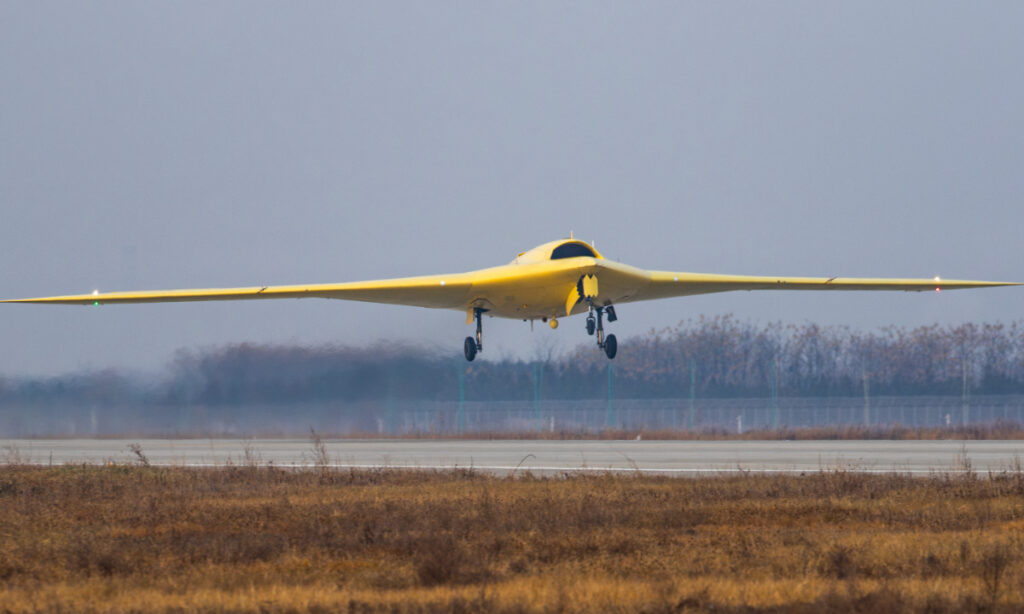
On December 15, 2025, China’s Global Times reported that the CH-7 stealth unmanned combat aerial vehicle (UCAV) successfully completed its maiden flight at an airfield in northwest China. The initial sortie was deliberately limited, concentrating on validating fundamental airworthiness, flight control laws, and autonomous ground and flight operations. These included automated taxiing, takeoff, landing, basic attitude control, and trajectory tracking. The CH-7 was first revealed to the public as a full-scale mockup at the Zhuhai Airshow in 2018, with stated roles spanning ground and maritime surveillance, target monitoring, information relay, and integration into networked strike and command systems.
Chinese sources emphasized that the first flight was designed to confirm the integrity of the aerodynamic configuration, propulsion integration, and control logic rather than demonstrate operational missions. This was particularly significant given the CH-7’s tailless flying-wing design, which lacks conventional vertical and horizontal stabilizers and therefore presents greater challenges in directional stability and control. Future test phases are expected to progressively expand the flight envelope to higher speeds and altitudes, longer endurance missions, and increasingly complex autonomous behaviors, followed by the step-by-step integration of sensors, data links, and internal payload trials.
The CH-7, also known as the Caihong-7 or Rainbow-7, made its debut appearance at the Zhuhai Airshow in November 2018 as part of China’s broader push into stealth unmanned aviation. At that time, it was presented as a large, jet-powered flying-wing drone broadly comparable in concept to the U.S. Northrop Grumman X-47B, emphasizing a balance between altitude, endurance, and internal payload volume. Early projections suggested a first flight around 2019 and possible production in the early 2020s, but progress thereafter appeared more measured, with development milestones mainly visible through airshow displays and design updates rather than confirmed flight activity.
A revised CH-7 configuration was displayed publicly in 2022, showing notable refinements such as sharper canted wingtips, reworked control surfaces, and an elongated dorsal engine nacelle. These changes suggested ongoing optimization of aerodynamic performance, stability, and propulsion integration. At Airshow China 2024, the manufacturer, China Aerospace Science and Technology Corporation (CASC), presented what it described as a genuine airframe rather than a mockup, featuring surface finishes, access panels, and structural details consistent with a flight-ready prototype. By 2025, imagery showed the aircraft on a runway in primer coatings typical of test aircraft, followed by footage confirming its first flight. Some reports have also suggested the possibility of detachable vertical stabilizers tailored to specific mission profiles.
From a design perspective, the CH-7 is a jet-powered, high-altitude, long-endurance stealth flying-wing UAV intended to minimize radar and infrared signatures while preserving internal volume for fuel, sensors, and weapons. The aircraft uses a dorsal air intake feeding a single jet engine, with an exhaust arrangement shaped to reduce detectability. Observed prototypes display extensive edge alignment, careful treatment of panel joints and fasteners, and clearly defined internal bay outlines. Early flight-test instrumentation, including pitot probes and a prominent dorsal antenna or sensor fairing, points to satellite communications, navigation, secure data links, and electronic sensing roles. Rear-end features such as slot-like exhaust geometry and trailing-edge details may continue to evolve as testing advances.
According to Chinese media, the CH-7’s primary missions will focus on intelligence, surveillance, and reconnaissance (ISR) and strike support within a networked operational concept, rather than frequent direct weapon release. Its sensor suite is expected to include electro-optical and infrared systems for day and night observation, as well as radar optimized for wide-area ground and maritime surveillance. Beyond collecting data, the CH-7 is described as a forward sensor and targeting node capable of detecting, identifying, and tracking targets, then transmitting real-time information to command centers, manned aircraft such as the J-20, J-16, and H-6K, and ground- or sea-based missile forces. Several accounts suggest it could support mid-course or terminal guidance for long-range weapons, particularly against radar emitters, command nodes, missile sites, and naval targets. Its higher speed and operational concept distinguish it from slower “loyal wingman” drones designed to fly in close formation with manned fighters.
Reported performance figures for the CH-7 have varied over time. Early data from 2018 cited a wingspan of around 27.3 meters, a maximum takeoff weight of roughly 8,000 kg, cruise speeds near 612 km/h, a service ceiling of about 16,000 meters, and endurance of up to 16 hours. Later references from 2022 mentioned a length of approximately 10 meters, a wingspan in the 22–26 meter range, a maximum takeoff weight closer to 10,000 kg, maximum speeds approaching 920 km/h, ceilings around 13,000 meters, and endurance of roughly 15 hours. Other claims have included maximum takeoff weights up to 13,000 kg, an operational radius of about 2,000 km, internal payload capacity potentially reaching 2,000 kg, and range estimates exceeding 11,500 km under certain assumptions. Within China’s expanding unmanned portfolio, the CH-7 is expected to complement platforms such as the GJ-11 Sharp Sword—often associated with more direct strike roles—and high-speed reconnaissance drones like the WZ-8, which prioritize speed over endurance.
About The Author