Japan has installed a 100 kW-class high-energy laser aboard its experimental ship JS Asuka, marking a major step in directed-energy naval weapons. The system, developed by the Acquisition, Technology & Logistics Agency, will undergo sea trials in 2026 and is designed to counter drones, loitering munitions, and cruise missiles with low-cost, high-speed precision. The move reflects Japan’s broader push for technological superiority and resilience in the Indo-Pacific, aligning with similar programs in the U.S. and UK navies.
Japan has reached a key milestone in its development of directed-energy weapons for naval use. On December 2, 2025, reports from the X account @agcdetk confirmed that the Japan Maritime Self-Defense Force (JMSDF) has installed a 100 kW-class laser weapon system aboard the experimental ship JS Asuka. Final integration is ongoing at Japan Marine United’s Isogo shipyard, with full-scale sea trials expected in 2026. This follows earlier railgun experiments conducted on the same platform.
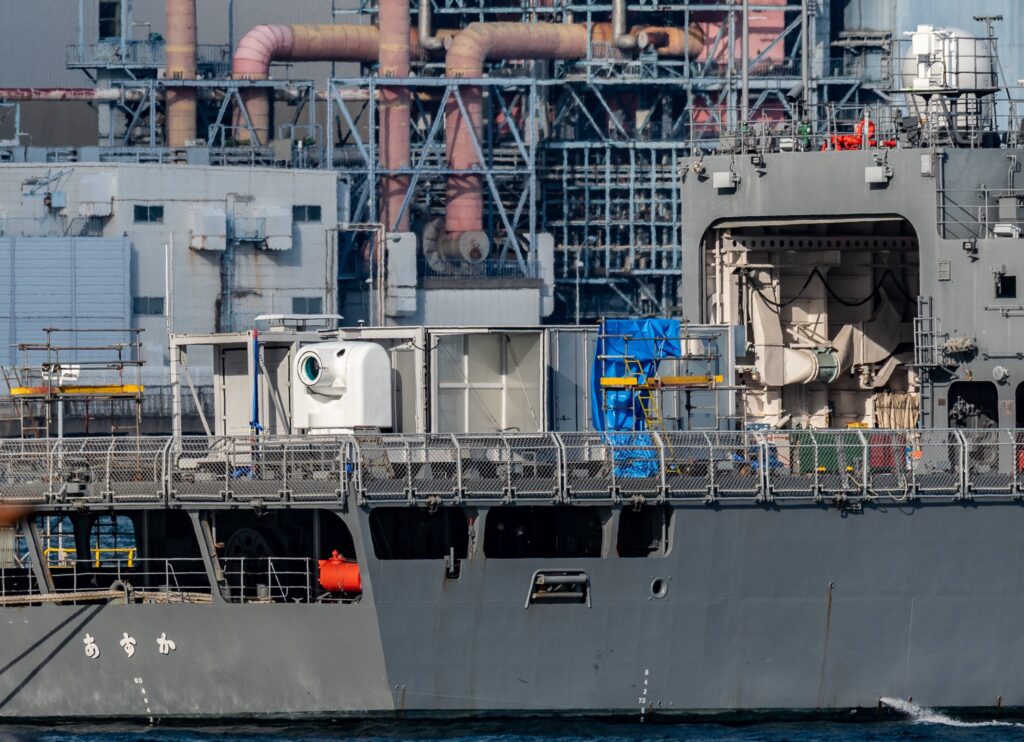
Commissioned in 1995, JS Asuka was designed as a testbed for advanced maritime defense technologies. As an experimental vessel, it allows the integration of non-standard equipment, including electromagnetic railguns, prototype combat systems, and now high-energy lasers, without affecting frontline fleet readiness. By testing cutting-edge technologies under real-world maritime conditions, Asuka helps Japan validate systems that contribute to the modernization of future naval platforms.
The laser system is the result of nearly seven years of R&D led by the Acquisition, Technology & Logistics Agency (ATLA). Initiated in 2018, the project culminated in February 2023 with a 100 kW-class laser demonstrator. Ground tests have confirmed key performance metrics, with sea-based trials expected to begin after February 27, 2026.
This deployment is significant due to the strategic value of directed-energy weapons in modern naval warfare. High-energy lasers like Japan’s 100 kW system are designed to counter fast, maneuverable, and low-cost aerial threats, including drones, loitering munitions, and cruise missiles, which are challenging and expensive to defeat with conventional systems.
Unlike interceptor missiles, which can cost hundreds of thousands per shot, a laser weapon has a virtually unlimited magazine limited only by power supply. Each shot costs far less than a missile and can be fired repeatedly with near-instant response—crucial against drone swarms or saturation attacks. High-energy lasers also offer silent, speed-of-light engagement with minimal collateral damage, making them ideal for selective engagement in sensitive maritime zones. They complement radar-guided missiles and CIWS in layered defense architectures.
Japan’s development aligns with other leading navies. The U.S. Navy deployed the 30 kW LaWS aboard USS Ponce in 2014 and has since advanced to 60 kW HELIOS lasers on Arleigh Burke-class destroyers. The UK is developing the 50 kW-class DragonFire laser for maritime deployment aboard Type 23 and Type 26 frigates, with trials ongoing since 2023.
These developments indicate a growing consensus that laser weapons are becoming essential for countering low-cost, high-volume threats. As shipboard power generation improves, lasers are likely to become standard defensive tools across new combat vessels.
For Japan, installing a high-energy laser aboard JS Asuka reflects a broader defense strategy emphasizing technological superiority, resilience, and reduced reliance on expensive missiles. The modular system, with advanced beam control and integrated cooling, may be scaled for future platforms, including Mogami-class frigates and Aegis destroyers, providing an effective and sustainable solution against emerging threats.
Beyond military applications, directed-energy systems could stimulate Japan’s defense industry, enabling joint R&D with allies and commercial spin-offs in optics, energy storage, and autonomous targeting technologies.
Upcoming sea trials aboard JS Asuka will test not only hardware but Japan’s strategic vision for a new kind of naval warfare, where energy replaces explosives as a central pillar of shipboard defense. Success could usher in a new era in which laser weapons become standard across Indo-Pacific fleets.
About The Author