Babcock International has begun deliveries of the six-wheel Jackal 3 Extenda from its Devonport facility, marking a key step in modernising the British Army’s high-mobility wheeled fleet through continued collaboration with Supacat and UK industry.
On 17 December 2025, Babcock International announced that the first Jackal 3 Extenda all-terrain vehicles had been completed at its Devonport facility, officially beginning deliveries under the second production tranche of the British Army’s Jackal 3 programme. This milestone reflects steady progress in modernising the Army’s high-mobility wheeled vehicle fleet and highlights the continued industrial partnership between Babcock and Supacat, whose High Mobility Transporter (HMT) design underpins the Jackal family.
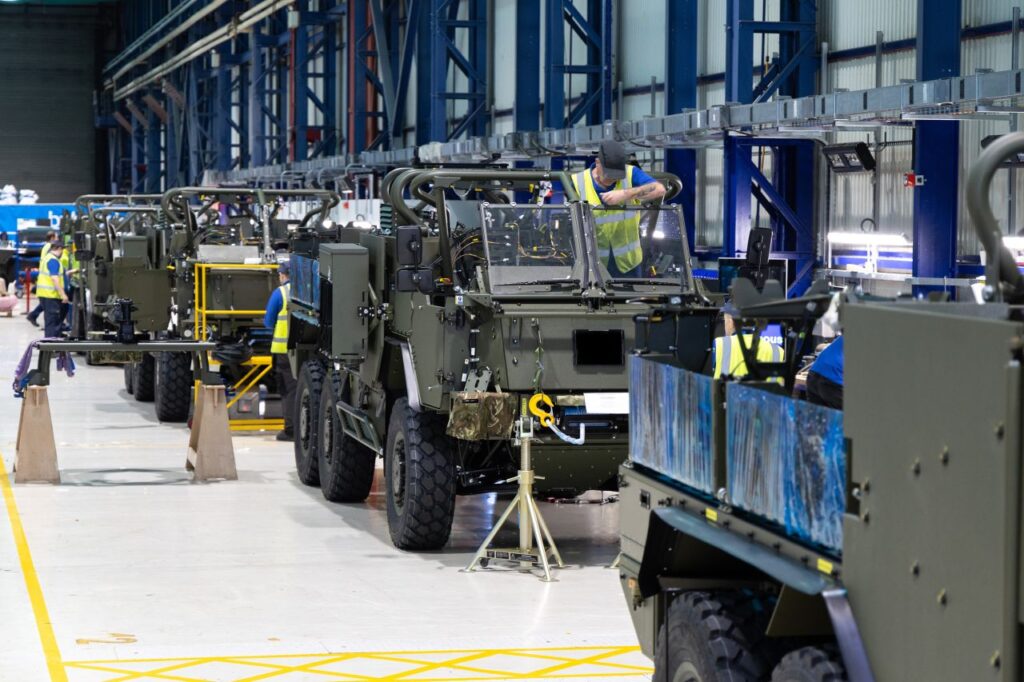
The vehicles now entering production are the six-wheel Jackal 3 Extenda, also known as Jackal 3 (E). Built on Supacat’s HMT Extenda modular platform, the 6×6 configuration expands on the four-wheel-drive Jackal 3 by adding an extra axle, increasing internal space and payload while preserving the platform’s renowned off-road mobility. The HMT Extenda offers a gross vehicle weight of up to 12 tonnes and a payload of approximately 4.2 tonnes, compared with around 2.4 tonnes for the 4×4 variant, enabling the carriage of heavier mission systems or additional supplies.
According to Babcock, the Jackal 3 Extenda is intended for a broad range of operational tasks, including reconnaissance, patrol, and support missions where extended range, endurance, and adaptability are required. The vehicle is engineered for demanding terrain and features independent air suspension with adjustable ride height, allowing it to optimise mobility across varied ground conditions while reducing stress on both crew and onboard equipment.
Manufacturing at Babcock’s Devonport site in southwest England reinforces the programme’s role in sustaining skilled defence-industry jobs and supporting UK-based supply chains. Under the partnership model, Supacat delivers the vehicle design and core platform architecture, while Babcock manages final assembly, systems integration, and delivery. The programme is presented as a clear example of domestic industrial capability being applied to meet evolving British Army mobility requirements.
Operationally, the Jackal 3 Extenda aligns with a wider shift within UK land forces toward highly mobile, rapidly deployable wheeled platforms. Compared with heavier tracked vehicles, systems like Jackal offer greater operational reach, endurance, and flexibility for light cavalry and reconnaissance units. The HMT Extenda design supports this concept through long road range, strong cross-country performance, and compatibility with air transport platforms such as the C-130, A400M, and C-17, as well as underslung helicopter transport in certain configurations.
The Jackal family has been in British Army service for more than a decade, seeing extensive use on overseas operations. Originally introduced under urgent operational requirements, the platform has evolved through multiple upgrade cycles. The Jackal 3 generation represents the latest phase of this evolution, incorporating improved payload capacity, modularity, and growth potential. The Extenda variant, enabled by the modular HMT architecture, allows integration of a wider array of mission equipment, including weapon stations, communications suites, and protection packages, while maintaining high levels of crew situational awareness.
From an industrial perspective, the Jackal 3 Extenda programme underscores the enduring relationship between the UK Ministry of Defence and domestic land-systems manufacturers. Although Babcock has not disclosed contract values or total vehicle numbers, the announcement confirms that the Extenda is part of an ongoing production effort rather than a limited run. The Devonport rollout therefore marks a transition to a new phase of fleet expansion focused on the six-wheel configuration.
The first Jackal 3 Extenda vehicles leaving the production line represent a tangible step forward in the British Army’s high-mobility modernisation strategy. The programme has clearly moved beyond design and contracting into sustained industrial output, reinforcing the role of UK industry in delivering specialist land-mobility capabilities. As additional vehicles enter service, the Jackal 3 Extenda is expected to become a key asset within the Army’s light and medium forces, combining a proven operational concept with updated vehicle architecture and domestic industrial support.
About The Author