Russia’s Airborne Forces begin testing the Omich-2, a multifunctional robotic ground vehicle capable of transport, evacuation, and support missions, carrying 350 kg over 20 km in 40 minutes.
Russia’s Airborne Forces have started testing a new multifunctional unmanned ground vehicle called Omich-2, developed by engineers in the Russian city of Omsk. The system is intended to perform transport, casualty evacuation, and potential combat-support missions on the battlefield.
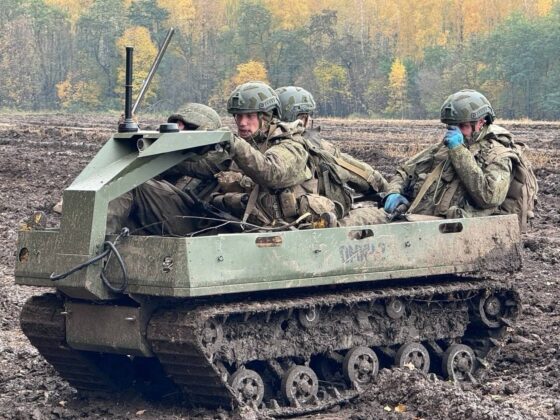
Omich-2 is described as an optionally piloted robotic platform with a total weight of around 650 kilograms and a payload capacity of up to 350 kilograms. It is designed to operate autonomously for up to 40 minutes, covering distances of as much as 20 kilometers during a single mission.
According to its developers, the platform’s primary roles include transporting assault troops and supplies, as well as evacuating wounded personnel from combat zones. The system is produced in multiple variants, including versions optimized for towing, medical evacuation, and airborne assault operations.
The airborne configuration of Omich-2 is reported to achieve speeds of 40 kilometers per hour or more, enabling it to keep pace with airborne and light infantry units. Russian sources state that the platform’s modular design allows it to be adapted for a wide range of operational requirements.
A representative of the manufacturing team highlighted the vehicle’s flexibility and potential for weapon integration, claiming it can be fitted with small arms up to 30 mm caliber, grenade launchers, mortars up to 120 mm, and various types of anti-tank guided missiles.
Some variants are also said to support the installation of advanced communications relay systems, electronic intelligence, and electronic warfare equipment. Developers have reportedly entered discussions with manufacturers of light automatic air defense systems aimed at countering drones, reflecting interest in using Omich-2 for the protection of airfields, industrial facilities, and border areas.
Beyond combat roles, the manufacturer claims the Omich platform has been adapted for non-combat applications. Using the same chassis, engineers have developed mobile power generation units capable of producing up to 20 kilowatts. The platform can also be equipped with mine-laying systems, mine-clearing trawls, and what are described as miniature multiple rocket launcher modules.
The developer further mentioned the possibility of integrating miniature multiple launch rocket systems similar to the “Solntsepyok” and “Tosochka,” although no technical data or test evidence has been released to support these claims.
Testing of the Omich-2 comes as Russia continues to experiment with unmanned and remotely operated ground systems following significant equipment losses in Ukraine. Russian forces have emphasized the need to reduce risks to personnel while maintaining mobility in environments increasingly shaped by drones, precision weapons, and electronic warfare.
With an endurance of 40 minutes and an operational range of 20 kilometers, Omich-2 falls into the category of short-range tactical unmanned ground vehicles rather than long-range logistics platforms. Its optional piloting capability allows it to be operated either remotely or by a human driver, offering flexibility in situations where communications may be disrupted.
About The Author