Germany is set to deploy 84 RCH 155 wheeled self-propelled howitzers following a €1.2 billion order through ARTEC, the Boxer joint venture. The acquisition boosts the Bundeswehr’s medium force artillery and reflects a wider European move toward mobile, survivable firepower shaped by lessons from the Ukraine conflict.
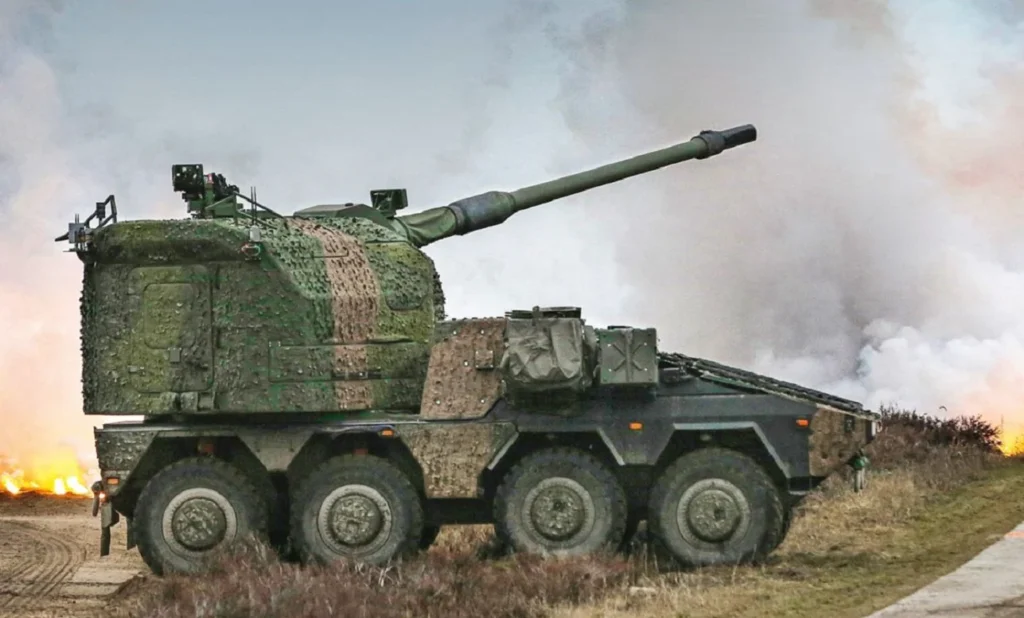
Germany’s Bundeswehr is modernizing its artillery with the acquisition of the RCH 155 wheeled self-propelled howitzer. ARTEC, the Boxer joint venture between KNDS Deutschland and Rheinmetall Landsysteme, received an order for 84 systems valued at €1.2 billion, which includes training equipment, logistical support, and in-service sustainment. The purchase reflects Berlin’s focus on an immediately deployable combat capability rather than a limited fleet.
The RCH 155 features a protected, turreted 155mm L52 gun compliant with NATO standards. It mounts the automated Artillery Gun Module on the Boxer 8×8 chassis, with an unmanned turret and a two-soldier crew under armor. Automation handles navigation, fire control, gun laying, and fully automated projectile and charge handling with inductive fuze setting. The system carries 30 fused rounds and 144 modular charges, can fire up to 9 rounds per minute, and has an effective range of 40 km (base bleed), 54 km (V LAP), and 70 km (VULCANO extended range).
Mobility under fire is a key tactical feature. The RCH 155 supports rapid shoot-and-scoot operations, Multiple Round Simultaneous Impact missions, and firing on the move against stationary or moving targets. On a European battlefield with pervasive drones and counter-battery sensors, this reduces detection-to-decision timelines and forces adversaries to expend more resources on reconnaissance and loitering munitions.
Germany plans to make the RCH 155 the primary artillery system for its new Medium Forces, emphasizing rapid road movement and dispersed combat while remaining protected. Using the Boxer chassis leverages existing vehicle commonality, easing training, spare parts supply, and maintenance compared with introducing a separate truck fleet.
The procurement aligns with broader artillery modernization. Germany is increasing 155mm ammunition stocks and boosting industrial production, addressing shortages highlighted by the war in Ukraine, and ensuring sustained supply for national and allied use.
Technically, the RCH 155 is a wheeled counterpart to the tracked Panzerhaubitze 2000. While the PzH 2000 excels in burst fire and sustained rates of fire, it has a larger crew and less road mobility for strategic redeployment. Germany also operates the MARS rocket artillery family, but tube artillery remains central for responsive, continuous fires, especially when paired with precision 155mm and extended-range ammunition integrated with NATO digital fire control.
Compared with Western alternatives, the RCH 155 balances mobility, automation, and fleet commonality. France’s CAESAR prioritizes light weight and road mobility, while Sweden’s Archer emphasizes automation but lacks Boxer compatibility. Germany’s choice of a protected Boxer-based system with a two-soldier crew and on-the-move firing suits medium brigades operating under persistent surveillance.
This procurement occurs amid a broader political and defense investment surge. In December 2025, Germany’s parliamentary budget committee approved over €50 billion in defense contracts to meet NATO commitments and respond to security challenges from Russia’s war in Ukraine. The move reflects a European trend of rising defense spending, rearmament, and the revival of high-intensity warfighting capabilities.
About The Author