Russia’s state defense conglomerate Rostec has confirmed the first flight of a Su-57 fighter equipped with the new Product 177 engine, launching a dedicated flight-test phase that will determine whether the aircraft’s propulsion can meet full fifth-generation performance standards.
On December 22, 2025, Russia’s state-owned defense conglomerate Rostec announced that the Su-57 fifth-generation fighter jet had successfully completed its first flight powered by the new “Product 177” engine. The milestone marks a transition from bench and ground testing to a full joint flight-test program conducted by the United Aircraft Corporation (UAC) and United Engine Corporation (UEC). As fifth-generation fighters remain central to modern deterrence and power-projection strategies, the integration of a new engine on Russia’s most advanced combat aircraft is being closely monitored by foreign defense analysts. Moscow is presenting the achievement not only as a technological breakthrough but also as evidence of industrial resilience and enhanced export potential.
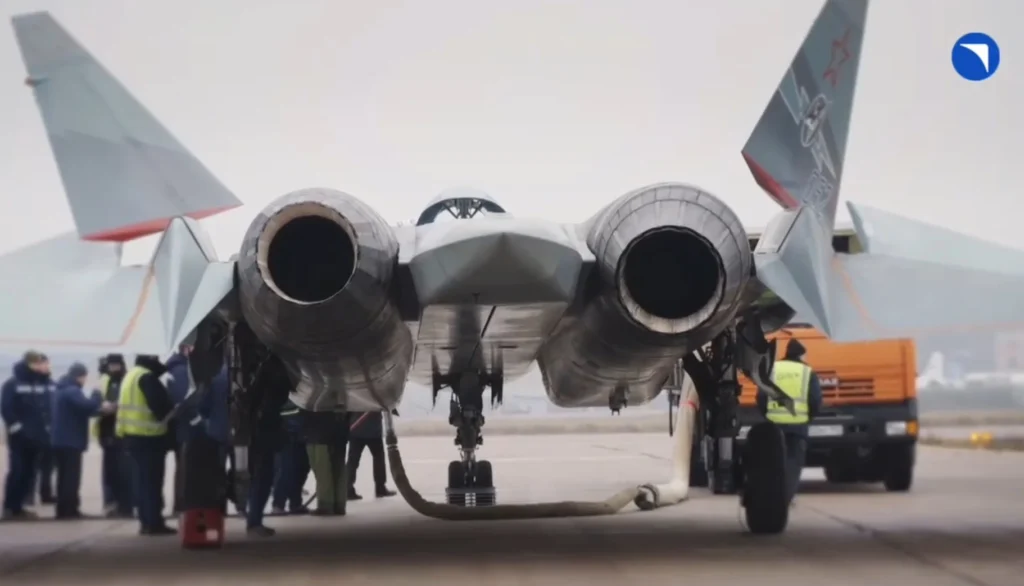
According to Rostec, specialists from UAC and UEC have begun dedicated flight testing of the Product 177 engine as part of the Su-57 fifth-generation aviation complex. The test flight was conducted by Honored Russian test pilot Roman Kondratyev and reportedly proceeded without incident, with the engine operating within normal parameters. Designed specifically for fifth-generation aircraft, Product 177 delivers up to 16,000 kgf of thrust in afterburner while offering reduced fuel consumption across all operating regimes and an extended service life compared to previous-generation engines. Evgeny Marchukov, General Designer at UEC’s A. Lyulka Design Bureau, stated that the use of new materials and innovative design solutions has enabled significant performance improvements, and that the first flight marks the start of integrated testing with the Su-57 platform.
Rostec places this engine milestone within a broader narrative of the Su-57 as a combat-tested and continuously evolving platform. The corporation emphasizes that the aircraft has performed effectively in real combat operations and has confirmed its compliance with fifth-generation requirements, including low observability. Designed as a multirole frontline combat aircraft, the Su-57 is intended to engage air, ground, and maritime targets under all weather conditions and in heavily contested electromagnetic environments. Rostec notes that operational experience gained during the Special Military Operation is directly informing ongoing modernization efforts, including upgrades to weapons integration and onboard systems. Sukhoi Design Bureau Director Mikhail Strelets describes the Su-57 as Russia’s most advanced fifth-generation fighter, highlighting its evolutionary development path aimed at rapidly integrating new technologies.
Operationally, the introduction of Product 177 is expected to provide the Su-57 with a meaningful performance advantage. Increased afterburning thrust supports improved acceleration, climb rate, and energy maneuverability, as well as greater flexibility when carrying heavier internal weapons loads. Reduced fuel consumption and longer engine life could translate into extended mission endurance, improved range, and lower lifecycle costs. While detailed performance figures remain undisclosed, the combination of higher thrust, improved efficiency, and greater durability suggests enhanced survivability and mission effectiveness in highly defended airspace characterized by advanced surface-to-air missile systems and electronic warfare threats.
With an afterburning thrust rating of approximately 16,000 kgf (around 157 kN), Product 177 places the Su-57’s propulsion system in a class comparable to the Pratt & Whitney F119 engine powering the F-22 Raptor. The F-35’s F135 engine remains more powerful in absolute terms, but Product 177 represents a substantial step forward for a twin-engine platform. Compared to European fighters such as the Eurofighter Typhoon and Rafale, whose individual engines generate significantly lower thrust, a single Product 177 delivers markedly higher output, while total installed thrust on the Su-57 remains competitive among modern fighters.
Beyond raw thrust, the long-term assessment of Product 177 will depend on its dry thrust performance, fuel efficiency, thermal and acoustic signatures, and reliability in sustained operations. Should UEC’s claims regarding reduced specific fuel consumption and increased service life be confirmed in operational service, the Su-57 equipped with two Product 177 engines would rank among the highest-performing fighters globally in terms of installed thrust and overall propulsion capability.
Strategically, the first flight with Product 177 underscores Russia’s intent to base its fifth-generation airpower on a fully domestic industrial foundation. Rostec reports that UAC is expanding production capacity to increase Su-57 deliveries to the Russian Aerospace Forces while actively promoting an export configuration of the aircraft. Although no specific customers have been identified, Rostec claims that foreign interest is strong and that export deliveries are already underway. The program involves a broad network of Rostec enterprises, reinforcing Moscow’s emphasis on technological sovereignty amid ongoing international sanctions.
For countries with limited access to Western fifth-generation fighters, a Su-57 powered by the Product 177 engine is positioned as an alternative pathway to advanced air combat capability. For NATO and its partners, progress in the engine’s development will be closely monitored as an indicator of Russia’s ability to field modernized, serially produced fifth-generation aircraft at scale.
Ultimately, the first flight of the Su-57 with Product 177 represents more than the testing of a new engine. It signals the maturation of the aircraft as an integrated combat system, combining combat experience, upgraded weapons and avionics, and a higher-thrust, more efficient domestically developed powerplant. The pace at which Product 177 advances through flight testing and enters series production will be a key factor shaping Russia’s future airpower posture and its competitiveness in the global fighter aircraft market over the next decade.
About The Author