The Royal Navy will conduct a thorough inspection of the airframe and substructure on its three F-35Bs to check for corrosion, after which affected parts will be removed, repaired, and reinstalled.
For the first time, the U.S. Navy’s Fleet Readiness Center Southeast (FRCSE) in Jacksonville, Florida, hosted three Royal Navy F-35B Lightning IIs for a “Production Asset Inspection Requirement Tier II (PAIR II) corrosion-mitigation inspection.” During this process, FRCSE personnel will inspect, repair, and remove any corrosion from the aircraft’s outer skin, which is covered with essential Radar Absorbent Material (RAM).
The FRCSE announced the work on Dec. 22, 2025, noting that the jets arrived on Dec. 3, with one aircraft identified as belonging to 809 Naval Air Squadron (NAS). The facility previously inducted its first F-35B on Aug. 7, 2024, from Marine Fighter Attack Squadron 122 (VMFA-122) “Flying Leathernecks” of MCAS Yuma, Arizona, for PAIR II work.
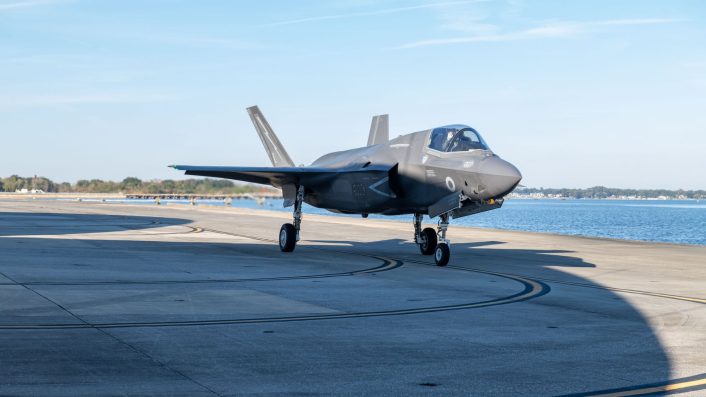
The UK operates 38 F-35Bs out of 48 ordered, with 18–24 recently deployed aboard HMS Prince of Wales during the eight-month Carrier Strike Group 25 (CSG25) deployment, Operation Highmast, from 617 Squadron, 809 NAS, and 207 Squadron. Exposure to harsh marine environments may have necessitated this PAIR II inspection.
The U.S.-UK cooperation extends to joint exercises and interoperability initiatives, including ‘interfly’ events with the Royal Australian Air Force, U.S. Marine Corps, U.S. Air Force, and Royal Air Force at Talisman Sabre, as well as routine cross-servicing drills with the Netherlands. FRCSE also shares corrosion prevention best practices with Royal Navy maintenance teams to reduce future repair costs.
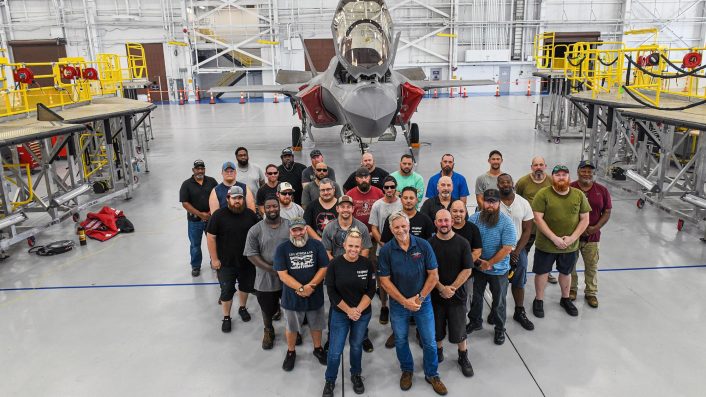
The work highlights the importance of maintaining Low Observability (LO) and Radar Absorbent Material (RAM) coatings on stealth jets like the F-35, F-22, and B-2. While coating degradation does not affect airworthiness, it increases radar visibility. Cockpit canopies are also inspected to prevent delamination, a problem addressed in 2019 through new contractor processes.
At FRCSE, PAIR II inspections involve removing panels, inspecting the substructure, treating or repairing corrosion, and reinstalling panels on a “corrosion speed line.” The process includes corrosion mapping, structural assessment, and component repair or replacement. Optimized procedures reduced turnaround from 180 to roughly 60 days, enhancing operational availability. FRCSE’s 60 trained artisans and staff, proficient with advanced systems and coatings, extend their expertise to Royal Navy aircraft, ensuring mission readiness.
About The Author