Russia fired an Oreshnik intermediate-range ballistic missile at Ukraine’s Lviv region, with impacts reported near the EU and NATO border, while Kyiv warned the strike threatens European security and noted that the U.S. and China were pre-notified to prevent misinterpretation.
Russia launched its Oreshnik intermediate-range ballistic missile (IRBM) at Ukraine late on January 8, striking an area near Lviv, close to the European Union and NATO border.
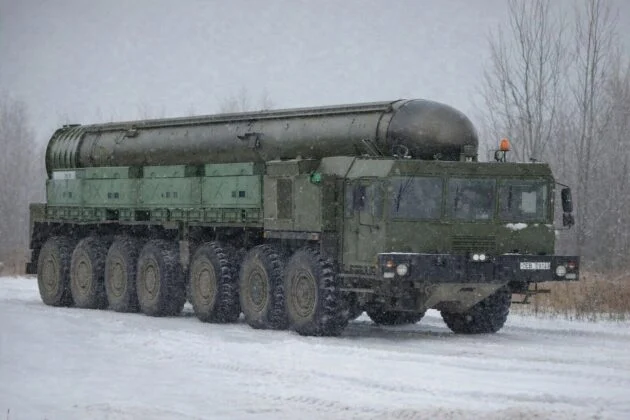
The Ukrainian Air Force reported that a nationwide alert began at 11:30 p.m. after detecting ballistic launches from Russia’s Kapustin Yar test range. Explosions were confirmed in the Lviv region following the alert. The Russian Ministry of Defense later acknowledged the launch, describing it as the second operational use of the missile system.
Ukrainian authorities identified the weapon as the Oreshnik, also known as the RS-26, an intermediate-range system derived from the Rubezh intercontinental ballistic missile. U.S. officials have stated that the missile is capable of nuclear delivery against targets in Europe. For this strike, as in its first operational use on November 21, 2024, the warhead contained mass-dimensional blocks made of concrete and metal rather than explosives.
The Oreshnik first appeared publicly following the November 2024 strike on Dnipro, when Ukrainian analysts noted it carried six primary warheads, each with six sub-munitions, none of which were explosive. That launch demonstrated the missile as a new component of Russia’s arsenal designed to test ballistic defenses and send strategic signals.
Ukraine’s Foreign Minister Andrii Sybiha condemned the strike, calling it a serious threat to European security. He criticized Russia for attempting to justify the attack with a fabricated “Putin residence attack,” calling it proof that Moscow does not require real justification for its military actions.
Sybiha stated that Ukraine is briefing international partners, including the United States, European nations, and global organizations, on the details of the strike. He described the use of an intermediate-range missile near NATO borders as a “global threat” requiring coordinated international response.
He also urged broader measures targeting Russia’s financial resources, including the tanker fleet, oil revenues, and overseas assets. Ukraine plans to convene an urgent UN Security Council meeting, sessions of the Ukraine-NATO Council, and responses within the EU, Council of Europe, and OSCE.
The Oreshnik launch marks an escalation in Russia’s missile operations and highlights the growing threat to NATO’s eastern flank. Unlike shorter-range missiles used previously in the conflict, the Oreshnik is designed for regional strategic targets, and its deployment near NATO borders underscores the expanded security challenges facing Europe.
Despite its potential risk, the launch was reportedly pre-notified to the United States and China to avoid misinterpretation as a nuclear strike, reflecting the missile’s intermediate-range classification and strategic profile.
About The Author