The U.S. Air Force has completed the first operational MH-139A Grey Wolf escort of a Minuteman III ICBM convoy at Malmstrom Air Force Base, marking a significant upgrade in safeguarding America’s land-based nuclear deterrent across vast and remote missile fields.
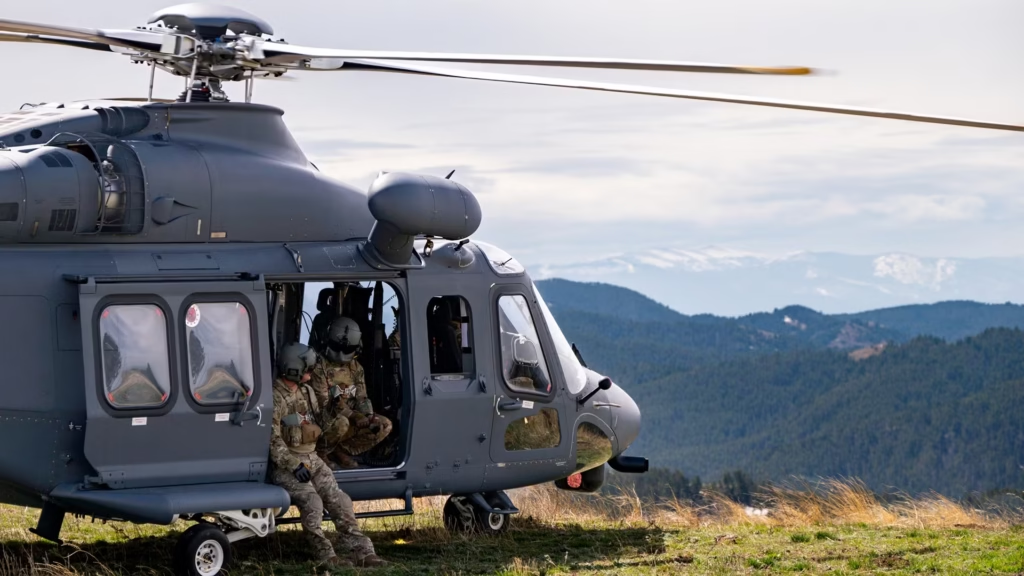
The U.S. Air Force Global Strike Command confirmed on January 13, 2026, that two MH-139A Grey Wolf helicopters from the 40th Helicopter Squadron completed the platform’s first operational Minuteman III intercontinental ballistic missile (ICBM) convoy security mission at Malmstrom Air Force Base on January 8. During the mission, the aircraft demonstrated exactly what the nuclear enterprise requires most: the ability to escort sensitive ground convoys for extended periods across remote terrain, remain on station without refueling, and deliver a faster, more capable airborne security presence than the aging UH-1N Huey it is replacing.
ICBM convoy escort missions are far from routine aviation tasks. Missile maintenance and security convoys must travel deep into sparsely populated launch areas, where long distances, harsh weather, and limited infrastructure create significant operational challenges. Malmstrom’s missile complex alone covers approximately 13,800 square miles and includes more than 100 dispersed launch facilities. In this environment, helicopters serve not merely as transport platforms but as airborne surveillance nodes, armed overwatch assets, communications relays, and rapid-response tools capable of concentrating force at critical points before threats can develop.
The MH-139A Grey Wolf is well suited to this mission set. Derived from the Leonardo AW139, it features a modern glass cockpit and advanced automation designed to reduce crew workload during long-duration, low-level operations. Its digital avionics and four-axis autopilot enhance sustained mission effectiveness by limiting fatigue and preserving decision-making quality during hours of continuous escort or rapid retasking in marginal weather conditions. The helicopter’s advanced electro-optical and infrared sensors significantly improve situational awareness, enabling earlier detection of suspicious vehicles, heat signatures in concealed terrain, or unusual activity near launch facility access points.
Survivability and defensive capability are central to Grey Wolf operations, given the high-value nature of ICBM convoys. The aircraft incorporates cockpit and cabin armor, missile warning and countermeasure systems, and self-sealing fuel tanks, providing protection tailored to homeland nuclear security missions. Two crew-served M240 machine guns add deterrence and suppressive fire capability, allowing the helicopter to operate closer to potential engagement areas while maintaining a defensive margin and signaling immediate armed response capability.
Speed, capacity, and endurance further enhance the MH-139A’s effectiveness. Compared to the UH-1N, the Grey Wolf is approximately 50 percent faster and can transport twice as many personnel. It can conduct missions lasting up to three hours at cruise speeds of around 135 knots without refueling, carrying up to nine fully equipped personnel. This capability enables faster insertion of Tactical Response Force elements, fewer lift cycles, reduced exposure during troop movements, and sustained aerial overwatch during convoy operations.
Beyond platform modernization, this mission reinforces the credibility of the land-based leg of the U.S. nuclear triad. The Minuteman III force remains continuously on alert, with 400 deployed missiles across F.E. Warren, Malmstrom, and Minot Air Force Bases. Its dispersed basing architecture complicates adversary planning and ensures a survivable, prompt response option, making daily security operations a cornerstone of nuclear deterrence.
Convoy escort missions are therefore among the most sensitive assignments within the nuclear enterprise. They protect the personnel and equipment that sustain the safety, security, and reliability of the ICBM force under strict nuclear surety standards. The MH-139A’s role—focused on convoy escort, emergency security response, and continuity of operations transport—demonstrates Air Force Global Strike Command’s intent to field a dedicated airborne security layer. The first operational convoy mission at Malmstrom represents not just a milestone, but an early indication that the Grey Wolf will reduce risk in the current Minuteman III force while supporting the transition toward the future Sentinel ICBM system.
About The Author