Malaysia has reportedly begun exploratory discussions with Korea Aerospace Industries on the KF-21 fighter as part of its MRCA planning, amid the planned retirement of F/A-18 Hornet and Su-30MKM fleets and continued delays in acquiring surplus Hornets from Kuwait.
According to Malaysia Military Power on January 11, 2026, Malaysia has reportedly begun exploratory discussions with Korea Aerospace Industries (KAI) regarding a potential acquisition of the KF-21 Boramae fighter jet. The talks come amid uncertainty surrounding Malaysia’s efforts to obtain additional surplus F/A-18 Hornets from Kuwait, raising concerns about future fighter force levels. These discussions are also linked to long-term planning under the Multi-Role Combat Aircraft (MRCA) program, as the Royal Malaysian Air Force (RMAF) prepares for the eventual retirement of its F/A-18D and Su-30MKM fleets.
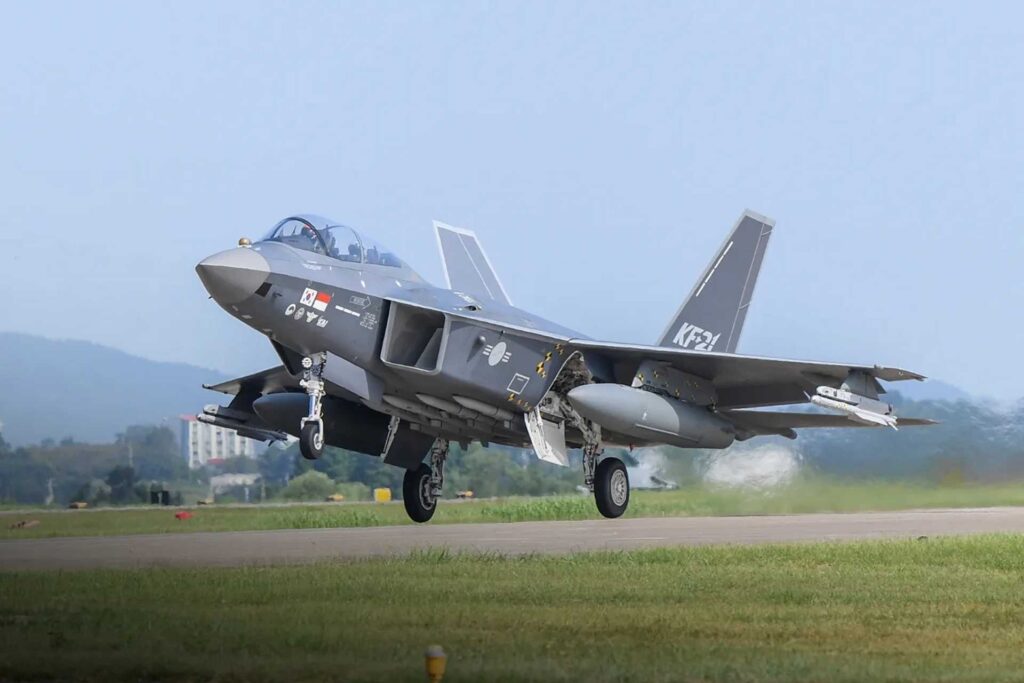
Under current plans, the KF-21 could eventually replace the F/A-18D Hornet and Sukhoi Su-30MKM, which are expected to retire around 2035 and 2040 respectively. Malaysia has sought surplus F/A-18 C/D aircraft from Kuwait as an interim solution, but the absence of a confirmed transfer timeline has created the risk of a future capability gap. Both the interim Hornet option and the MRCA are closely linked, as Malaysia must maintain sufficient combat aircraft numbers while ageing platforms approach retirement. These efforts fall under the broader Capability Development Plan 2055 (CAP55), which aims to modernise the air force over several decades. At present, discussions on the KF-21 remain exploratory and do not represent a procurement decision.
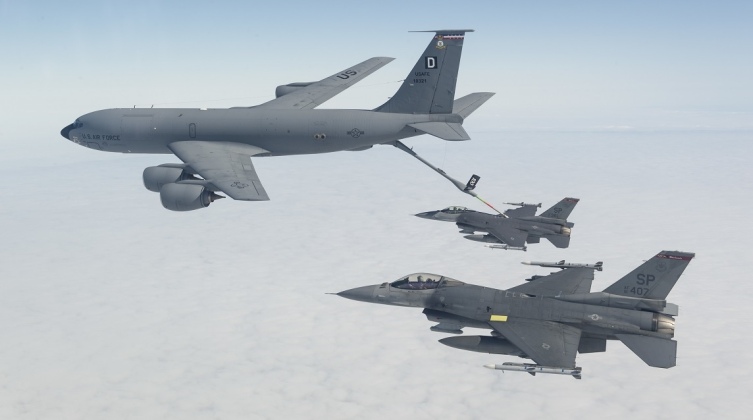
The RMAF’s current fighter inventory is limited in size and heavily reliant on ageing aircraft. It operates 18 Su-30MKM fighters delivered between 2007 and 2009, and seven F/A-18D Hornets delivered in 1997, following the loss of one aircraft in August 2025 due to a bird strike. These are supplemented by 12 Hawk 208 light fighters, which are themselves affected by age and attrition. While this force provides essential air defence and strike capabilities, it offers limited depth and surge capacity. To partially stabilise the situation, Malaysia signed a $920 million contract with South Korea in 2023 for 18 FA-50M light combat aircraft. Deliveries are scheduled to begin with six aircraft by the end of 2026, followed by the remaining 12 between 2027 and 2028. However, the FA-50M is intended to supplement rather than replace frontline fighters.
Malaysia’s pursuit of surplus Kuwaiti F/A-18 C/D Hornets dates back to 2017, following the retirement of its MiG-29 fleet. The plan envisioned acquiring up to 33 aircraft as a cost-effective interim measure while awaiting a long-term MRCA solution. This depended on Kuwait retiring its Hornets after receiving F/A-18E/F Super Hornets ordered in 2016. As of late 2025, Kuwait has not confirmed a firm delivery schedule for its replacement aircraft, a process that also requires U.S. approval. As a result, the release timeline for the older Hornets remains uncertain despite years of evaluations and discussions.
Even if the aircraft were released, Malaysia would still face significant delays before operational use. Mandatory software updates and system modifications are estimated to require around 15 months after transfer. Combined with the uncertain release date, this could push operational availability into the early or mid-2030s, overlapping with the planned retirement of Malaysia’s own Hornets in 2035. Each year of delay reduces the effective service life and cost-effectiveness of the interim solution, increasing sustainment and training challenges. Consequently, the Hornet stopgap has evolved from a bridging option into a planning risk, prompting reassessment of long-term replacement timelines.
The MRCA program provides the long-term framework intended to address these challenges. Initially launched in the early 2010s, the program evaluated aircraft such as the F/A-18E/F, Rafale, Eurofighter Typhoon, and Gripen, but was paused in 2014 due to budgetary constraints. Revived under CAP55, the MRCA now aims to replace both the Hornet and Su-30MKM fleets with two squadrons of next-generation fighters. With a standard Malaysian squadron comprising 18 aircraft, the program envisions a total of 36 fighters. Procurement was originally planned for the mid-2030s, with full operational capability between 2035 and 2040, combining fleet renewal with capability modernisation.
Since 2024 and 2025, growing uncertainty around interim aircraft options has made the MRCA timeline more flexible. Accelerating the program would require earlier funding, infrastructure readiness, and expanded pilot and technician training, while also impacting other CAP55 priorities. Malaysia must balance financial constraints against the operational risks of a capability gap. As a result, the MRCA has become the central reference point for evaluating all fighter options, with any candidate required to align with planned Hornet and Su-30MKM retirement timelines.
In this context, the KF-21 presents a potentially attractive option for Malaysia, particularly as it could operate alongside the FA-50, also produced by KAI, mirroring the structure planned by the Republic of Korea Air Force. If discussions progress, they are expected to focus on timing, configuration, and system integration. KAI plans to deliver the first 40 KF-21 Block 1 aircraft, optimized for air-to-air missions, to South Korea starting in 2026, with export availability following domestic deliveries. It remains unclear which KF-21 variant would be relevant for Malaysia, with possibilities ranging from Block 2 to the more advanced Block 3, which is associated with features closer to fifth-generation standards, including internal weapons bays, enhanced sensor fusion, and improved low-observable characteristics. For now, Malaysia’s engagement with KAI is aimed at assessing long-term capability alignment with MRCA requirements rather than committing to a near-term purchase.
About The Author