Greece officially welcomed the HS Kimon on January 15, 2026, as the first FDI HN Belharra-class frigate sailed into the Saronic Gulf and headed to Salamis naval base.
The HS Kimon, the first FDI HN Belharra-class frigate for the Hellenic Navy, arrived in Greece on January 15, 2026, following its delivery from France. Its induction marks the first new frigate added to the Greek fleet in 28 years and is the lead ship of a four-vessel modernization program. HS Kimon sailed into the Saronic Gulf shortly before noon and proceeded to the Salamis naval base, completing the delivery voyage from France and formally joining the fleet as part of Greece’s broader defense modernization effort launched in 2021, amid ongoing tensions in the Aegean and Eastern Mediterranean.
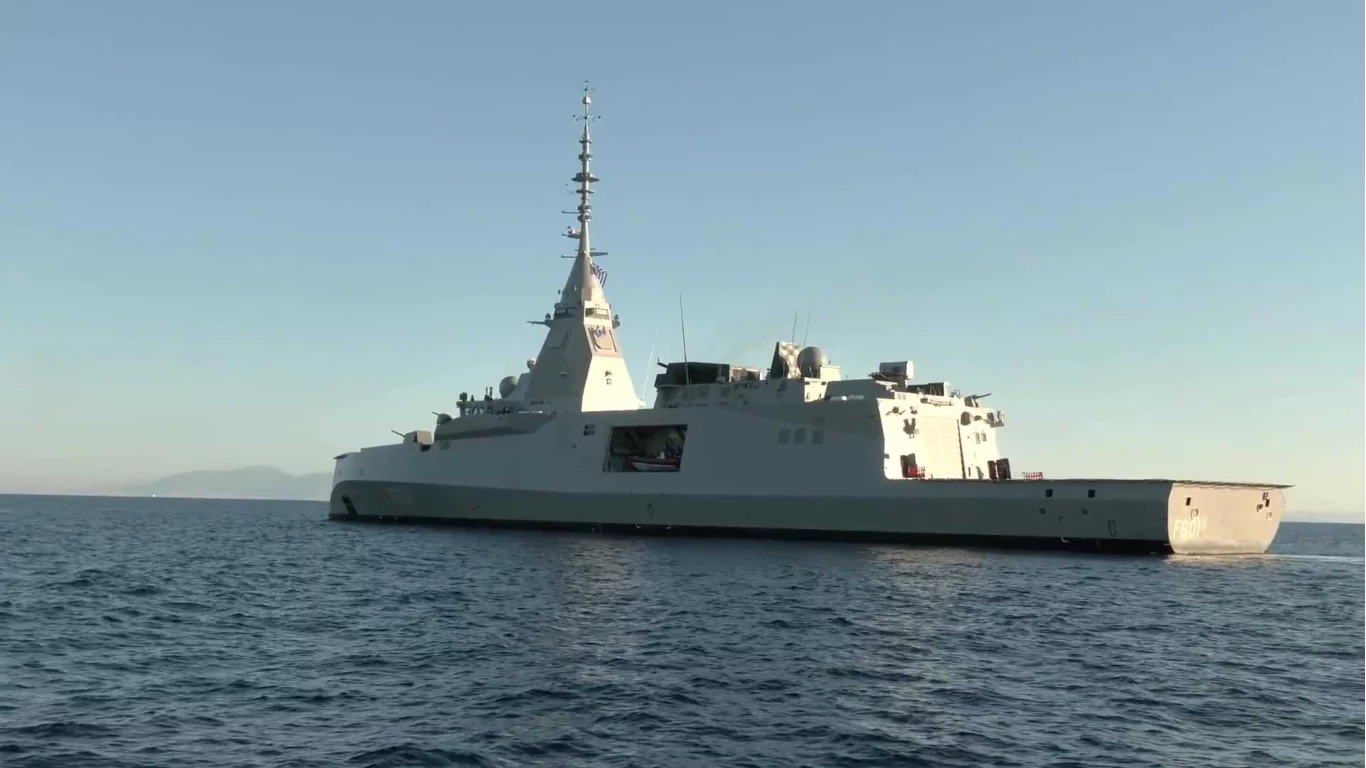
The welcoming ceremony at sea brought together Greece’s political and military leadership, including Prime Minister Kyriakos Mitsotakis, President Constantine Tassoulas, National Defence Minister Nikos Dendias, and Vice Admiral Dimitrios–Eleftherios Kataras, chief of the Hellenic Navy General Staff. Symbolic elements such as a copy of an ancient Athenian trireme and the historic cruiser Georgios Averof escorted HS Kimon to Salamis, linking modern fleet renewal to Greece’s naval history. Government statements tied the arrival to broader rearmament plans, including the acquisition of 24 Rafale fighter jets and a €25 billion defense modernization budget through 2036, with integrated air, missile, and anti-drone systems under the Achilles’s Shield program.
HS Kimon’s journey began with its naming ceremony and the raising of the Greek flag on December 18, 2025, at the shipbuilder’s facilities in Lorient, France, attended by Minister Dendias. The frigate then sailed to Brest for weapon system integration, sensor coupling, and full operational checks before departing for Greece, arriving at Salamis on January 15. The ship has now entered an internal integration process including certifications, system testing, crew training, and phased operational adoption.
The frigate displaces approximately 4,500 tonnes, measures 122 meters in length with an 18-meter beam, and is capable of operations in both open and confined waters. Powered by a combined diesel-diesel system producing roughly 32 MW, it can reach a maximum speed of 27 knots and a range of 5,000 nautical miles at 15 knots, with an endurance of up to 45 days. Its aviation facilities support an MH-60R Seahawk helicopter and one Schiebel Camcopter S-100 UAV, enhancing surveillance, targeting, and anti-submarine capabilities.
HS Kimon is equipped with a more advanced combat suite than its French counterpart, the Amiral Ronarc’h. This includes the Sea Fire radar, Aster-30 surface-to-air missiles in A50 vertical launchers, Exocet MM40 Block 3C surface-to-surface missiles, MU90 lightweight torpedoes, a RAM point-defense missile system, a 76 mm Oto Melara main gun, and two 20 mm Lionfish remote weapon stations. The layered configuration enables operations across air, surface, and sub-surface domains in the Aegean and Eastern Mediterranean.
Political leaders highlighted the frigate’s strategic role in deterrence and force posture. Prime Minister Mitsotakis emphasized fleet modernization and personnel development, while President Tassoulas highlighted its multi-domain capabilities across surface, anti-air, anti-submarine, and electronic warfare operations. The ship’s name honors the 5th century BCE Athenian admiral Kimon, continuing historical naming conventions while reflecting modern naval utility.
HS Kimon’s arrival sets the timeline for the remaining Belharra-class frigates, with Nearchos and Formion expected by the end of 2026 and Themistoklis in 2028. Near-term priorities focus on testing, certification, crew training, and phased integration into operational service. Within Greece’s €25 billion modernization plan and integrated defense framework, HS Kimon represents the first step in renewing the Hellenic Navy’s surface combatant capabilities and enhancing maritime readiness in the region.
About The Author