On February 5, 2026, Turkish President Recep Tayyip Erdoğan stated that a joint investment with Saudi Arabia in Türkiye’s Kaan fighter jet program could be realized at any time, indicating that discussions are open and ongoing but not yet finalized.
Türkiye’s next-generation fighter jet program, known as Kaan, is gaining international attention as Turkish President Recep Tayyip Erdoğan signaled that a potential joint investment with Saudi Arabia could happen at any time. While no formal agreement has been finalized, the statement highlights growing global interest in Türkiye’s rapidly expanding defense industry and positions the Kaan project as a key pillar of future international defense cooperation.
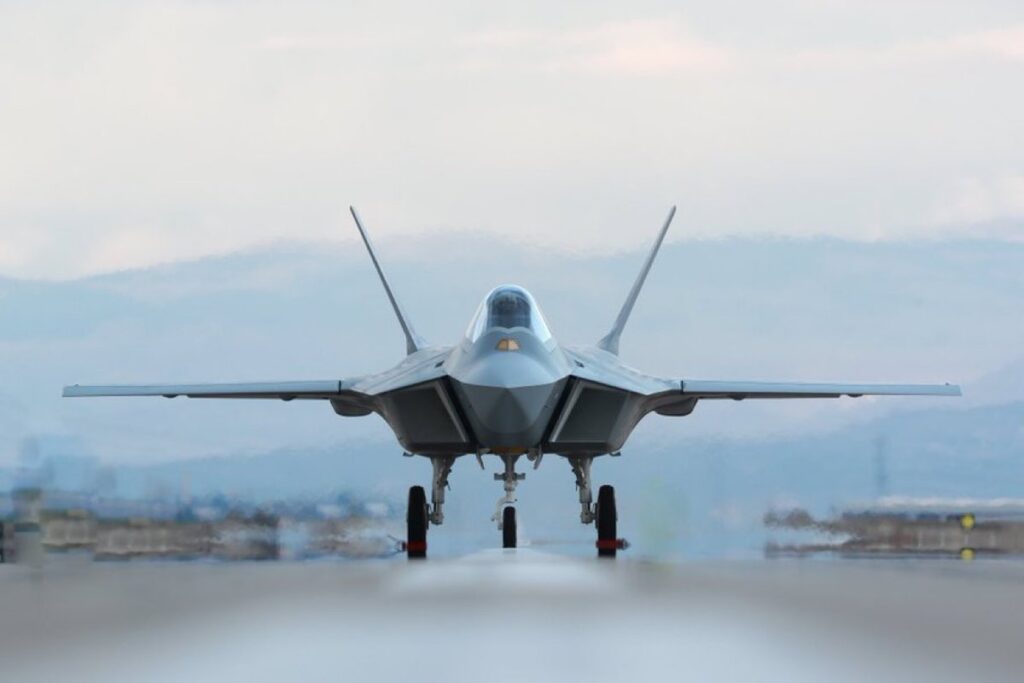
Türkiye and Saudi Arabia discussed a potential order of up to 100 Kaan fighter jets, focusing on technology transfer and joint production. (Image source: TUSAŞ)
Speaking after returning from official visits to Saudi Arabia and Egypt, Erdoğan described the possibility of Saudi participation in the Kaan fighter program as open and achievable whenever both sides decide to proceed. He emphasized that Türkiye’s defense priorities remain focused on meeting its own national security needs first, but cooperation with friendly countries is an important part of Ankara’s long-term strategy. According to Erdoğan, the Kaan project is not just an aircraft development effort but a broader industrial and technological initiative aimed at strengthening Türkiye’s defense autonomy and global competitiveness.
The remarks came within the context of expanding diplomatic and economic ties between Türkiye and Saudi Arabia. During the visit, both countries signed multiple agreements covering defense, transportation, health, investments, and contracting sectors. Erdoğan highlighted that bilateral trade reached approximately $8 billion in 2025 and that Turkish companies have completed more than 400 projects in Saudi Arabia valued at around $30 billion. With major events such as EXPO-2030 and the FIFA World Cup 2034 on the horizon, both nations expect further economic collaboration. Discussions during the trip also included regional political issues, including Palestine and Syria, reinforcing the strategic nature of the relationship.
Saudi Arabia’s interest in the Kaan fighter aligns with its long-term objective of acquiring a fifth-generation combat aircraft and strengthening domestic defense manufacturing under Vision 2030. For years, Riyadh has attempted to obtain the F-35 but has been unable to secure approval, prompting exploration of alternative platforms and partnerships. Previous discussions between Turkish and Saudi defense officials have suggested a possible requirement of up to 100 Kaan aircraft, potentially involving technology transfer, joint production, and local industrial participation. However, despite the ongoing dialogue, no official procurement decision has been announced.
The Kaan program itself stems from Türkiye’s ambition to develop an indigenous next-generation fighter capable of replacing aging F-16 fleets and reducing reliance on foreign suppliers. Strategic planning for the project dates back to the early 2010s, when Ankara identified the need for a domestically controlled air superiority platform that could operate without political restrictions tied to foreign defense imports. The design and development contract was signed in August 2016 with an initial investment of $1.18 billion, focused on building national expertise in design, testing, and certification.
Development of the aircraft is led by Turkish Aerospace Industries, with early design phases supported by limited international cooperation. The first production variants of Kaan are expected to use twin General Electric F110 engines, providing proven reliability while Türkiye continues parallel efforts to develop a fully domestic engine under the TF35000 program, targeted for introduction after 2030. This phased approach reflects a balance between immediate operational readiness and long-term technological independence.
A major milestone for the project came on February 21, 2024, when the first Kaan prototype completed its maiden flight. The aircraft remained airborne for 13 minutes, reaching speeds of approximately 230 knots and an altitude of 8,000 feet. A second flight followed in May 2024, expanding performance parameters and validating core aerodynamic and flight-control systems. Additional prototypes are currently under construction to support a broader test campaign that will gradually integrate advanced avionics, mission systems, and expanded operational capabilities throughout the decade.
From a design perspective, Kaan is a fifth-generation, twin-engine, single-seat fighter intended for both air superiority and multirole missions. The aircraft features low-observable shaping, internal weapons bays, and advanced network-centric combat capabilities. Its sensor architecture includes an AESA radar integrated within a broader electronic warfare framework, alongside electro-optical targeting, infrared search and track, distributed aperture systems, and missile warning sensors. The aircraft also incorporates integrated communication, navigation, and identification systems supported by centralized mission computing, as well as a comprehensive self-protection suite against radar, laser, and infrared threats.
Beyond domestic deployment, Türkiye has positioned the Kaan as a future export platform supported by industrial partnerships. Indonesia has already signed agreements linked to potential acquisition and cooperation in assembly, maintenance, and training infrastructure. Azerbaijan has engaged in discussions involving development participation and data collaboration. Other countries that have expressed varying levels of interest include Egypt, Pakistan, the United Arab Emirates, Ukraine, Spain, and Saudi Arabia. These engagements reflect a broader Turkish strategy that combines aircraft exports with long-term industrial collaboration and technology sharing.
Technically, the Kaan measures approximately 20.3 meters in length, with a wingspan of 13.4 meters and a height of 5 meters. The aircraft has a maximum takeoff weight of around 34,750 kilograms and is powered by two F110-class turbofan engines delivering up to 131 kilonewtons of thrust each with afterburner. Expected performance includes a maximum speed of Mach 1.8, a service ceiling exceeding 16,700 meters, and maneuver limits of +9 g and −3.5 g.
Its weapons configuration combines eight internal and six external hardpoints, supported by a 30×113 mm internal gun. Air-to-air capabilities include Gökdoğan and Bozdoğan missiles, along with a future ramjet-powered beyond-visual-range missile. For air-to-surface missions, the aircraft is designed to carry SOM-series cruise missiles, Kuzgun variants, the Akbaba anti-radiation missile, and the Roketsan Çakir missile family. It will also be compatible with a wide range of precision-guided munitions, including bunker-buster bombs such as SARB-83 and NEB-84.
The growing international attention surrounding the Kaan program reflects Türkiye’s evolving role in the global defense market. By combining domestic capability development with export potential and industrial partnerships, Ankara aims to position itself among the few nations capable of producing advanced fifth-generation combat aircraft. The possibility of Saudi investment further underscores the strategic and economic importance of the project, even as formal agreements remain under discussion.
As development continues and more prototypes enter testing, the Kaan program is expected to play a central role in shaping Türkiye’s future air power while also influencing regional defense dynamics. Whether through domestic deployment or international collaboration, the fighter represents a major step in Türkiye’s pursuit of technological independence and long-term defense industry growth.
About The Author