A Russian-built Mi-171E helicopter linked to the U.S. Army’s Aviation Technology Office (ATO) was spotted returning from a local flight near Phoenix on January 31, 2026.
On January 31, 2026, photos shared on X by user venom13 showed a Russian-built Mi-171E helicopter returning from a local flight near Phoenix, Arizona. The aircraft, carrying serial number 14-0184, is believed to be associated with the U.S. Army’s Aviation Technology Office (ATO), a little-known unit tasked with evaluating foreign aircraft and supporting missions where standard U.S. military attribution is undesirable.
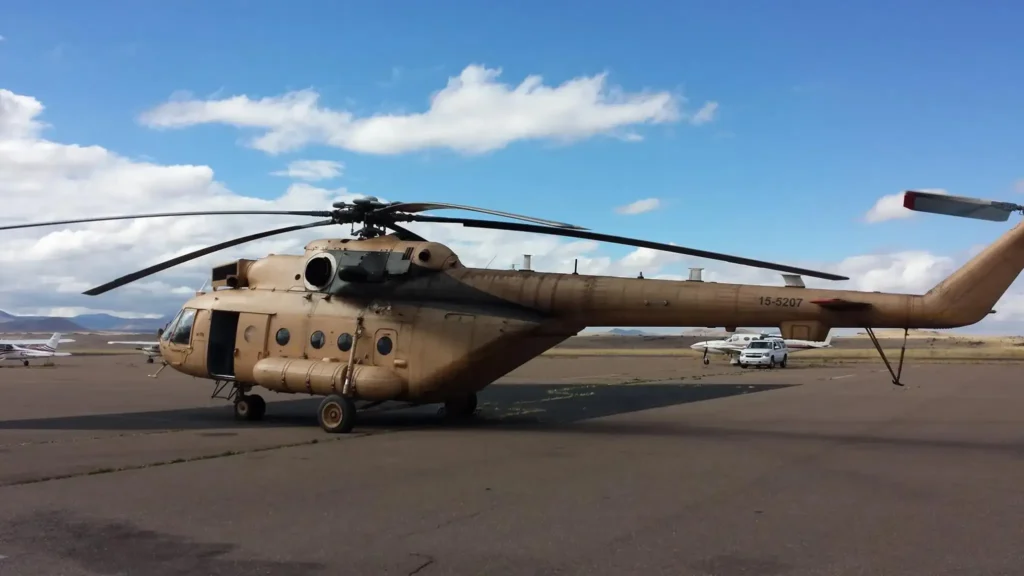
The Mi-171E can transport up to 27 passengers or carry around 4,000 kg of cargo internally or via an external sling. (Source: X/venom13)
The sighting drew attention because the Mi-171E is part of a fleet reportedly used in discreet operations connected to U.S. special operations elements. The ATO operates a mix of aircraft types—including Mi-17 and Mi-171 helicopters, Bell 407 and Bell 429 light helicopters, MD-500 series aircraft, and Beechcraft King Air turboprops. This diverse fleet allows crews to train on and evaluate aircraft commonly used by foreign military and paramilitary forces, while also enabling missions to be conducted with a degree of plausible deniability.
The origins of the Aviation Technology Office trace back to March 2, 1981, when the U.S. Army established a covert aviation unit widely known as SEASPRAY. Initially operating under the cover designation “1st Rotary Wing Test Activity,” the unit provided aviation support for missions that could not be attributed to conventional U.S. military forces. Early operations relied on unmarked Hughes 500D helicopters and later expanded to include fixed-wing aircraft such as Cessnas and Beechcraft King Airs. Throughout the 1980s, the unit operated from locations including Tampa, Florida, supporting missions linked largely to Central America.
By the late 1980s, SEASPRAY was integrated into Delta Force as its aviation component, known as E Squadron. In the 1990s, it reemerged as the Flight Concepts Division before eventually adopting the Aviation Technology Office designation in the 2010s. The organization remains administratively connected to the Army Aviation Flight Test Directorate at Fort Eustis, Virginia.
ATO’s mission combines operational aviation support with the evaluation of non-standard aircraft and systems. Operationally, the unit is believed to conduct discreet insertion and extraction of personnel, transport of sensitive cargo, and aviation support for missions where overt U.S. military involvement would be politically or operationally unsuitable. These activities typically involve small teams, limited aircraft, and short deployments, with aircraft often configured to blend into civilian or host-nation aviation environments.
At the same time, the office evaluates foreign-built aircraft, avionics, navigation systems, and communications equipment not used in standard Army inventories. This includes helicopters like the Mi-171, which are tested for performance in demanding conditions such as high temperatures, high altitudes, and austere landing zones. The findings support operational readiness rather than purely experimental or developmental goals.
Historically, ATO and its predecessor units have been associated with providing aviation support to elite U.S. special operations forces operating under national-level tasking. During the SEASPRAY and E Squadron eras, the unit supported missions requiring low-visibility flight profiles. In its current form, it is linked to Joint Special Operations Command (JSOC) requirements, enabling aviation support where basing, attribution, and visibility must remain minimal. This helps explain the continued use of foreign aircraft, including Russian helicopters, within U.S. Army structures.
The Mi-171E itself is an export variant of the Mi-8/Mi-17 helicopter family developed by Russia’s Mil design bureau. First flying in the early 1990s, it entered operational service shortly afterward and has been produced primarily at the Ulan-Ude Aviation Plant, with related variants built at Kazan Helicopters. The aircraft retains the classic Mi-8 airframe layout but incorporates improved propulsion and onboard systems designed for government and military users.
Powered by twin Klimov turboshaft engines—later versions using the VK-2500—the helicopter offers strong performance in hot and high environments. It features a five-bladed main rotor, tail rotor configuration, and an auxiliary power unit for autonomous starts and onboard power generation. These characteristics make it suitable for operations in remote or infrastructure-limited regions.
In transport configuration, the Mi-171E can carry up to 27 passengers or up to 4,000 kilograms of cargo internally, with external sling capacity reaching up to 5,000 kilograms in upgraded versions. The aircraft can be adapted for multiple roles, including troop transport, logistics, medical evacuation, search and rescue, and government support missions. Its rugged landing gear and structural design enable operations from unprepared or semi-prepared landing zones.
Globally, the Mi-171E and related Mi-8/Mi-17 variants have been widely adopted by military, paramilitary, and government operators across Asia, Africa, Latin America, and Eastern Europe. The helicopter’s versatility, reliability, and availability have made it one of the most widely used medium transport platforms in the world. By 2014, more than 12,000 helicopters from the Mi-8/17 family had been produced and delivered to over 100 countries, accumulating millions of flight hours.
This widespread global use helps explain why platforms like the Mi-171E remain valuable for evaluation by specialized units such as the U.S. Army’s Aviation Technology Office. Familiarity with commonly operated foreign aircraft can support operational planning, training, and mission flexibility in environments where standard U.S. military equipment may not be the most suitable or discreet option.
About The Author