On January 25, 2026, Russian regulators approved funding for a detailed underwater inspection of the PD-50 floating dock, sunk in Kola Bay in 2018, to evaluate recovery or dismantling options—an essential step toward resolving ongoing repair constraints affecting the aircraft carrier Admiral Kuznetsov.
According to WWW1.Ru, on January 25, 2026 Russian authorities approved a 240-million-ruble contract to conduct a detailed underwater inspection of the PD-50 floating dock that sank in 2018 in Kola Bay. The survey aims to generate precise structural and seabed data needed for any future decision on dismantling or raising the dock, a step considered essential for resolving long-standing repair constraints affecting Russia’s only aircraft carrier, Admiral Kuznetsov.
Russian media reported that the contract authorizes an underwater survey of the sunken dock in the Murmansk region, without which the prolonged repair process of Admiral Kuznetsov would be impossible. JSC Lenmorniproekt is listed as the customer, while the contractor had not yet been identified. The project focuses on collecting accurate physical data through diver inspections, instrumental measurements, and seabed mapping, with a key outcome being a high-resolution three-dimensional digital model of the wreck. The initiative is aimed at technical assessment rather than immediate recovery.
The survey program includes a full diving and instrumental inspection of the PD-50 hull, ballast compartments, and nearly four kilometers of anchor and mooring connections. Structural elements will be documented through coordinated photo and video recording. Engineers will measure metal thickness, evaluate corrosion, and analyze structural integrity. Seabed studies will use multibeam echo sounders, sonar, and lidar to map terrain, calculate list and trim angles, and assess seabed penetration. The resulting digital model will represent the dock’s condition and seabed interaction within a 150-meter radius, along with obstacles along a potential transport corridor.
This contract follows a January 15, 2026 assessment estimating that lifting the PD-50 from the seabed of Kola Bay would cost about 840 million rubles. Earlier procurement notices covered geodetic, geological, environmental, and archaeological studies, as well as searches for potentially explosive objects. Additional work included fisheries assessments and evaluations of impacts on aquatic biological resources, with hydrobiological research assigned to the Murmansk Marine Biological Institute.
The PD-50 sank on October 30, 2018 during Admiral Kuznetsov’s departure after repair work. A power outage caused the dock to submerge, and a crane collapse damaged the carrier’s hull and flight deck. The loss of the dock removed a critical heavy-lift repair facility in the Murmansk area and forced adjustments to naval repair planning. Since then, the dock has remained on the seabed and continues to influence infrastructure decisions for large naval vessels.
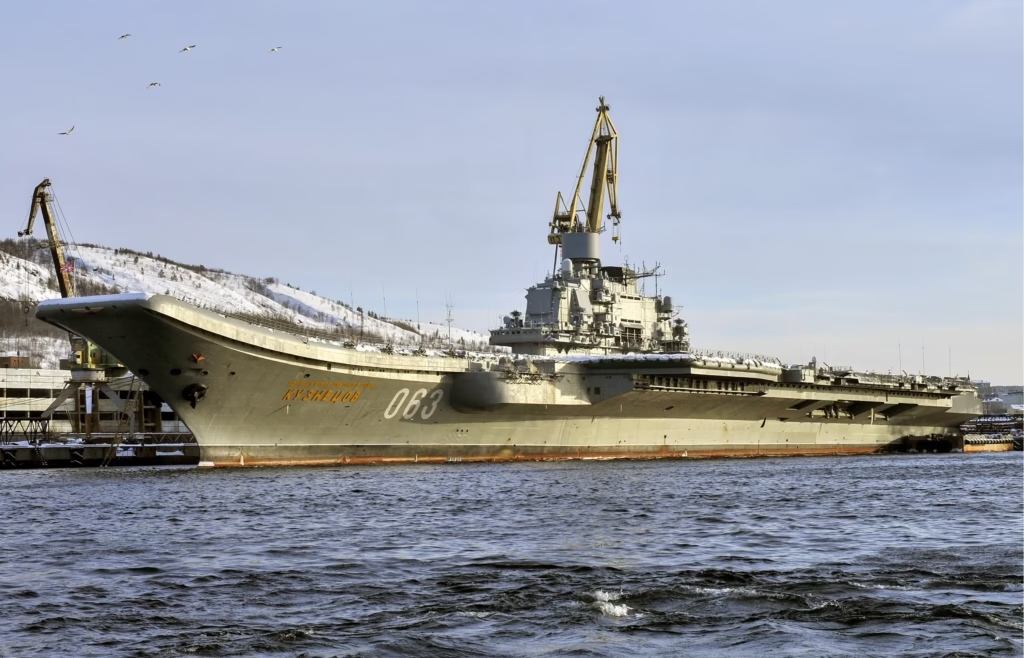
Admiral Kuznetsov is currently moored in Murmansk at the 35th Ship Repair Plant, part of the Zvezdochka Ship Repair Center, where it has undergone prolonged repairs and modernization since 2017. The project aimed to extend its service life by ten years but faced repeated delays due to technical and industrial setbacks, including the PD-50 accident. Work was paused in 2025 amid rising costs, pending a final decision on whether repairs will resume, the ship will be sold, or it will be scrapped. Statements from officials have reflected uncertainty over its future.
The Admiral Kuznetsov is a Project 1143.5 heavy aircraft carrier built at the Black Sea Shipyard in Mykolaiv. Ordered in 1981, laid down in 1982, launched in 1985, and commissioned in 1991, it entered service with the Soviet Navy and later joined Russia’s Northern Fleet. Its design features a ski-jump flight deck for fixed-wing aircraft operations without catapults and includes both aviation facilities and heavy missile armament. Its only combat deployment took place off Syria in 2016–2017, after which it returned for major repairs.
The carrier’s displacement ranges from about 46,540 tonnes standard to over 59,000 tonnes full load, with maximum figures exceeding 61,000 tonnes. It measures over 306 meters in length overall, with a beam approaching 72 meters. Propulsion is provided by a four-shaft boiler-turbine system supported by multiple boilers and generators, enabling speeds up to 29 knots and an endurance of around 45 days.
The hull uses low-magnetic steel and a compartmentalized internal structure, with layered anti-torpedo protection. Defensive systems include AK-630 close-in weapon systems, Kortik missile-gun systems, and Kinzhal air-defense launchers, along with anti-submarine rocket launchers. The ship originally carried P-700 Granit anti-ship missiles beneath the flight deck, though modernization plans proposed removing them to reduce weight and free internal space.
Admiral Kuznetsov can operate roughly 28 fixed-wing aircraft and 24 helicopters, with total air wing numbers varying by configuration. Planned aircraft include MiG-29K and Su-33 fighters along with Ka-27 helicopters. Its sensor suite incorporates multiple radar systems, aviation control and combat management systems, sonar, and electronic warfare equipment, with modernization plans including upgrades to the flight deck, propulsion systems, and close-in defenses such as Pantsir-M.
About The Author