On February 8, 2026, the United Kingdom and Bangladesh signed a government-to-government defense agreement to transfer the former Royal Navy hydrographic survey vessel, HMS Enterprise (H88), to the Bangladesh Navy.
On February 8, 2026, the United Kingdom and Bangladesh signed a government-to-government defense sales agreement in Dhaka to transfer the former Royal Navy hydrographic survey vessel, HMS Enterprise, to the Bangladesh Navy. The transfer is intended to enhance Bangladesh’s hydrographic, oceanographic, and maritime security capabilities in the Bay of Bengal while extending the operational life of the vessel, which was decommissioned by the Royal Navy in March 2023.
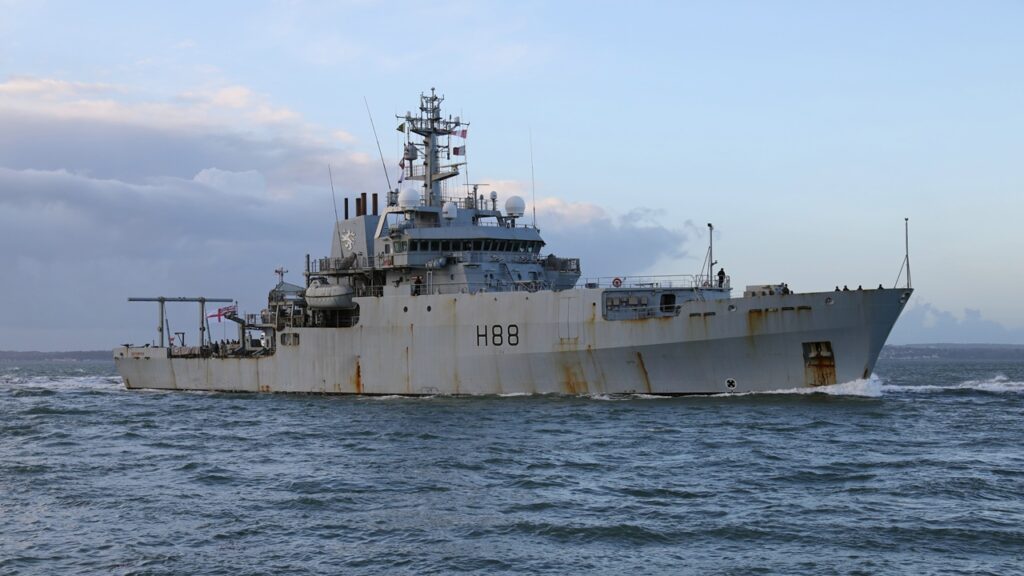
The agreement was finalized at Bangladesh Navy Headquarters in Dhaka after extensive technical consultations between the Bangladesh Navy, the UK Ministry of Defence, and the Royal Navy. The deal forms part of wider UK–Bangladesh maritime cooperation in the Bay of Bengal and the Indo-Pacific region. HMS Enterprise had been laid up at Portsmouth Naval Base since her decommissioning, and the sale provides a modest but unspecified payment to the Royal Navy while keeping a structurally sound hydrographic vessel in active service.
The transfer will allow Bangladesh to strengthen its capabilities in hydrography, oceanography, maritime security, and disaster response, while also supporting research partnerships with universities and national scientific institutions. The Bangladesh Navy, established in July 1971 with roughly 22,000 personnel, has previously integrated former Royal Navy vessels, such as BNS Anushandhan (formerly HMS Roebuck), into its fleet to support charting and maritime boundary operations. HMS Enterprise, pennant number H88, was the tenth ship in the Royal Navy to bear the name and, along with HMS Echo (H87), formed the two-ship Echo-class of multi-role hydrographic survey vessels.
The Echo-class vessels were developed in the mid-1990s to replace older coastal and ocean survey ships, including HMS Bulldog, HMS Beagle, and HMS Roebuck. These modern multi-role ships were designed to operate in both shallow coastal and deep-water environments. Ordered in June 2000 under a £130 million program with 25 years of through-life support, the vessels were built by Appledore Shipbuilders under prime contractor Vosper Thornycroft. HMS Echo was floated out on March 2, 2002, and HMS Enterprise launched on April 27, 2002, before commissioning in 2003.
Based on the Canadian VARD Marine 9 105 research vessel design, the Echo-class ships were the first Royal Navy vessels to use diesel-electric azimuth thrusters, enabling 360-degree maneuverability and precise station-keeping via dynamic positioning and integrated navigation systems. HMS Enterprise displaced 3,740 tonnes, measured 90.6 meters in length with a beam of 16.8 meters, and had a draught of 5.5 meters. Diesel generators producing 4.8 MW powered two 1.7 MW azimuth thrusters and a 0.4 MW bow thruster, giving a maximum speed of 15 knots and an operational range of 9,300 nautical miles at 12 knots, with endurance for up to 35 days at sea.
The vessel’s primary mission was hydrographic and oceanographic survey in support of naval operations, including submarine and amphibious missions. HMS Enterprise was equipped with multi-beam and single-beam echo sounders, side-scan sonar, sub-bottom profilers, undulating oceanographic profilers, Doppler current logs, bottom sampling equipment, and deployable off-board sensors for conductivity, temperature, depth, and turbidity measurements. Survey motor boats allowed operations in shallow waters, estuaries, and ports, and collected data could be transmitted ashore for charting, research, and operational use.
In addition to survey tasks, HMS Enterprise could host a mine countermeasures command team and serve as a tasking authority platform for mine warfare support. Defensive armament included two Oerlikon 20 mm cannons, three miniguns, and four general-purpose machine guns for protection in unstable environments. The ship accommodated a crew of 72, with 48 typically embarked at one time, and could host up to 81 personnel if needed. A three-watch system allowed high operational availability, with up to 330 days at sea per year.
During her service from 2003 to 2023, HMS Enterprise operated in the Mediterranean, Gulf of Aden, Somali Basin, West Africa, Indian Ocean, Persian Gulf, South Atlantic, Black Sea, and Asia-Pacific region. She took part in humanitarian missions, including evacuating 110 British and European citizens from Libya in 2014 and rescuing over 9,000 migrants in the Mediterranean between 2015 and 2016 during EU Operation Sophia. The vessel also served as flagship for Standing NATO Mine Countermeasures Group 2, participated in Exercise Trident Juncture in Norway, and transited the Taiwan Strait in December 2019. In August 2020, she deployed to Beirut following the port explosion, conducting harbor surveys and assisting Lebanese authorities.
The retirement of HMS Enterprise and the Echo-class ships reflects the increasing reliance on autonomous survey systems such as unmanned underwater vehicles and long-endurance gliders capable of operating for hundreds of days while gathering oceanographic data. While unmanned systems reduce operational costs and manpower requirements, they cannot fully replicate the capabilities of a crewed vessel capable of combining survey, presence, command, humanitarian, and mine warfare support missions within a single hull.
About The Author