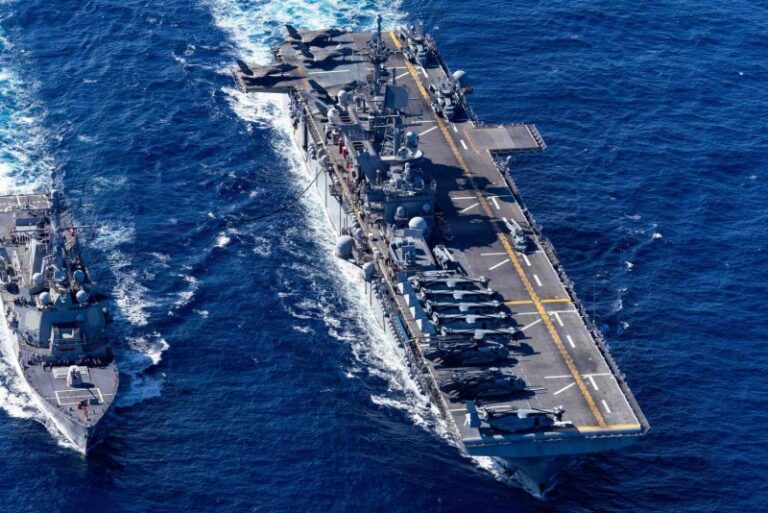
The U.S. Navy’s USS Kearsarge, a Wasp-class amphibious assault ship, successfully carried out its inaugural F-35B Lightning II short takeoff and vertical landing (STOVL) operations in the Atlantic on February 10, 2026, U.S. Fleet Forces Command confirmed. This achievement enhances the Navy and Marine Corps’ capacity to deploy fifth-generation airpower from amphibious ships in open-sea environments.
The U.S. Navy’s amphibious assault ship USS Kearsarge (LHD 3), a Wasp-class vessel, successfully conducted F-35B Lightning II flight operations in the Atlantic on February 10, 2026, marking the first time the fifth-generation fighter landed aboard this class of ship. U.S. Fleet Forces Command confirmed the milestone, highlighting it as a critical step in integrating the F-35B into amphibious operations and expanding the Atlantic Fleet’s operational flexibility. The at-sea trials tested the ship’s flight deck, aviation support systems, and command-and-control architecture, validating its ability to sustain short takeoff and vertical landing (STOVL) operations under challenging maritime conditions.
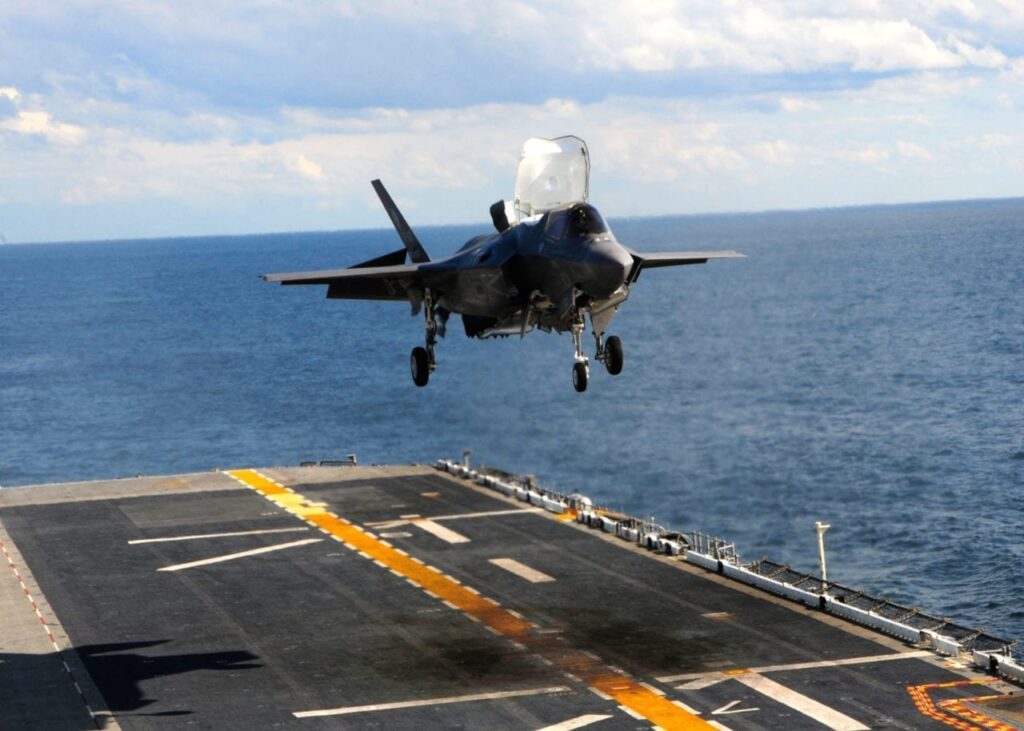
F-35B lands on USS Kearsarge during first Atlantic flight, marking fifth-generation strike capability. (U.S. Navy)
While other Wasp-class ships have previously hosted F-35Bs, Kearsarge’s certification signals a broader shift toward generating credible fixed-wing combat power from amphibious ready groups. Heat-resistant flight decks, aviation fuel systems, and secure data networks were all rigorously assessed to ensure safe operations under the intense downward thrust and thermal loads produced by the F-35B.
Commissioned in 1993, USS Kearsarge displaces around 40,500 tons and measures 257 meters in length. Originally designed to deploy Marine Expeditionary Units with helicopters, MV-22B Ospreys, and AV-8B Harriers, the ship now incorporates fifth-generation stealth fighters, reflecting the ongoing modernization of U.S. amphibious forces into multi-domain platforms capable of operating in contested maritime environments.
The F-35B STOVL aircraft, powered by the Pratt & Whitney F135 engine with approximately 40,000 pounds of thrust, features a shaft-driven lift fan by Rolls-Royce and a swiveling exhaust nozzle for vertical or short takeoffs. Its strength lies in advanced sensor fusion, integrating the AN/APG-81 AESA radar, Distributed Aperture System, Electro-Optical Targeting System, and electronic warfare suite into a unified tactical picture displayed via the pilot’s helmet-mounted display.
The fighter carries precision-guided munitions such as GBU-32 JDAM, GBU-53 StormBreaker, and AIM-120 AMRAAM internally for stealth, while external hardpoints allow expanded payloads when low observability is not required. Beyond strike capabilities, the F-35B functions as an airborne intelligence, surveillance, and battle management node, sharing targeting data with naval vessels, joint air assets, and ground forces, effectively extending the reach of the entire task group.
Strategically, Kearsarge’s certification enhances the Navy’s capacity to distribute combat power across additional platforms. In the Atlantic, amid increased Russian naval activity and Arctic access concerns, a Wasp-class LHD with F-35B capability adds flexibility without relying solely on carrier strike groups. Amphibious ready groups equipped with stealth fighters can conduct air superiority, suppression of enemy air defenses, amphibious support, and maritime control operations in contested environments.
Integration required technical upgrades to maintenance facilities, secure communications, and compatibility with the ODIN logistics network, ensuring efficient aircraft sustainment, mission planning, and rapid sortie generation at sea.
For the U.S. Marine Corps, this milestone significantly enhances expeditionary capabilities. F-35Bs enable Marine Air-Ground Task Forces to operate as fully networked combat systems, integrating aviation, maneuver units, and logistics under unified command. In crisis scenarios, the aircraft delivers immediate air superiority and precision strike; in high-intensity conflict, it serves as a forward sensor and strike platform for naval campaigns, forcible entry operations, and maritime interdiction.
As the Marine Corps adapts to distributed maritime operations and stand-in force concepts in both Indo-Pacific and European theaters, the ability to project fifth-generation airpower from amphibious ships like USS Kearsarge provides commanders with a resilient, flexible option. The February 10 landing represents more than a technical achievement—it signals the evolution of U.S. amphibious warfare, fusing traditional sea-based assault capabilities with stealth airpower to shape the future maritime battlefield.
About The Author