General Atomics Aeronautical Systems revealed that the U.S. Air Force has officially designated DARPA’s LongShot project as the X-68A. The concept involves an air-launched unmanned aircraft intended to operate ahead of fighters such as the F-15 and deploy its own air-to-air missiles. Granting it an X-plane status formally places the effort within the experimental aircraft category and underscores a strategic push to expand U.S. air dominance capabilities in high-intensity scenarios, including a possible Indo-Pacific conflict.
On 19 February 2026, General Atomics Aeronautical Systems announced that the U.S. Air Force had assigned the experimental designation X-68A to DARPA’s LongShot initiative. The move formally recognizes the project as an air-launched, uncrewed weapons carrier intended to fly ahead of manned aircraft and deploy its own air-to-air missiles. By granting it an X-plane status, the Air Force signals that LongShot has progressed beyond conceptual imagery into a structured flight-test program with a defined operational sponsor, with integration efforts initially focused on the F-15 platform. GA-ASI presents the development as part of its broader shift from counterinsurgency ISR missions toward high-end air dominance challenges expected in future conflicts.
What sets LongShot apart is the complexity of its dual-separation sequence. First, a host aircraft must release the compact drone without disturbing its own flight stability. Once the X-68A stabilizes, it must then safely launch an internally carried air-to-air missile. This “nested” release creates significant aerodynamic challenges, as airflow disruption, shock interactions, and transient loads could jeopardize safe separation. DARPA reports that full-scale wind tunnel tests have been completed, along with parachute recovery demonstrations and initial weapons-release system trials. An integrated flight test campaign is projected for late 2026.
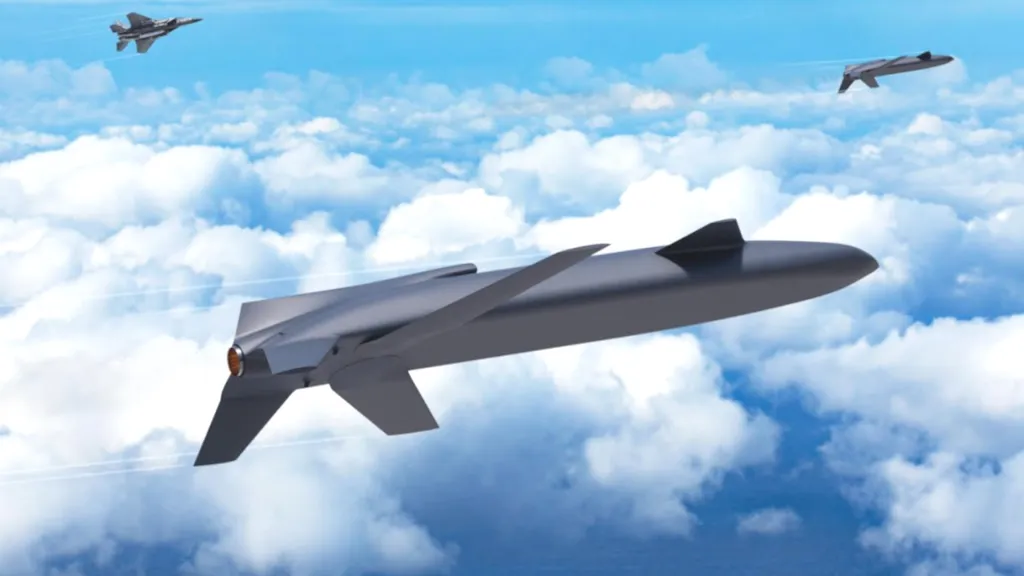
Although official specifications remain limited, concept imagery suggests a cruise-missile-inspired design optimized for carriage rather than runway takeoff. The airframe appears slender, with a chined nose, deployable lifting surfaces for compact storage, and tail geometry tailored for stable, low-drag flight during weapon release. Renderings show a dorsal air intake feeding a small turbojet or turbofan engine, paired with fold-out wings and foreplanes for immediate post-release control. Unlike traditional ISR drones, the X-68A is intended as a mission-focused effector platform designed to survive long enough to position and launch missiles from advantageous geometry.
A key strategic feature of the X-68A is its potential compatibility with multiple launch platforms. DARPA and GA-ASI emphasize integration with both fighters and bombers, while also exploring palletized deployment from cargo aircraft. Such flexibility would require the drone to withstand varied separation environments, from high-speed fighter release dynamics to ramp-style deployment concepts similar to the Air Force’s Rapid Dragon program. In vast operational theaters like the Indo-Pacific, mobility aircraft operating outside high-threat zones could theoretically deploy air-launched effectors to extend defensive counterair coverage.
Operationally, the X-68A functions as a forward-positioned missile launch node that extends the engagement envelope and complicates adversary targeting calculations. In contested anti-access/area-denial environments, preserving high-value assets such as tankers and airborne command platforms is critical. LongShot offers a hybrid stand-off/stand-in solution: the host aircraft remains farther from threats while the drone advances to release missiles with greater range and energy advantage. By launching from altitude and speed ahead of the formation, the drone effectively expands missile reach and compresses enemy reaction time, introducing a new tactical dynamic focused on kinematic advantage rather than traditional dogfighting.
The Air Force’s decision to assign an X-designation reflects the program’s maturation. LongShot initially awarded Phase I design contracts to General Atomics, Lockheed Martin, and Northrop Grumman, aiming to demonstrate controlled flight and safe weapon release under realistic conditions. GA-ASI ultimately advanced as the primary industry partner. The stakeholder network now includes the Air Force’s F-15 program office, test wings, AFRL, Navy aviation test units, NASA, and Army engineering centers, underscoring the complexity of certifying nested release operations and ensuring safety across diverse test environments.
In competitive terms, the X-68A does not face a single rival platform but rather alternative operational concepts. Traditional approaches rely on longer-range missiles, forward basing, or expanded escort packages, all resource-intensive and potentially vulnerable in high-end scenarios. Meanwhile, collaborative combat aircraft initiatives—including GA-ASI’s YFQ-42A, Anduril’s YFQ-44A under the Air Force’s CCA program, and Australia’s Boeing MQ-28 Ghost Bat—focus on runway-launched loyal wingmen operating as formation partners. The distinction lies in employment philosophy: whereas CCAs function as reusable teammates, the X-68A is conceived as a launched effector carried to the fight and released forward. If proven operationally viable, it would establish a new category of airborne munition positioned between a missile and a fighter aircraft, making the X-68A designation a substantive milestone rather than a nominal rebranding.
About The Author