Russia is reportedly studying deeper operational integration between the Su-30SM multirole fighter and the S-70 Okhotnik heavy unmanned combat aerial vehicle, according to a senior military aviator. The approach reflects Moscow’s intent to preserve a strong manned aviation core while developing loyal wingman–type concepts that may significantly influence the evolution of its air combat doctrine.
On February 25, 2026, Russian outlet NEWS.ru released an interview with Major General Vladimir Popov, in which he outlined his perspective on the evolving relationship between crewed and uncrewed combat aircraft. He characterized the close integration of fighter jets with heavy drones as a “new philosophy” in warfare. According to his comments, Russia is examining manned–unmanned teaming built around the Sukhoi Su-30SM and the Sukhoi S-70 Okhotnik-B. Despite rapid advances in drone technology, Popov stressed that piloted aviation will continue to play a dominant role for decades, with unmanned systems developing alongside rather than replacing it.
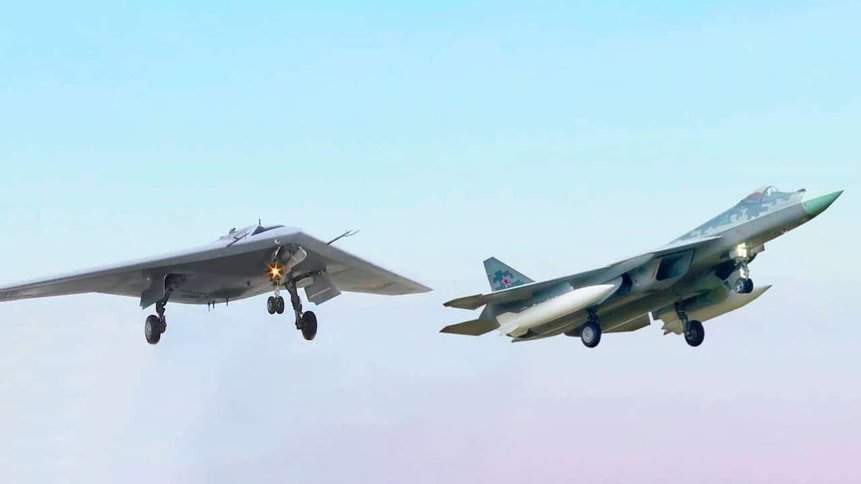
Popov explained that while global military aviation trends are clearly moving toward expanded use of unmanned platforms, this shift represents a redistribution of functions rather than the elimination of pilots. He noted that the S-70 can operate in coordination with aircraft such as the Su-30SM and the Sukhoi Su-34 (often referred to historically as Su-32). In this model, manned fighters would retain mission control responsibilities, while drones conduct high-risk strike or reconnaissance tasks. The implication is that Su-30SM crews could act as airborne mission leaders within a broader network of remotely piloted or semi-autonomous systems, increasing operational safety for aircrews.
At the core of this approach are established fighters like the Su-30SM and the Sukhoi Su-35S, which Popov described as proven platforms forming the backbone of Russia’s Aerospace Forces. Within such a structure, the Su-30SM would serve not only as a multirole combat aircraft but also as a coordination hub for unmanned assets. The S-70, as a large stealth-oriented UAV, could extend the fighter’s reach into heavily defended airspace. Although specific technical details were not discussed, the concept implies advanced datalink connectivity, shared sensor inputs, and distributed weapons employment between manned and unmanned elements.
Doctrinally, Popov’s remarks suggest a possible transition toward using fighters as airborne controllers of drone formations rather than as isolated shooters. This structure would allow crewed jets to operate from safer stand-off distances while unmanned aircraft handle tasks such as strike missions, suppression of enemy air defences, or deep reconnaissance. He emphasized the advantage of protecting trained personnel by assigning the most dangerous objectives to unmanned systems. Such thinking aligns with broader international trends in air warfare, where survivability and resilience under dense air-defence networks are increasingly central to force design.
From a tactical perspective, pairing the Su-30SM with the S-70 could enable coordinated employment of sensors and weapons across an integrated formation. A fighter functioning as a command node might gather intelligence from multiple platforms, assign targets dynamically, and adapt mission parameters in real time. In this configuration, the drone effectively becomes a forward extension of the fighter’s combat capabilities, capable of operating in environments where risk to human pilots would be unacceptable. While Popov referred to this as a transformative philosophy, the maturity and operational readiness of such systems remain unclear.
Strategically, the assertion that manned aviation will remain essential for roughly the next half-century indicates that Russia envisions gradual evolution rather than abrupt replacement. Fighter units equipped with Su-30SM and Su-35S aircraft are likely to remain central, with unmanned platforms integrated as force multipliers. This balanced path reflects a belief in preserving pilot expertise and human judgment in engagement decisions while steadily expanding automation. If fully implemented, manned–unmanned teaming could enhance flexibility, deterrence value, and operational endurance under high-threat conditions.
Overall, Popov’s interview sketches a future in which aircraft like the Su-30SM continue to anchor Russian airpower but increasingly operate within mixed formations that include systems such as the S-70 Okhotnik. Rather than sidelining pilots, this approach seeks to combine human decision-making with the endurance and risk tolerance of advanced drones, gradually reshaping how air operations are organized and executed.
About The Author