United States Central Command has published new photographs showing United States Air Force F-16 Fighting Falcon fighter jets taking part in combat operations during Operation Epic Fury, the ongoing campaign targeting Iran’s missile, drone, and air-defense infrastructure. The imagery underscores Washington’s priority of neutralizing Iranian radar and air-defense systems to establish control of the airspace, while closely coordinating aerial operations with the Israeli Air Force.
On February 28, 2026, the United States Central Command (CENTCOM) initiated Operation Epic Fury, a major air offensive targeting Iran’s missile, drone, and air-defense network. The campaign marked the beginning of an extensive aerial effort intended to weaken Tehran’s strategic strike capabilities. As operations expanded, CENTCOM released new images showing F‑16 Fighting Falcon aircraft prepared for combat missions over Iranian territory. These visuals provide insight into the suppression and strike tactics being used as U.S. forces, working closely with the Israeli Air Force, conduct continuous air operations to establish dominance over Iranian airspace. The messaging around the campaign reflects a shift from simple deterrence toward sustained offensive pressure focused on gaining air superiority.
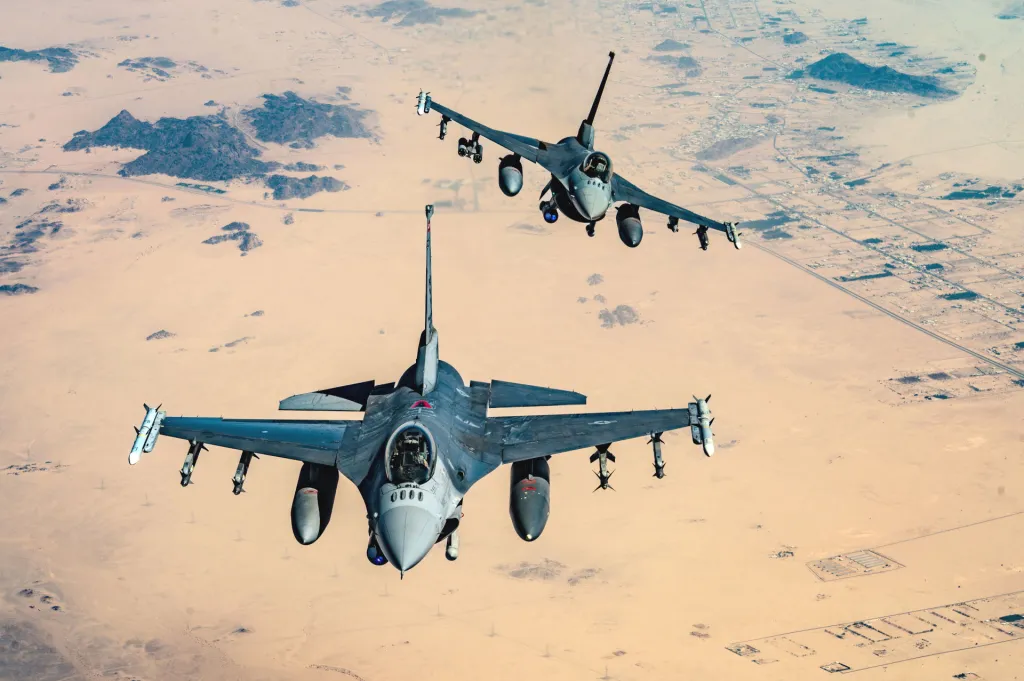
The photographs reveal F-16CJ “Wild Weasel” fighters equipped for both Suppression of Enemy Air Defenses (SEAD) and Destruction of Enemy Air Defenses (DEAD) missions. Each aircraft carries two AGM‑88 HARM anti-radiation missiles designed to destroy radar emitters, along with external fuel tanks to extend operational range. The jets also mount air-to-air weapons, including the AIM‑120 AMRAAM for long-range engagements and the AIM‑9X Sidewinder for close-range combat. This mixed configuration highlights the F-16’s versatility, allowing it to attack ground-based radar systems while still being capable of defending itself against enemy fighters or drones. Through advanced datalinks and sensor integration, these aircraft remain connected to the broader coalition air-combat network during missions.
Central to the Wild Weasel mission is the integration of the AGM-88 missile with the AN/ASQ‑213 HARM Targeting System pod. Mounted near the aircraft’s intake, this system detects and analyzes enemy radar signals without emitting its own signals. It can locate Iranian surveillance and fire-control radars and pass targeting data directly to the HARM missile. Once a radar activates, pilots can quickly generate a firing solution and launch the missile within seconds. This forces air-defense operators to either shut down their radars—losing awareness of incoming threats—or keep them active and risk immediate destruction. Over repeated strike waves, this pressure gradually degrades Iran’s integrated air-defense network, opening corridors for follow-up strikes by other aircraft and bombers.
The presence of air-to-air weapons on these jets also highlights the U.S. strategy of maintaining control of the skies while conducting deep strike missions. The AIM-120 AMRAAM provides strong beyond-visual-range engagement capability, allowing F-16 pilots to intercept hostile aircraft, cruise missiles, or large unmanned aerial vehicles before they can threaten high-value support assets such as aerial refueling tankers or airborne early-warning aircraft. Meanwhile, the AIM-9X Sidewinder, with its helmet-mounted targeting capability, gives pilots a decisive advantage in close-range dogfights. In coordination with other coalition aircraft—including stealth fighters such as the F‑22 Raptor—these Wild Weasel formations contribute to both offensive and defensive counter-air operations designed to deny Iran any effective aerial presence during critical stages of the campaign.
Another important system visible in the imagery is the AN/AAQ‑28 Litening targeting pod, which significantly enhances the aircraft’s precision-strike and reconnaissance capabilities. Using electro-optical and infrared sensors, the pod enables pilots to detect and track targets such as mobile missile launchers, drone facilities, and small command centers. It can also generate accurate targeting coordinates and provide laser designation for precision weapons. This capability is particularly valuable when engaging mobile threats like transporter-erector-launchers that may relocate quickly after firing. By shortening the time between detection and engagement, the system ensures that fleeting targets can be destroyed before they move or launch missiles.
The external fuel tanks seen on these F-16s—typically 370-gallon tanks mounted under each wing—highlight the endurance required for long-range strike missions during Operation Epic Fury. Aircraft operating from regional bases must remain airborne for extended periods to maintain patrol coverage and respond to emerging targets. Combined with aerial refueling support, these tanks allow F-16s to loiter longer near contested areas, monitor missile launch zones, and respond rapidly to new threats. Sustained presence in the air ensures that any attempt by Iranian forces to reactivate radar systems or reposition missile assets can be quickly countered.
From a broader operational perspective, the Wild Weasel missions shown in CENTCOM’s images fit into a highly coordinated air-campaign framework managed through a Combined Air Operations Center and daily Air Tasking Orders. In many cases, F-16 SEAD flights operate ahead of strike aircraft, suppressing radar coverage and clearing safe entry routes into defended airspace. At the same time, combat air patrols equipped with long-range missiles guard critical support platforms such as tankers and surveillance aircraft. Intelligence from satellites, airborne sensors, and reconnaissance platforms helps guide these fighter formations toward emerging threats. This integrated approach gradually isolates Iranian air defenses and air-force units, allowing coalition aircraft to strike deeper strategic targets with reduced risk.
Publicizing these F-16 Wild Weasel operations also sends a strategic signal. For Tehran, it demonstrates that even advanced defensive networks built over many years can be systematically dismantled by coordinated airpower. For regional allies, the images reassure partners that the United States retains the capability and willingness to counter missile and drone threats in the Middle East. At a broader level, the campaign illustrates how modern warfare combines fourth-generation fighters, stealth aircraft, bombers, cyber capabilities, space-based intelligence, and unmanned systems into a single integrated strike architecture capable of overwhelming sophisticated defenses.
As Operation Epic Fury progresses, the role of the F-16 Wild Weasel remains central to the air campaign. By destroying radar systems with HARM missiles, identifying mobile threats through advanced targeting pods, and maintaining aerial security with AMRAAM and Sidewinder missiles, these aircraft embody the flexibility of modern U.S. airpower. Their operations highlight a strategy focused on securing air dominance and systematically reducing Iran’s ability to project missile, drone, or airpower threats across the region.
About The Author