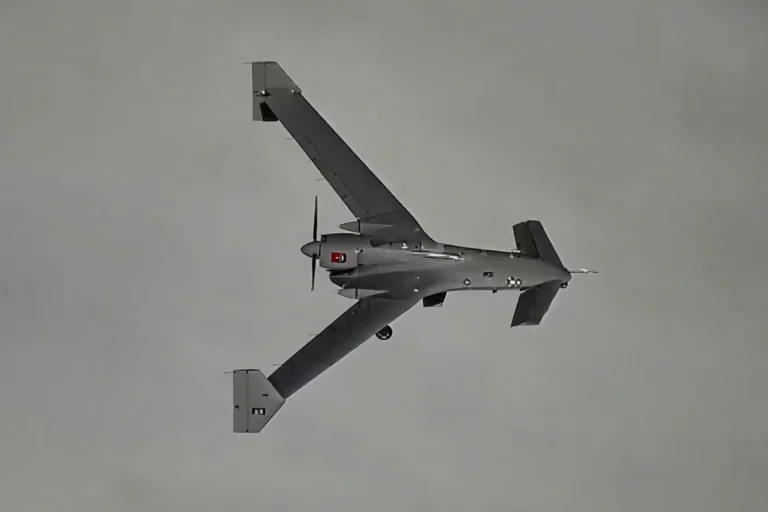
Azerbaijan reported that two drones originating from Iran entered the airspace of the Nakhchivan Autonomous Republic and struck close to Nakhchivan International Airport, leaving two people injured and causing damage to civilian facilities. Regional sources suggest the UAVs were likely Arash-2 loitering munition systems, an Iranian long-range kamikaze drone capable of carrying a warhead of around 120 kilograms.
Two unmanned aerial vehicles launched from Iranian territory reportedly entered the airspace of Azerbaijan and struck near Nakhchivan International Airport, injuring two individuals and damaging civilian structures, according to officials from Azerbaijan’s foreign ministry. The incident took place in the Nakhchivan Autonomous Republic, an Azerbaijani exclave located close to the Iranian frontier.
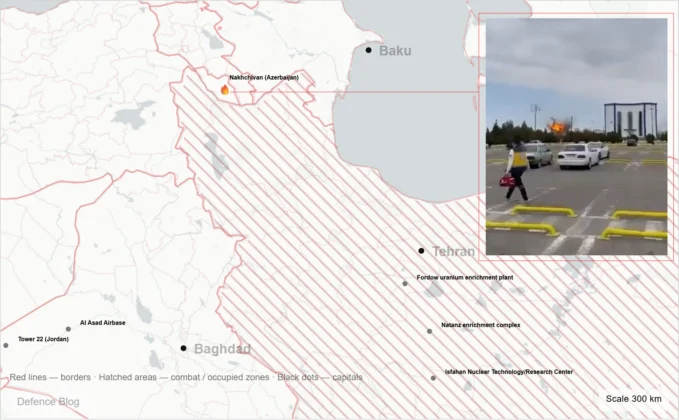
Authorities stated that the drones crossed into Azerbaijani territory roughly 10 kilometers from the border with Iran. One of the UAVs reportedly hit the airport’s terminal area, while the second landed close to a school in a nearby village, causing damage to surrounding infrastructure.
Sources familiar with the Azerbaijani government told Reuters that the explosions triggered a fire at the scene. Emergency teams were dispatched quickly, and two people were reported wounded during the incident.
Reports from local media indicated that the event involved two separate drone strikes rather than a single stray UAV. Analysts noted that the pattern and timing of the impacts suggested a deliberate attack rather than an accidental cross-border incident.
Regional security reports suggested that the drones involved were likely the Arash‑2 loitering munition, a long-range Iranian kamikaze drone developed for precision strike missions.
The Arash-2 system is believed to be larger and faster than the widely known Shahed‑136 loitering munition. It reportedly carries a warhead of up to 120 kilograms and is designed to destroy targets by crashing directly into them during the final phase of its mission.
Loitering munitions operate differently from conventional missiles. After reaching the target area, they can circle overhead until the operator confirms the objective before diving onto the target. Because the drone itself functions as the delivery system and weapon, the explosive payload detonates upon impact.
Iran has previously employed Arash-series drones in attacks against strategic infrastructure and military sites across the Middle East. Regional sources have reported the use of similar systems in operations targeting facilities in Kuwait, Saudi Arabia, and Qatar.
The Nakhchivan Autonomous Republic occupies a unique geographic position, separated from mainland Azerbaijan by territory belonging to Armenia. Its close proximity to Iran means that both civilian and military sites are located within a short distance of the border, raising the possibility of cross-border security incidents affecting the region.
Nakhchivan International Airport serves as the primary air transport hub for the exclave and is critical for maintaining connections between Nakhchivan and the rest of Azerbaijan. Any damage to the airport could disrupt passenger travel and regional supply routes.
Officials in Azerbaijan strongly condemned the drone strike, stating that such actions violate international law and warning that incidents of this nature could further increase tensions in the region.
About The Author