U.S. Northrop Grumman B-2 Spirit stealth bombers carried out strikes during Operation Epic Fury, releasing numerous 2,000-pound penetrating bombs on Iran’s underground ballistic-missile launch facilities. The operation is intended to dismantle fortified subterranean sites that enable Iran to store and launch long-range missiles.
U.S. Central Command reports that Northrop Grumman B-2 Spirit stealth bombers carried out heavy strikes during Operation Epic Fury, releasing multiple 2,000-pound penetrating bombs against Iran’s deeply buried ballistic-missile launch infrastructure. The mission focused on reinforced underground sites built to shield missile forces from standard aerial attacks. These strikes typically employ hardened bunker-penetrating weapons such as the BLU-109 penetrator bomb, which is designed to punch through thick reinforced concrete before exploding inside protected facilities. By using these munitions, stealth platforms like the B-2 can destroy underground launch systems that would normally survive conventional bombing.
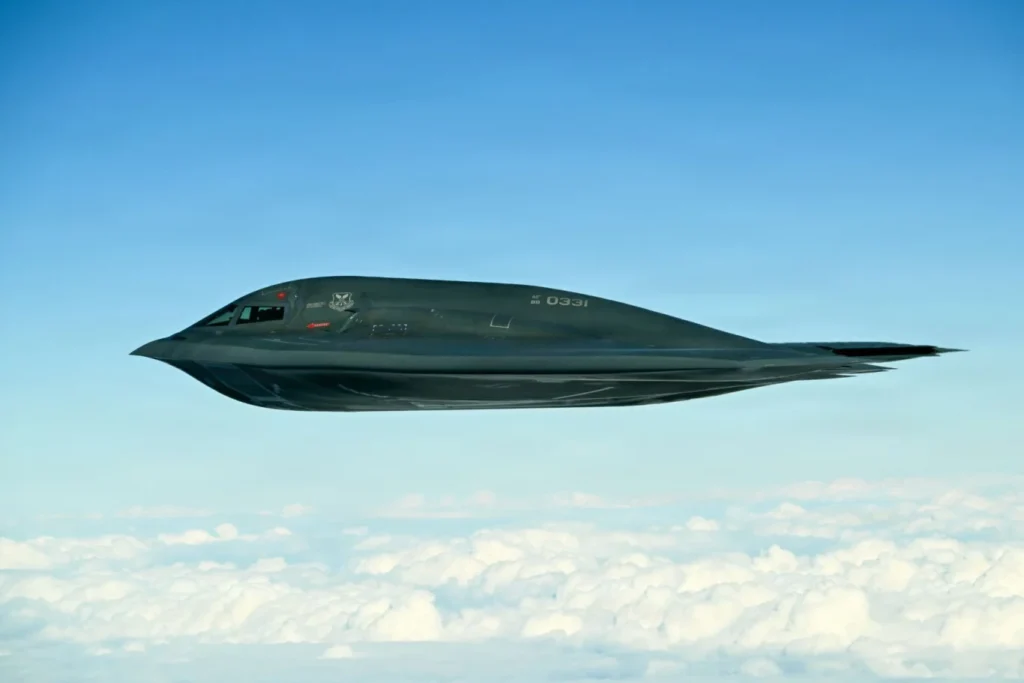
The opening phase of the operation reportedly included at least four B-2 bombers flying from the continental United States and completing several aerial refueling operations along the route, highlighting the mission’s long-range strategic nature. The exact number of aircraft involved in the most recent strikes has not been publicly confirmed by CENTCOM. The U.S. Air Force operates nineteen B-2 bombers overall, although only a portion of the fleet is typically mission-ready due to maintenance and modernization work. In a previous operation conducted in June 2025, seven B-2 aircraft were deployed, demonstrating the potential scale of these long-distance strike missions.
The Northrop Grumman B-2 Spirit is specifically engineered to infiltrate heavily defended airspace without detection. Its distinctive flying-wing shape and radar-absorbing materials reduce radar reflections as well as thermal and acoustic signatures, making it extremely difficult for modern air defense systems to track. The bomber has an unrefueled combat range of roughly 6,000 nautical miles, but with aerial refueling it can strike targets on a global scale. Its internal weapons bays can carry more than 18 tons of payload, including both conventional and nuclear weapons, allowing it to engage multiple hardened targets during a single mission.
CENTCOM only confirmed the use of “2,000-pound penetrating bombs,” without specifying the exact model. Based on publicly available U.S. Air Force data, the weapons involved are likely part of the GBU-31 JDAM family. These precision weapons combine a 2,000-pound bomb body—often the BLU-109 penetrator bomb or the Mk 84 bomb—with a GPS-guided JDAM kit. This system converts traditional unguided bombs into highly accurate precision weapons capable of striking fixed targets within only a few meters, even in poor weather conditions. The BLU-109 warhead is particularly effective against reinforced structures because it can penetrate several meters of concrete before detonation.
The sites described by CENTCOM appear to be part of Iran’s underground missile infrastructure, commonly referred to as “missile cities.” These complexes are built inside mountains or in extensive tunnel networks linked to launch positions. They are operated by the aerospace division of the Islamic Revolutionary Guard Corps to store ballistic missiles and protect launch platforms such as transporter-erector-launcher vehicles. These mobile launchers transport missiles, raise them into a vertical position, and conduct launch procedures. In some facilities, tunnels open directly toward external launch pads, allowing missiles to move quickly from underground shelters to firing points.
Satellite imagery assessments and research by the Center for Strategic and International Studies indicate that locations including Khorramabad, Tabriz, and Kermanshah host storage and launch facilities connected to this network. Iran maintains the largest and most varied ballistic-missile arsenal in the Middle East, consisting of thousands of missiles across multiple range categories. Underground bases play a key role in this structure because they conceal missile stockpiles, safeguard launch crews, and protect command systems from preemptive strikes.
Destroying these installations is particularly difficult. Rather than being positioned on exposed launch pads, the missiles are hidden within hardened underground structures, dispersed across rugged terrain. Successful strike missions must therefore penetrate defended airspace and carry sufficient firepower to hit several vulnerable points. Important targets include tunnel entrances, ventilation systems, access routes, supply areas, and communication hubs. Even if the main underground facility survives, damage to these components can disrupt launch operations and slow the ability to carry out additional missile attacks.
According to U.S. officials, the frequency of Iranian missile and drone strikes has decreased since the start of Operation Epic Fury. However, since late February Iran has attempted retaliatory attacks against U.S. forces and regional partners including Kuwait, Qatar, Saudi Arabia, and Bahrain. In response, Washington and allied nations have strengthened missile-defense and air-defense systems around military installations and key energy facilities.
The targeting of underground missile bases reflects a broader shift in U.S. strategy. Rather than focusing solely on intercepting missiles after launch or attacking individual launch units, the campaign now aims at the infrastructure that supports Iran’s long-term missile capabilities, including storage depots, command centers, and production networks. Gradually degrading these critical systems could reduce Tehran’s capacity to conduct sustained missile operations while also signaling that the United States is prepared to strike even the most heavily protected elements of Iran’s military architecture.
About The Author