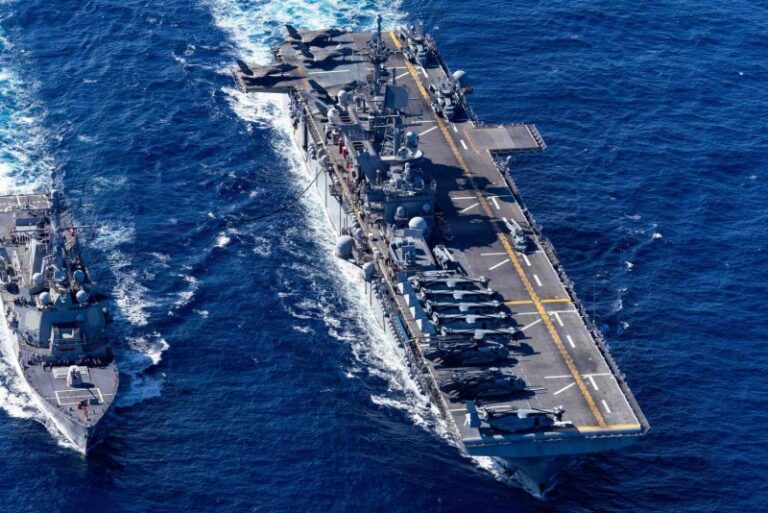
The United Kingdom has swiftly moved Royal Navy Wildcat HMA Mk2 helicopters to RAF Akrotiri in Cyprus using a C-17 strategic airlifter, reinforcing regional defenses against the rising threat of drones in the Eastern Mediterranean. The deployment highlights how NATO militaries are increasingly responding to low-cost unmanned threats by positioning fast-deployable sensor-and-strike platforms close to key bases and vital maritime routes.
Britain’s decision to rapidly deploy Royal Navy Wildcat helicopters to Cyprus represents far more than a routine transfer of aviation assets. It signals a quick reinforcement of the United Kingdom’s forward air defense posture in the Eastern Mediterranean. By moving a highly mobile sensor-and-strike platform closer to British bases, vital shipping routes, and regional tension points, the UK is responding to an operational environment increasingly shaped by one-way attack drones and other low-cost unmanned threats.
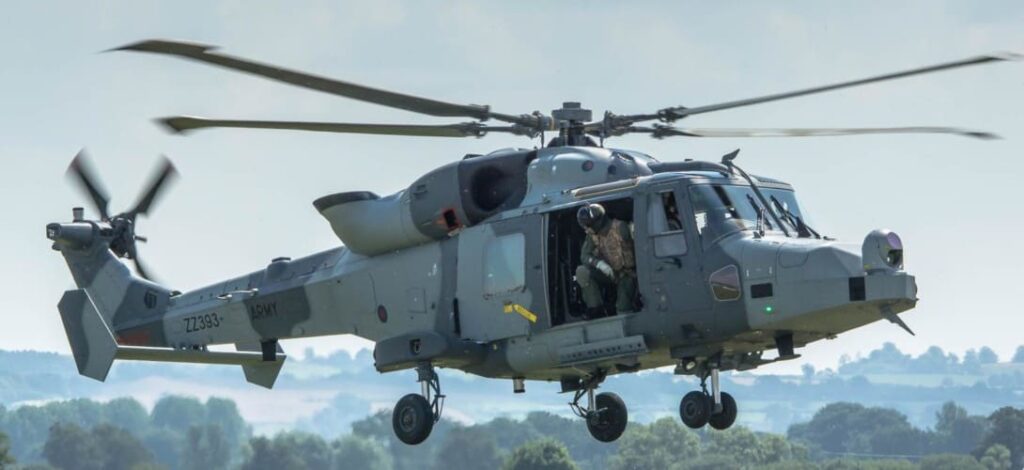
UK rapidly deploys Royal Navy Wildcat helicopters with Martlet missiles to Cyprus to boost defenses against drone and maritime threats in the Eastern Mediterranean (Picture source: UK Royal Air Force).
The Royal Air Force confirmed that a C-17 Globemaster from No. 99 Squadron transported a Wildcat helicopter from RNAS Yeovilton to RAF Akrotiri within a single 24-hour mission cycle. At the same time, the UK government separately announced that two Wildcats equipped with Martlet missiles will operate alongside HMS Dragon to enhance protection against the growing threat posed by drones.
According to the RAF, the mission was conducted at short notice and required significant preparation. The Wildcat had to be partially dismantled at Yeovilton, loaded at an airfield not normally configured for large strategic transport aircraft, and then delivered quickly to Cyprus. Operationally, this demonstrates the UK military’s ability to rapidly generate combat capability without relying on slower maritime transport or waiting for ships to arrive. Rapid strategic airlift effectively transforms the Wildcat from a ship-based helicopter into a rapidly deployable theater reinforcement, capable of supporting base defense, maritime surveillance, force protection, and emergency response missions from Akrotiri.
In practical terms, the move was not merely about relocating a helicopter. It highlighted Britain’s ability to compress deployment timelines while maintaining operational flexibility in a threat environment where warning time is limited and drone attacks can occur with little notice.
The aircraft itself is a highly capable platform. The Wildcat HMA Mk2 serves as the Royal Navy’s primary shipborne multi-role helicopter and is designed to operate from frigates, destroyers, and support vessels in missions including anti-surface warfare, maritime security, counter-piracy, counter-narcotics operations, force protection, anti-submarine warfare, and intelligence surveillance and reconnaissance tasks. Official Royal Navy specifications indicate a maximum speed of about 160 knots and a range of roughly 250 nautical miles. The helicopter measures around 15 meters in length and can lift payloads of up to one tonne.
It is operated by a pilot and an observer while also offering crashworthy seating for up to six additional personnel. Compared with the older Lynx helicopter it replaced, the Wildcat uses more powerful LHTEC CTS800-4N engines, allowing it to perform effectively in demanding environments. The aircraft is also equipped with a modern digital glass cockpit, an MX-15 Wescam electro-optical targeting sensor for day-night operations, and the Seaspray radar system, which the Royal Navy has successfully used for both maritime and land surveillance missions.
Where the Wildcat truly gains combat significance is in its weapons capability. The helicopter can be armed with Sting Ray torpedoes, a 12.7 mm M3M heavy machine gun, Martlet lightweight missiles, and the more powerful Sea Venom anti-ship missile. Royal Navy testing has shown that the aircraft can operate with a full weapons load even in challenging sea conditions, including asymmetric weapon configurations that leave space for additional mission equipment such as a gun or rescue winch.
During Martlet trials, the Royal Navy demonstrated that a Wildcat can carry as many as 20 missiles, giving the helicopter a dense magazine suited to engaging small and fast targets. For heavier strike missions, the Sea Venom missile provides a roughly 20-kilometer-class anti-ship capability with a warhead in the 30-kilogram range. The missile features sea-skimming flight profiles, salvo launch capability, and a data link that allows operators to retarget or abort an attack while the missile is in flight, making it particularly effective in crowded littoral environments.
This diverse weapons suite also explains why the Wildcat is well suited for counter-drone operations. The UK government has confirmed that the helicopters deployed to the Eastern Mediterranean are armed with Martlet missiles specifically to counter unmanned aerial threats. Official material from Defence Equipment & Support describes the 13-kilogram Lightweight Multirole Missile as being designed to defeat drones, helicopters, other aircraft, and small fast maritime targets.
The Royal Navy has already demonstrated these capabilities in testing and live-fire trials. In July 2023, the service conducted its first aerial-target firing with Martlet during trials. Later, in November 2024, a Wildcat successfully destroyed a Banshee drone over the Bristol Channel during the first air-to-air test of this kind. For counter-UAS missions, the helicopter therefore offers a mobile interceptor capable of detecting targets using radar and electro-optical sensors, identifying them at range, and engaging them without relying solely on fixed ground-based air defense systems.
From a tactical perspective, the importance of this capability lies in the nature of modern drone defense. Effective counter-drone operations depend heavily on positioning and persistent coverage rather than missile range alone. A helicopter can push the engagement area further away from defended assets, patrol sea approaches, protect ships in port, or intercept threats that slip through wider air-defense networks.
Although the Wildcat does not replace the area-air-defense role of a Type 45 destroyer or dedicated ground-based air defense systems, it provides an important intermediate layer between long-range missile defense and point protection. Its ability to operate from ships or austere forward locations, conduct surveillance, escort missions, and deliver kinetic strikes day or night makes it particularly valuable against complex mixed drone attacks targeting maritime infrastructure and critical sea routes.
In the Eastern Mediterranean, where the UK is maintaining a military presence and protecting personnel, this flexibility has clear strategic benefits as well as tactical advantages.
The deployment to Cyprus also reflects a broader trend in British naval aviation. The Wildcat Maritime Force based at Yeovilton operates 28 HMA Mk2 helicopters across 815 and 825 Naval Air Squadrons. Over time, the aircraft has evolved from a capable maritime utility platform into a more credible strike and force-protection asset. Martlet missiles entered service in 2021, Sea Venom has added a stronger anti-ship strike capability, and ongoing support agreements and missile procurement programs indicate that the UK intends to keep the Wildcat fleet effective against emerging threats.
As a result, the aircraft arriving at RAF Akrotiri represents more than a simple helicopter deployment. It functions as a compact and deployable combat system that provides Britain with a faster response option against drones, surface threats, and instability in littoral regions at a time when the distinction between base defense and expeditionary operations is increasingly fading.
About The Author