Breaking: U.S. Approves Emergency $151.8 Million Bomb Sale to Israel as IDF Intensifies Air Campaign Against Iran
In a significant escalation of U.S.-Israel military coordination, the United States has greenlighted an emergency foreign military sale worth $151.8 million to supply Israel with 12,000 BLU-110 1,000-pound aerial bombs. The approval was fast-tracked under emergency authority, allowing the transfer to move forward without the standard congressional review period due to urgent security requirements. This move underscores both the intensity of Israel’s ongoing air campaign and the strategic necessity of ensuring the country has the munitions to sustain high-tempo operations.
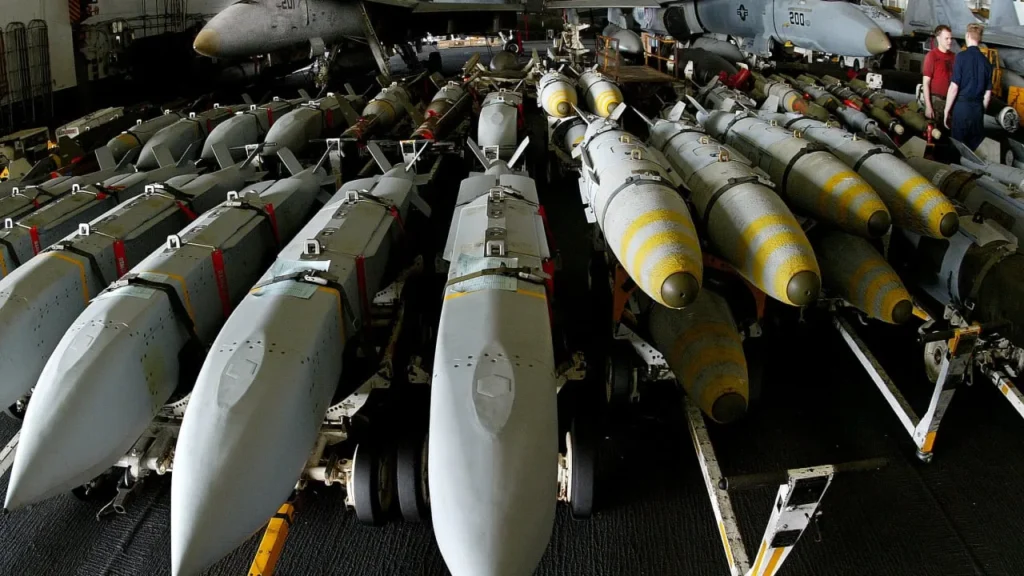
(photo credit: YVES HERMAN/REUTERS)
The BLU-110: Versatile and Deadly
The BLU-110 is a general-purpose 1,000-pound bomb widely used by Western air forces. Its versatility lies in its ability to be fitted with different fuze options or precision guidance kits such as JDAM (Joint Direct Attack Munition) or laser-guided systems. These upgrades enable aircraft to strike hardened structures, military infrastructure, and strategic facilities with pinpoint accuracy, even in complex battlefield conditions.
In Israel’s current campaign, this capability is essential. The bombs can target missile production sites, command centers, weapon depots, and other critical infrastructure deep inside Iran, minimizing collateral damage while maximizing operational effectiveness. Analysts note that the sheer quantity of 12,000 bombs highlights the scale of aerial operations Israel is undertaking and anticipates in the coming weeks.
Scale of the Air Campaign
According to the Israeli Defense Forces (IDF), the Israeli Air Force has already deployed over 6,500 bombs on Iranian targets since the start of the military operation. This staggering number provides a glimpse into the scale and intensity of the campaign. Israeli officials report that their operations have been focused on:
- Missile production and storage facilities
- Military infrastructure supporting Iran’s ballistic and cruise missile programs
- Strategic regime-linked facilities, including command centers and logistics hubs
Defense analysts emphasize that the number of bombs deployed reflects the high operational tempo and Israel’s intent to maintain air superiority while degrading Iran’s military capabilities.
U.S. Emergency Approval: Why It Matters
The emergency nature of this sale is critical. Typically, foreign military sales undergo lengthy congressional review, sometimes taking weeks or even months. In this case, U.S. authorities utilized emergency export authority, bypassing the standard timeline. This ensures that Israel receives the bombs without delay, allowing the IDF to replenish stockpiles amid ongoing operations.
Strategically, this underscores the close military partnership between the U.S. and Israel. By providing munitions at a moment of urgency, the U.S. demonstrates its commitment to supporting Israel’s operational capabilities, particularly in high-intensity conflict scenarios.
Financial Perspective
The BLU-110 bomb is a highly valuable piece of military hardware. The approved shipment’s cost of $151.8 million reflects both the quantity and the logistical support required for such a large-scale transfer. While each bomb can be fitted with additional precision kits, even the base version is designed for maximum destructive effect, capable of neutralizing hardened targets.
From a financial perspective, this highlights a broader trend in modern warfare: high-cost precision munitions are essential for maintaining battlefield effectiveness. Israel’s use of 6,500 bombs in just weeks demonstrates the intense consumption rates, which makes the replenishment provided by this U.S. emergency sale both urgent and strategic.
Implications for Israel’s Air ForceThe newly approved shipment of 12,000 bombs will have immediate operational implications. Analysts suggest that:
- Israel can sustain high-intensity air operations for an extended period.
- The IDF can replace expended munitions, preventing gaps in operational capability.
- Strategic targeting can continue uninterrupted, maintaining pressure on key Iranian military sites.
Without such resupply, Israel’s campaign could face operational constraints, particularly if the conflict escalates further. The shipment ensures that the Israeli Air Force retains the ability to project power deep into Iranian territory with precision-guided munitions.
Strategic Context: Israel vs. Iran
The ongoing air campaign against Iran is part of a broader regional confrontation. Over the past decades, Israel has expressed concern over Iran’s ballistic missile programs, nuclear ambitions, and regional influence. The current high-intensity strikes are reportedly aimed at degrading Iran’s military-industrial infrastructure, particularly facilities related to missile production.
Analysts note that these operations are unprecedented in scale, with the IDF employing thousands of aerial bombs in a compressed timeframe. The U.S. decision to fast-track the shipment of 12,000 BLU-110 bombs suggests Washington’s intent to ensure Israel can sustain these operations and respond quickly to emerging threats.
Operational Challenges
Even with this emergency shipment, the IDF faces several operational challenges:
- Target accuracy and intelligence: Striking high-value targets in Iran requires real-time intelligence and precise targeting. Precision guidance kits help, but the complexity of Iran’s infrastructure remains a challenge.
- Logistical coordination: Integrating 12,000 new bombs into existing inventory, ensuring storage safety, and timely deployment requires careful planning.
- Escalation risk: Sustained bombings could provoke broader regional responses or trigger retaliatory actions, making operational timing and strategy crucial.
These challenges underline why the U.S. considered emergency approval necessary — Israel cannot afford delays in resupply when operating at such high intensity.
The Broader Military and Political Message
Beyond operational utility, this sale sends a clear political signal. It demonstrates:
- U.S. support for Israel in critical military operations
- A willingness to bypass standard bureaucracy to respond to urgent military needs
- The strategic importance of maintaining Israel’s operational readiness in a volatile Middle East
For Iran, the message is equally clear: Israel has the capability to continue a sustained campaign, backed by U.S. logistical and financial support.
Analysts’ Take on Long-Term Implications
Defense experts suggest that the 12,000 BLU-110 bombs will not only replenish Israel’s inventory but also allow the IDF to plan future operations with greater confidence. Key points:
- Israel can rotate targets strategically, hitting missile sites, infrastructure, and regime facilities without worrying about immediate depletion of munitions.
- U.S. emergency sales reflect real-time operational support, highlighting the depth of military partnership between the two countries.
- Long-term, Iran may be forced to disperse assets or harden key facilities in anticipation of precision-guided attacks, reshaping regional military strategy.
Conclusion
The emergency U.S. approval of $151.8 million in BLU-110 bombs represents a pivotal moment in the Israel-Iran confrontation. With more than 6,500 bombs already deployed, Israel’s high-intensity air campaign continues unabated, and the new shipment ensures operational continuity.
From the perspective of military strategy, financial logistics, and international relations, this development highlights:
About The Author