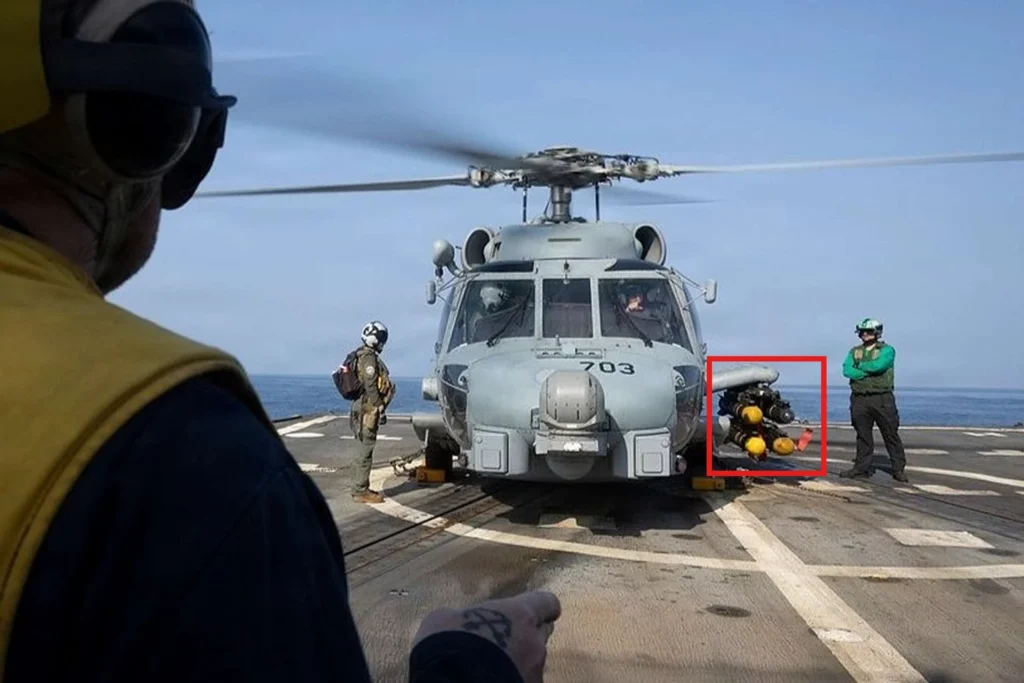
A newly released U.S. Navy image reveals an MH-60R Seahawk helicopter loaded with precision Hellfire missiles operating from a guided-missile destroyer in the Middle East. The deployment highlights how armed naval helicopters are becoming a key tool for countering fast attack boats and other asymmetric threats in increasingly tense regional waters.
As tensions continue to rise across the Middle East, the U.S. Navy is strengthening its maritime security posture by deploying armed helicopters capable of striking hostile vessels before they reach American warships.
Newly released imagery from March 7, 2026, shows an MH-60R Seahawk helicopter conducting flight operations from the USS Delbert D. Black (DDG‑119), an Arleigh Burke-class destroyer currently operating in the United States Central Command region as part of Operation Epic Fury.
The photograph captures a moment during flight-deck operations as a sailor guides the helicopter during launch or recovery procedures. But what stands out most is the aircraft’s weapon configuration: the Seahawk is clearly armed with four AGM‑114 Hellfire precision-guided missiles, mounted for surface-strike missions.
This configuration transforms the helicopter from a reconnaissance platform into a fast-reacting strike asset designed to neutralize small surface targets threatening U.S. naval forces.
A Helicopter Built for Multi-Mission Warfare
The MH‑60R Seahawk serves as the primary ship-based combat helicopter for the United States Navy. Designed to operate from destroyers and cruisers, the aircraft is capable of performing a wide variety of missions including:
- Anti-submarine warfare
- Anti-surface warfare
- Maritime surveillance
- Targeting and reconnaissance
- Maritime interdiction operations
Equipped with sophisticated radar systems, electro-optical sensors, sonar equipment, and advanced data links, the helicopter can locate and track targets far beyond the radar horizon of the ship that launched it.
When armed with weapons such as Hellfire missiles, torpedoes, and machine guns, the aircraft becomes a forward-deployed hunter capable of eliminating threats before they can approach the warship.
Why Hellfire Missiles Matter at Sea
The presence of Hellfire missiles on the Seahawk is particularly important in today’s maritime threat environment.
In narrow waterways and congested shipping routes common in the Middle East, naval forces often face asymmetric threats from small, fast-moving boats armed with rockets, explosives, or anti-ship missiles.
Iran’s naval doctrine has long emphasized the use of swarm tactics, where multiple small vessels rapidly converge on a larger warship in an attempt to overwhelm its defenses.
In such situations, the Hellfire-armed Seahawk provides a precise and flexible response. The helicopter can quickly identify suspicious vessels and, if necessary, launch precision strikes against them without forcing the destroyer to use heavier ship-launched weapons.
This capability allows U.S. naval forces to maintain control of the surrounding waters while keeping the main warship at a safer distance from potential threats.
Role in Operation Epic Fury
The deployment is also closely linked to Operation Epic Fury, a major U.S. military campaign launched in late February 2026.
The operation targets elements of Iran’s military infrastructure believed to threaten U.S. and allied forces in the region. These targets include:
- Missile launch sites
- Drone facilities
- Air defense systems
- Command and control centers
U.S. forces have already carried out multiple coordinated strikes using aircraft, naval vessels, and long-range cruise missiles.
Destroyers operating in regional waters play a key role in the campaign by launching Tomahawk cruise missiles and providing air-defense coverage for coalition forces.
Within this environment, the presence of an armed Seahawk adds another layer of protection, allowing ships to deal quickly with smaller threats while focusing their heavier weapons on strategic targets.
Expanding the Reach of a Destroyer
Modern destroyers are no longer limited to the weapons mounted on their decks.
By operating helicopters like the MH-60R, ships dramatically extend their surveillance and engagement range. The helicopter can scout areas far beyond the ship’s sensors and relay targeting data back through secure data links.
This concept reflects a broader shift in naval strategy toward distributed lethality, where multiple platforms—ships, aircraft, drones, and sensors—work together to create a networked combat system.
In this network, the Seahawk acts both as an airborne sensor and a precision strike platform, capable of independently engaging threats while sharing information with the rest of the fleet.
A Layered Defense in High-Risk Waters
The image of the Hellfire-armed Seahawk operating from USS Delbert D. Black illustrates how modern naval warfare relies on layered defenses.
The destroyer itself carries powerful systems such as:
- The Aegis combat system for air and missile defense
- Standard missiles for intercepting aircraft and ballistic threats
- Tomahawk cruise missiles for long-range strike missions
Adding an armed helicopter to this mix creates a highly flexible combat platform capable of responding to threats ranging from ballistic missiles to small attack boats.
In contested regions such as the Persian Gulf and nearby waters, that versatility is essential for maintaining sea control and protecting coalition naval forces.
The Future of Naval Aviation
As Operation Epic Fury continues, the role of ship-based helicopters is becoming increasingly important.
The deployment of the Hellfire-armed MH-60R demonstrates how rotary-wing aviation is evolving into a critical component of naval strike operations. These helicopters not only expand a warship’s surveillance capabilities but also provide a rapid and precise way to deal with emerging threats.
In an era where naval forces must confront both high-tech weapons and unconventional tactics, the ability to deploy flexible, forward-based strike assets could prove decisive.
For the U.S. Navy, the Seahawk remains a vital part of maintaining dominance in some of the world’s most contested maritime regions.
About The Author