A new entry in the SIPRI Arms Transfers Database suggests that Azerbaijan may be preparing to equip its upcoming JF-17 Block III fighter fleet with advanced ASELPOD targeting systems from Türkiye. If confirmed, the move would significantly expand the precision-strike and surveillance capabilities of Azerbaijan’s future combat aircraft.
A recent update to the global arms trade database maintained by the Stockholm International Peace Research Institute has drawn attention to a potential new defense procurement linking Azerbaijan, Pakistan, and Türkiye.
According to the database update published on March 9, 2026, Azerbaijan has reportedly ordered 40 ASELPOD targeting pods produced by the Turkish defense company ASELSAN. The pods are said to be intended for integration with the country’s future fleet of JF-17 Block III fighter jets, which Azerbaijan is scheduled to receive from Pakistan.
However, it is important to note that neither Azerbaijani authorities nor officials from Pakistan or Türkiye have publicly confirmed the procurement so far. The information currently appears only in the SIPRI database, meaning it should be treated as a reported transfer rather than an officially announced deal.
Even so, the reported linkage is significant because it suggests that Azerbaijan may be planning a fully equipped multirole fighter capability from the moment the aircraft enter service.
Preparing a Multirole Fighter Fleet
If the SIPRI listing reflects actual procurement planning, Azerbaijan appears to be structuring its new JF-17 fleet around a complete combat capability rather than simply acquiring airframes.
The database associates the reported purchase of 40 ASELPOD targeting pods with a fleet of 40 JF-17 Block III fighters, indicating a potential one-to-one equipment ratio. Such a configuration would allow every aircraft in the fleet to operate with its own advanced targeting system.
This approach suggests that Azerbaijan intends to operate the aircraft as fully capable day-and-night multirole fighters, able to perform both air-to-air and air-to-ground missions.
What ASELPOD Brings to the Battlefield
The ASELPOD targeting system is designed to enhance the strike and reconnaissance capabilities of modern fighter aircraft.
According to technical information released by ASELSAN, the pod combines several advanced technologies in a single platform. These include:
- High-resolution infrared and television imaging sensors
- Dual-wavelength laser rangefinder and designator
- Advanced image-processing systems
- Precision geo-location capability
- Inertial tracking and stabilization systems
- Automatic alignment with the host aircraft
In practical combat scenarios, these systems allow pilots to detect, identify, track, and designate ground targets with exceptional precision, even in poor weather or nighttime conditions.
For modern air forces, targeting pods are a critical component of precision warfare because they reduce reliance on external reconnaissance platforms and enable aircraft to independently complete the entire targeting process.
Capabilities of the JF-17 Block III
The aircraft expected to carry these pods is itself a highly capable multirole fighter.
Developed jointly by Pakistan and China and produced by the Pakistan Aeronautical Complex, the JF-17 program has evolved significantly since its introduction.
According to official specifications, the JF-17 features:
- A maximum takeoff weight of approximately 13,500 kilograms
- Top speeds approaching Mach 1.6
- Operational ceilings exceeding 55,000 feet
- Eight external weapon stations
- Up to 3,400 kilograms of external payload capacity
The Block III version represents the most advanced variant of the aircraft, incorporating modern avionics, improved sensors, and enhanced combat capabilities designed for both air-defense and strike missions.
Azerbaijan has already described the aircraft as an all-weather fighter capable of operating day or night, making the integration of an advanced targeting pod particularly valuable.
Existing Operational Precedent
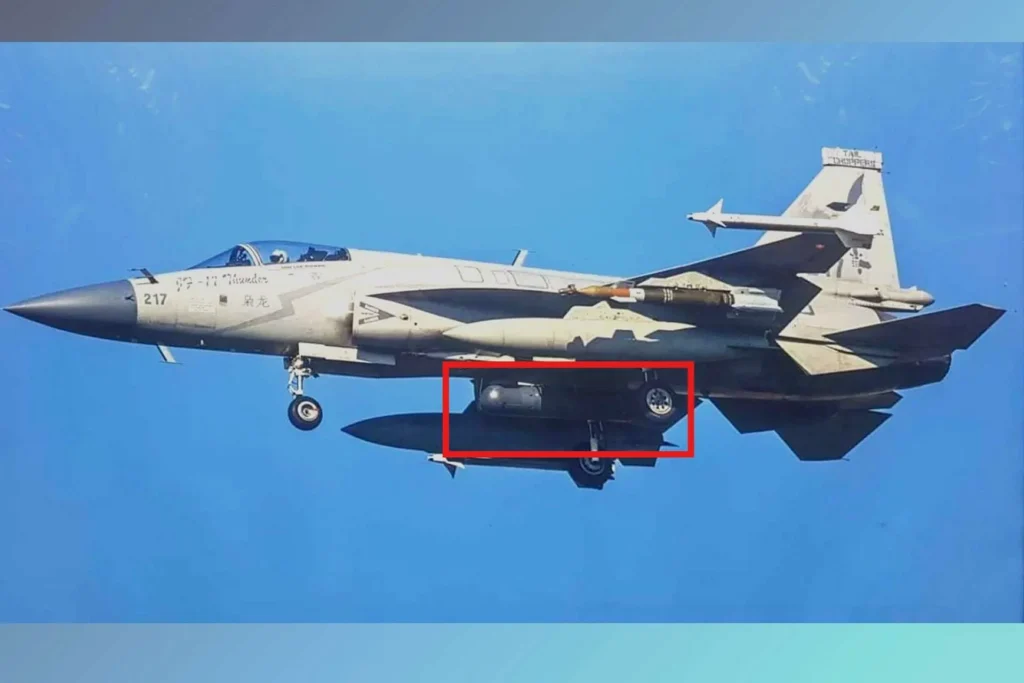
Another factor that strengthens the plausibility of the reported procurement is that the ASELPOD-JF-17 combination already exists in operational service.
The Pakistan Air Force has previously integrated ASELPOD systems on its own JF-17 fighter aircraft. This means that the sensor and aircraft pairing has already undergone technical integration and operational testing.
For Azerbaijan, adopting an already-proven configuration would significantly reduce both technical risk and integration time compared with introducing an entirely new system.
Tactical Advantages for Azerbaijan
If the acquisition is confirmed, pairing ASELPOD targeting systems with the JF-17 Block III would provide Azerbaijan with a more flexible and responsive air combat capability.
The system would enable pilots to:
- Rapidly detect and identify targets
- Track moving vehicles or mobile missile systems
- Conduct precision strikes against time-sensitive targets
- Support close air support missions
- Improve reconnaissance and battlefield awareness
In fast-moving operational environments, these capabilities can dramatically shorten the time between detecting a target and engaging it—often referred to as reducing the “kill chain.”
This advantage becomes especially important in complex terrain or rapidly evolving battlefield conditions.
A Growing Defense Partnership
Beyond its tactical implications, the reported procurement also highlights a broader geopolitical pattern in defense cooperation.
The potential arrangement links three partner nations:
- Azerbaijan, as the aircraft operator
- Pakistan, as the supplier of the JF-17 fighter
- Türkiye, as the producer of the targeting system
Such cooperation reflects a growing trend in which mid-tier defense industries collaborate to produce integrated combat systems that can compete with traditional Western or Russian suppliers.
For Azerbaijan, diversifying suppliers while building stronger partnerships with Pakistan and Türkiye may provide both military and diplomatic benefits.
The Bigger Picture
Modern combat aircraft are no longer defined solely by their airframes. Instead, their effectiveness increasingly depends on the integration of sensors, weapons, and targeting systems into a unified combat architecture.
If the SIPRI-listed procurement is confirmed, Azerbaijan’s JF-17 Block III fleet would represent exactly that type of integrated capability.
Rather than simply adding new fighters to its inventory, Baku would be investing in a precision-focused airpower structure capable of performing interception, reconnaissance, and strike missions with a single platform.
In an era where speed, accuracy, and flexibility determine battlefield effectiveness, such an approach could significantly strengthen Azerbaijan’s future air combat capabilities.
About The Author