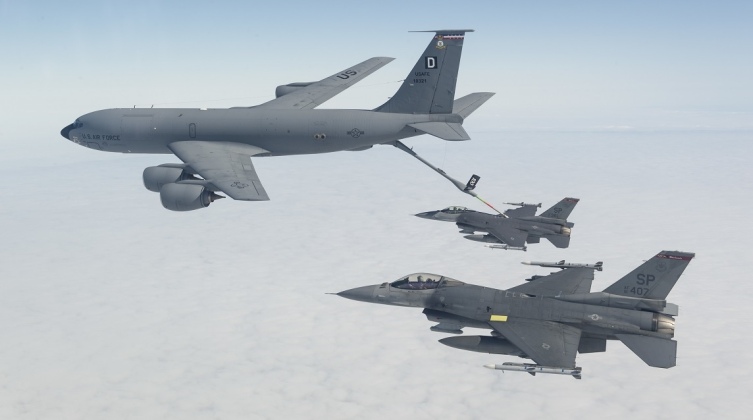
On the evening of November 8, 2025, the skies over southwestern Spain lit up with one of the most iconic sights in military aviation: three U.S. Air Force B-52H Stratofortresses thundering in to land at Morón Air Base. Call signs CAGER 11, 12, and 13, these legendary bombers from the 2nd Bomb Wing at Barksdale AFB, Louisiana, had just completed a transatlantic crossing supported by KC-46 Pegasus and KC-135 Stratotanker refuelers. This wasn’t a surprise visit — it was the official kickoff of Bomber Task Force (BTF) 26-1, the first European deployment of the new U.S. fiscal year.
And it’s more than just a training rotation. With tensions simmering from the Arctic to the Middle East, these 60-year-old warhorses — still packing a bigger punch than most modern fighters — are back in Europe to train, integrate, and deter.
Let’s break down what this deployment means, who’s involved, and why the sight of those eight-engine smoke trails cutting across the Spanish sunset matters more than ever.
The Mission: Train Hard, Deter Harder
Bomber Task Force deployments aren’t new — they’ve been a staple of U.S. global power projection since 2018 — but each one carries weight. BTF 26-1 will see the B-52s operating from Morón as a forward staging hub for missions across Europe, Africa, and the Middle East.
Expect:
- High-threat airspace simulations — practicing the “find, fix, track, target” kill chain
- Live weapons drops (as seen in past BTFs)
- Joint exercises with NATO allies
- Flypasts over key events (diplomatic signaling wrapped in a training mission)
The U.S. Air Force put it bluntly:
“Crews will train against simulated ground and air threats designed to deny freedom of maneuver — forcing decisive action to counter and gain air superiority.”
Translation? They’re practicing war — just without firing in anger (yet).
Meet the Allies: Finland, Sweden, Lithuania, and More
This isn’t a solo act. The B-52s will be flying, training, and integrating with some of NATO’s newest and most strategically placed members:
- Finland – Now fully in NATO, guarding the northern flank near Russia
- Sweden – Celebrated its first NATO anniversary earlier this year with a B-52 flyover and live bomb drop alongside JAS 39 Gripens
- Lithuania – Hosting NATO air policing, right on Russia and Belarus’s doorstep
These aren’t just photo ops. They’re about building muscle memory — teaching newer allies how to plug into U.S. bomber ops, share targeting data, and coordinate in contested environments.
And it’s not just Northern Europe. Spanish Eurofighter Typhoons (C.16 Tifón) welcomed the Buffs with mock intercepts over the Atlantic — a standard but symbolically loaded gesture. Portuguese fighters also got in on the action during the oceanic leg, coordinating via HF radio and interplane freqs.
The B-52H: Still the King of Long-Range Strike
Yes, the B-52 first flew in 1952. Yes, it still uses TF33 engines that leave thick black smoke trails like a 1960s muscle car. But don’t let the age fool you — this is a lethal, upgraded, and irreplaceable strategic asset.
Current capabilities:
- 20,000+ lb weapons payload — ALCMs, JDAMs, MALDs, JASSMs, even hypersonic ARRW (in testing)
- 14,000+ mile range with aerial refueling
- Advanced radar jamming (via ALQ-155, ALQ-161)
- Link 16 integration — full battlespace awareness
- Future upgrades: New engines (F130), radar (AESAR), and hypersonic weapons by 2030
The B-52 isn’t going anywhere until at least 2050. And right now? It’s the only U.S. bomber that can deploy in large numbers, loiter for hours, and deliver massive conventional or nuclear payloads.
Mock Intercepts: When Allies Play “Enemy”
One of the coolest parts of any BTF arrival? The mock intercepts.
As the B-52s crossed into Lisbon FIR, Portuguese air traffic control asked:
“CAGER flight, can you accommodate a practice intercept?”
The lead Buff replied:
“Affirmative. Switching to interplane frequency 234.6.”
Minutes later, Portuguese F-16s appeared on their wings. Then, over Spain, Eurofighter Typhoons took over — sleek, digital, fourth-gen fighters “attacking” a Cold War relic.
It’s theater. It’s training. It’s deterrence.
Because if a real adversary ever tries to challenge U.S. bombers, NATO fighters will be there — and they’ve practiced this exact scenario.
Meanwhile in the Pacific: B-1Bs Quietly Deploy to Japan
While Europe gets the spotlight, the U.S. hasn’t forgotten the Indo-Pacific.
In late October 2025, four B-1B Lancers from Dyess AFB, Texas, deployed to Misawa Air Base, Japan — potentially under the same BTF 26-1 umbrella (though PACAF hasn’t confirmed the label).
This is huge for several reasons:
- First BTF to Japan earlier this year (BTF 25-2)
- First time U.S. heavy bombers based in Japan for extended ops since Vietnam
- Missions likely include freedom of navigation in the South China Sea
Local spotters caught the Bone rocking supersonic dashes and low-level runs over the Sea of Japan. No official photos from the USAF — possibly due to the ongoing U.S. government shutdown impacting PA releases.
But the message to China? Crystal clear.
Why Morón? The Perfect Forward Base
Morón Air Base isn’t random. It’s:
- 1,200 miles closer to the Middle East than the UK
- U.S.-operated under Spanish sovereignty
- Fully equipped for heavy bomber ops (long runways, hardened shelters, fuel farms)
- Strategically placed for Africa Command (AFRICOM) and CENTCOM ops
Past BTFs from Morón have supported:
- Strikes in Syria/Iraq (pre-2024)
- Deterrence patrols over the Sahel
- Joint drills with Morocco, Tunisia, and Italy
If things heat up? These B-52s can be over Libya in 90 minutes, Syria in two hours.
The Bigger Picture: Deterrence in a Multipolar World
BTF deployments aren’t just training — they’re strategic messaging.
Russia watches B-52s fly over the Baltic. China tracks B-1s near Taiwan. Iran sees bombers within strike range of its nuclear sites.
And allies? They sleep better knowing U.S. strategic airpower is forward, flexible, and ready.
As one U.S. Air Force colonel said:
“We don’t permanently base bombers overseas anymore. But with BTF, we don’t need to. We show up, we train, we deter — then we go home. But we can always come back. Fast.”
What’s Next for BTF 26-1?
We don’t know the full duration — some BTFs last a week, others a month. But expect:
- Live drops in the UK or Nordic ranges
- Baltic Air Policing integration
- Possible Black Sea presence (with Romanian or Bulgarian escort)
- Public flypasts — maybe over Madrid or Helsinki
Aviation enthusiasts in Spain were out in force, cameras ready, as the sun set and the Buffs rolled in. Those smoke trails? They’re not just exhaust — they’re history in motion.
About The Author