The wind was howling across the flight line at Minot Air Force Base, North Dakota, when the C-17 touched down on October 21, 2025. Out came a single trailer, a couple of rugged cases, and eleven people who had never worked this mission together before. By the time they loaded back up a week later, they had detected, tracked, jammed, and physically destroyed more than a hundred drone targets in live scenarios, packed everything into the same aircraft, and flown home to Colorado Springs with a brand-new certification in hand. That, in a nutshell, is the story of USNORTHCOM’s first fully validated Counter-small Unmanned Aerial System (C-sUAS) fly-away kit, a mobile bubble of sensors, jammers, and autonomous interceptors built by Anduril Industries to keep the homeland safe from the cheapest, most prolific threat in modern war.
Picture the problem first. A hobby-store quadcopter with a grenade taped underneath can hover for thirty minutes, slip past a perimeter fence, and turn a billion-dollar B-52 into a very expensive lawn ornament. Multiply that by dozens and you have the swarm nightmare that keeps base commanders awake. Traditional air-defense missiles are overkill; small-arms fire is dangerous and usually illegal over U.S. soil. What you need is something that sets up fast, sees everything, decides in seconds, and neutralizes cleanly—kinetic or non-kinetic, whatever the moment demands. That is exactly what rolled off the cargo ramp at Minot.
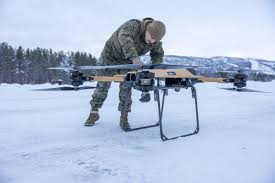
The kit is built around five core pieces that talk to each other through Anduril’s Lattice software. Heimdal is the trailer-mounted eye in the sky: 360-degree radar, thermal cameras, and automated tracking that spots a drone at five kilometers and never blinks. Wisp adds persistent infrared coverage, painting full-motion video around the clock. Pulsar is the invisible hand—radio-frequency jamming that severs the link between drone and operator, forcing an auto-land or return-to-home. When words fail, Anvil steps in: a small autonomous drone that launches, closes at high speed, and either rams the target or snares it in a net. Lattice sits in the middle, fusing every feed into a single God’s-eye picture and letting one operator click “engage” instead of shouting across three different consoles.
None of this is theoretical anymore. Over seven frigid days the team ran the full cycle. Day one was uncrating and calibration; by day four they were live-jamming real drones out of the sky; day five saw the first mid-air Anvil collision, a puff of carbon fiber and lithium batteries raining onto the snow. They threw curveballs at themselves—low slow fliers skimming the tree line, high-speed racers, simultaneous swarms of thirty targets—and the system swallowed every scenario. Chief Warrant Officer 3 Joey Frey, who runs the program, told reporters the team “far exceeded expectations,” turning strangers from different services into a single counter-drone strike cell in under a week.
Minot was the perfect stress test. Home to the 5th Bomb Wing and a chunk of America’s land-based nuclear deterrent, it sits in the middle of nowhere with weather that can flip from clear to whiteout in an hour. If the kit can work here, it can work anywhere. The 5th Bomb Wing kept overall authority for base defense while the USNORTHCOM crew handled the tech; the 21st Space Base Delta ran logistics and airlift; FAA and Department of Transportation reps made sure every engagement stayed inside the strict legal box laid out in Title 10 U.S.C. § 130i. By the end of the exercise Minot’s permanent 130i defense plan had a brand-new annex: here’s how we call in the fly-away team when the next mystery drone shows up.
The human side mattered as much as the silicon. Tech. Sgt. Ian Kay, who moved the gear, put it plainly: “Rank and career field don’t matter when the swarm is inbound. Teamwork does.” Major Austin Fairbairn, who ran ground ops, said the deployment “built muscle memory we’ll use for real incidents tomorrow.” That is the real payoff—turning a pickup squad into a rapid-response force that can land at any CONUS base, spin up in an hour, and hand the keys back to the installation commander before dinner.
Anduril’s role is the headline, but the broader story is doctrinal. The Pentagon is done waiting for ten-year acquisition cycles. This fly-away concept—modular, software-first, continuously upgradable—is the template for every major command. NORAD wants it for radar sites, the Navy wants it for piers, the Army wants it for ammo depots. The Minot certification is the first domino; expect dozens more to fall in the next eighteen months.
Drones are not going away. They are getting smaller, smarter, and cheaper by the month. But for the first time the U.S. has a counterpunch that deploys faster than the threat can proliferate. Eleven people, one trailer, seven days, a hundred kills, and a clean pack-out. That is what homeland base defense looks like in 2025.
About The Author