In a move that’s caught the defense world off guard, NATO has officially scrapped its plans to buy the Boeing E-7 Wedgetail as the long-term replacement for its aging E-3 Sentry AWACS fleet. The announcement came straight from the Netherlands Ministry of Defence on November 13, 2025, speaking for the core group of nations leading the Alliance Future Surveillance and Control (iAFSC) program. Just two years after selecting the E-7 in 2023, the alliance is now pivoting hard, hunting for alternatives that lean more heavily on European industry and promise greater independence from U.S. procurement drama.
This isn’t a minor course correction—it’s a full U-turn. Back in 2023, the E-7 seemed like the perfect fit. Built on the proven Boeing 737 Next Generation airframe and topped with the powerful Northrop Grumman MESA radar, the Wedgetail offered true 360-degree active electronically scanned array coverage, long endurance, and deep integration with modern fighter networks. More importantly, it promised seamless interoperability with the U.S. Air Force, which was planning to buy 26, and the UK’s Royal Air Force, already committed to three. The logic was simple: a shared platform means lower sustainment costs, standardized training, and a unified data picture across the alliance.
But then the ground shifted. In July 2025, the United States pulled out of the iAFSC partnership, citing ballooning costs—the E-7’s price tag had jumped from $588 million to $724 million per aircraft—and growing concerns about survivability in contested environments dominated by long-range missiles and advanced air defenses. Without the U.S. as the anchor buyer, the financial and strategic case for NATO collapsed. The UK, already deep into its own troubled E-7 program plagued by delays and overruns, suddenly found itself even more isolated. With only a handful of operators, long-term support costs were set to skyrocket.
Across the Atlantic, the U.S. Air Force’s relationship with the E-7 has become a political football. The Pentagon’s FY2026 budget proposal explicitly called for canceling the program, pushing instead for space-based early warning systems and using the smaller, cheaper E-2D Hawkeye as a temporary bridge. But Congress has other ideas. Lawmakers, backed by a powerful lobbying effort from Boeing and a chorus of retired four-star generals, have repeatedly forced E-7 funding back into the budget. Just days ago, as part of a bill to avert a government shutdown, $199.7 million was secured for continued prototyping, with directives to reprogram existing funds for long-lead components. Boeing is already building two rapid prototype aircraft in Birmingham, UK, under a $2.6 billion contract. Whether the USAF ends up with a token fleet or none at all remains up in the air—literally.
Meanwhile, NATO’s 14 remaining E-3 Sentries, based at Geilenkirchen Air Base in Germany, are feeling every one of their 40-plus years. Originally 18 strong, the fleet has been whittled down by retirements and accidents. These Boeing 707-based giants, with their iconic rotating radar domes, have been the backbone of alliance air surveillance since the Cold War—coordinating everything from Balkan air campaigns to Libyan strikes to real-time monitoring of Russian activity near Ukraine. But maintenance is a growing nightmare. Mission-capable rates hit just 55.7% in 2024, and technicians need expertise in three to four times more specialized tasks than on newer platforms. Even noise complaints from local communities have become a persistent headache. Pratt & Whitney landed a sustainment contract in September 2025 to keep the TF33 engines turning, but everyone knows 2035 is the absolute drop-dead date for retirement.
NATO Secretary General Mark Rutte, speaking at Geilenkirchen on the same day as the announcement, stood in front of a gleaming E-3 and delivered a masterclass in diplomatic deflection. The former Dutch prime minister praised the base’s 1,200 personnel as the “unsung guardians of our skies” and stressed the irreplaceable role of airborne early warning in modern defense. But when pressed by reporters about the E-7 decision and what comes next, he kept it vague: “The planes need to be replaced, that’s clear. The process is ongoing, and I will do everything to speed it up.” No mention of Wedgetail, no hints at alternatives—just reassurance that NATO remains vigilant.
So where does the alliance go from here? The smart money is on Saab’s Erieye system, now evolved into the GlobalEye configuration on Bombardier Global 6000 or 6500 business jets. With Sweden officially in NATO since 2024, Erieye is no longer a foreign option—it’s a full alliance capability. France has already chosen GlobalEye to replace its E-3s, and Sweden’s air force has long relied on earlier Erieye variants. The system uses a dorsal “ski” mounted gallium-nitride AESA radar that delivers near-360-degree awareness—130 degrees of full tracking per side, with detection-only in the fore and aft sectors. It’s not as powerful as the E-7’s MESA in raw range or high-altitude target discrimination, but it excels at detecting low, slow, and stealthy threats like drones, cruise missiles, and periscopes.
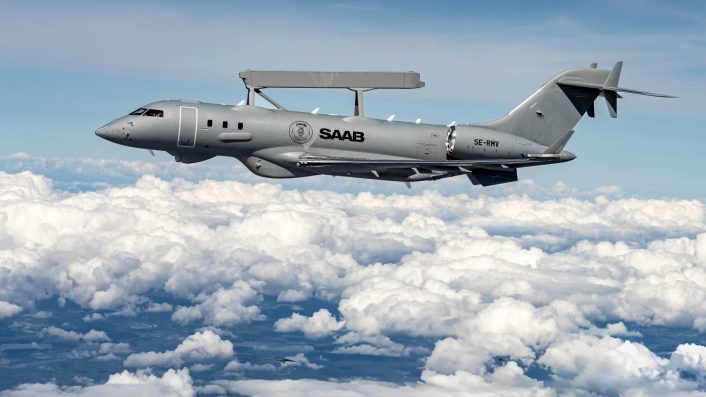
GlobalEye brings more than just radar. It’s packed with extras: FLIR electro-optical sensors, a belly-mounted Seaspray maritime radar, electronic support measures, and robust self-protection suites. The bizjet platform gives it impressive range—over 12,000 km—and endurance beyond 11 hours, with global deployment capability without refueling. Crew requirements are minimal—just five or six, thanks to heavy automation. And critically, it’s cheaper. A single GlobalEye costs roughly $300–400 million, meaning NATO could field two or even three for the price of one Wedgetail. More platforms mean more coverage, greater redundancy, and less risk if one goes down for maintenance.
The Dutch announcement made a pointed reference to “investing as much as possible in European industry,” a clear signal that transatlantic dependency is out, and alliance self-reliance is in. Saab, as a Swedish company, checks that box perfectly. And with France already on board, political momentum is building. Back when Saab competed for the UK contract, it even proposed a wild dual-array Erieye on an Airbus A330—two radar panels for true 360-degree tracking. That idea didn’t fly then, but with NATO now desperate for options, a Saab-Airbus partnership could resurface, especially if a larger airframe is needed for endurance or crew capacity.
Time, however, is not on anyone’s side. NATO wants initial operational capability by 2031 and full replacement by 2035. That means a decision needs to be locked in by mid-2026 at the latest. Rushing a clean-sheet design is out of the question, so the field narrows to proven, off-the-shelf systems. GlobalEye is flying today, integrating with Link 16, SATCOM, and modern fighter data links. It’s not a perfect match for the E-7’s raw power, but in a European theater where flight times are shorter and threats are more distributed, its agility, cost, and proliferation potential could be exactly what NATO needs.
For Boeing, this is a gut punch. The company was banking on NATO’s buy to stabilize the E-7 production line after the U.S. waffled. Now, with only Australia, South Korea, Turkey, and a limping UK program, the future looks uncertain. The two prototypes will still be built, and the USAF might end up with a small fleet if Congress keeps forcing the issue. But the dream of a global Wedgetail community? That’s grounded.
For NATO, the message is clear: airborne early warning isn’t going away—it’s evolving. The E-3 served brilliantly for decades, but the future belongs to flexible, resilient, and ideally European-built solutions. Whether it’s GlobalEye, a Saab-Airbus hybrid, or something else entirely, one thing is certain: the alliance’s next set of eyes in the sky will look very different from what anyone expected just two years ago.
About The Author