The Caribbean sky over the Venezuelan coastline is typically a corridor for commercial traffic and sun-seeking tourists, but on November 24, 2025, the atmosphere shifted dramatically as the unmistakable silhouette of American strategic airpower cast a long shadow over the region. In a move that observers have called one of the most aggressive demonstrations of U.S. military capability in the southern Caribbean in decades, a B-52H Stratofortress, the legendary heavy bomber of the U.S. Air Force, executed a highly visible patrol just miles from Venezuelan sovereign airspace. This wasn’t a solitary flight through international waters; the bomber was flanked by a lethal escort of U.S. Navy F/A-18 Super Hornets, creating a visual spectacle that was tracked by tens of thousands of aviation enthusiasts online and monitored with intense anxiety by the government in Caracas. The timing of this mission was far from coincidental, occurring merely hours after Washington formally designated the “Cartel de los Soles”—a network alleged to be deeply embedded within the Venezuelan state and military apparatus—as a foreign terrorist organization. This designation has fundamentally rewritten the legal and geopolitical rules of engagement between the two nations, turning a routine show of force into a potent symbol of a rapidly escalating pressure campaign that now blends counter-terrorism mandates with traditional gunboat diplomacy.
For aviation trackers and open-source intelligence analysts, the mission profile of the bomber, operating under the callsign PAPPY11, offered a fascinating glimpse into the mechanics of modern power projection. The journey began far to the north at Minot Air Force Base in North Dakota, home to the grim guardians of America’s nuclear triad. The aircraft sliced south across the continental United States and the Gulf of Mexico, running “dark” with its transponders off to mask its approach until it reached the Caribbean theater. It was there, north of the islands of Aruba and Curaçao, that the crew flipped the switch on their Mode S transponder, effectively lighting up civilian radar screens like a flare in the night. This deliberate return to visibility was a tactical choice designed to ensure the world—and specifically the regime of Nicolás Maduro—knew exactly who was knocking at the door. As the bomber banked toward the South American continent, it began a run that hugged the coastline, skirting the Paraguaná peninsula in Falcón state and threading the needle between the Venezuelan mainland and the offshore islands of La Orchila and La Tortuga. By the time PAPPY11 positioned itself near Maiquetía, the gateway to Caracas, it was clear that this was not just a navigation exercise; it was a message delivered at 50,000 feet.
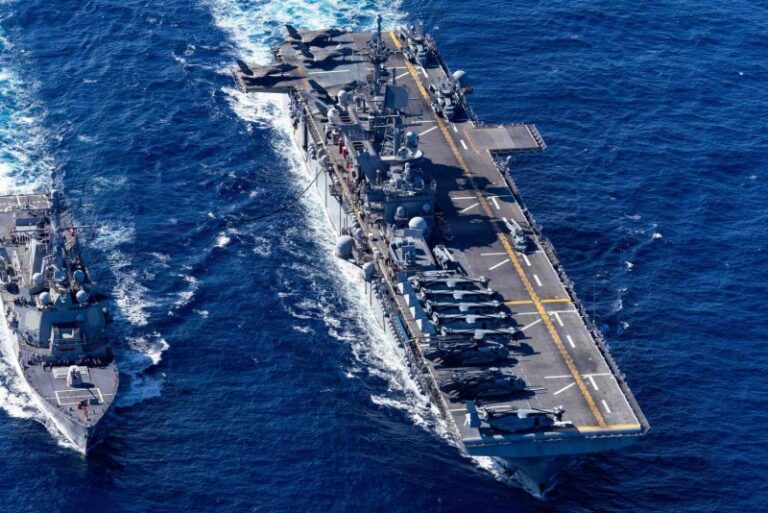
Flying tight on the bomber’s wing were the sharp shapes of F/A-18E/F Super Hornets, the workhorses of the U.S. Navy’s carrier air wings. Tracked under the callsign RHINO, these fighters weren’t operating from a distant land base but had launched from the flight deck of the USS Gerald R. Ford, the nuclear-powered supercarrier that had recently entered the U.S. Southern Command’s area of responsibility. The presence of the Ford’s air wing alongside an Air Force strategic bomber highlights a level of joint-service integration that is rarely seen outside of major conflict zones. It demonstrated the Pentagon’s ability to seamlessly layer different types of firepower, combining the intercontinental reach of the B-52 with the agile, tactical dominance of carrier-based aviation. For the pilots in the cockpits and the commanders back in the States, this was a validation of complex cross-domain tactics, testing communications and refueling logistics in a real-world environment. For the Venezuelan military operators watching their radar scopes light up, it was a stark reminder of the overwhelming technological gap they face, forcing them to activate air defense systems and unwittingly provide U.S. electronic warfare officers with valuable data on their frequencies and reaction times.
The digital footprint of the mission was nearly as significant as the physical one. On Flightradar24, one of the world’s most popular flight tracking platforms, the cluster of U.S. military assets quickly rose to the top of the “most tracked” list. At the peak of the operation, over 70,000 users were glued to their screens, watching the digital icons of the B-52 and its escorts trace a line along the Venezuelan coast. The visual on the screen told a compelling story: while the military formation pressed forward, Venezuelan civil airspace was eerily empty, devoid of the usual private traffic, leaving the U.S. aircraft as the sole masters of the northern coastline. This transparency, facilitated by the deliberate use of transponders, is a modern form of psychological warfare. It amplifies the political signaling at zero additional cost, allowing the global public to witness the encirclement of the Venezuelan regime in real time. The mission eventually concluded as the formation turned north of Margarita Island, heading back toward the open ocean and vanishing from public tracking feeds as they went “dark” once again, leaving behind a rattled region and a bevy of unanswered questions about what comes next.
However, the hardware flying overhead is only half the story; the political context on the ground provides the explosive fuel for this fire. The decision by the U.S. government to label the Cartel de los Soles as a Foreign Terrorist Organization (FTO) just hours before the engines roared over the Caribbean changes the complexion of the entire standoff. Operation Southern Spear, the umbrella name for this surge in regional activity, is no longer just about counternarcotics or diplomatic disapproval; it is now framed within the context of the Global War on Terror. By designating the state-linked cartel as terrorists, Washington has unlocked a new suite of legal authorities and aggressive options, signaling to Maduro’s inner circle that the shield of sovereignty may no longer protect them from direct action. The B-52 flight, therefore, serves as the physical manifestation of this new legal reality. It suggests that the U.S. is prepared to back up its court filings and sanctions with high-end kinetic capabilities if the situation deteriorates further.
This escalation has not occurred in a vacuum. The weeks leading up to the November 24 sortie saw a steady rhythm of military buildup that has turned the Caribbean into a congested theater of operations. Earlier in the month, B-1B Lancer bombers and F-35B stealth fighters had conducted similar presence patrols, while the massive USS Gerald R. Ford carrier strike group arrived to anchor the naval component of the strategy. Western media outlets and regional news channels like NTN24 have reported a heavy rotation of aircraft through Puerto Rico’s former Roosevelt Roads Naval Station, suggesting that logistics hubs are being reactivated for sustained operations. In response, the Venezuelan armed forces have mobilized troops and placed Russian-made Buk-M2E missile batteries on high alert, creating a hair-trigger environment where a single miscalculation could lead to disaster. The Federal Aviation Administration (FAA) has taken note of this volatility, issuing Notices to Air Missions (NOTAMs) warning civil operators of “heightened military activity” and GPS interference in the region. This electronic fog of war, where navigation signals are jammed or spoofed, poses a tangible risk to commercial airliners, further isolating Venezuela as insurers and airlines reassess the safety of flying near the conflict zone.
Ultimately, the November 24 mission was a masterclass in strategic signaling, designed to be ambiguous enough to avoid immediate war but clear enough to convey imminent threat. For the United States, utilizing a bomber airframe that has been in service since the 1950s alongside the newest carrier technology symbolizes a commitment that spans generations and domains. It tells adversaries that the U.S. can strike from anywhere, at any time, with overwhelming force. For the nations of the Caribbean and South America, the episode is a sobering indication that their region is once again becoming a chessboard for great-power competition. As the B-52 returned to Minot and the F-18s trapped back aboard the Ford, the message remained hanging in the humid air over Caracas: the margin for error has narrowed, the legal gloves have come off, and the roar of engines over the coastline may be the prelude to a much louder, more destructive storm if the political deadlock does not break.
About The Author