The transformation of the Polish Armed Forces is moving rapidly from bureaucratic approvals to the arrival of genuine, high-end firepower on the tarmac. In a significant move that solidifies Warsaw’s commitment to securing NATO’s Eastern Flank, Deputy Prime Minister and Defence Minister Władysław Kosiniak-Kamysz confirmed on November 27 that the government has officially signed a contract valued at approximately 500 million dollars to acquire the AIM-120D-3 Advanced Medium-Range Air-to-Air Missiles (AMRAAM). This procurement is not merely a purchase of munitions but a strategic leap forward, equipping Poland’s incoming fleet of F-35A Lightning II “Husarz” jets and its modernized F-16C/D “Jastrząb” fighters with one of the most sophisticated air-to-air weapons currently available in the transatlantic arsenal. The deal follows a crucial approval granted by the U.S. State Department back in the spring, which cleared the path for a potential Foreign Military Sale worth up to 1.33 billion dollars for as many as 400 of these missiles. While that initial authorization set the ceiling, this 500 million dollar agreement marks the concrete beginning of deliveries, positioning RTX—formerly Raytheon—in Tucson, Arizona, as the prime contractor responsible for supplying the hardware that will define Polish air superiority for decades to come.
This contract represents a massive upgrade in capability, moving beyond the older variants of the AMRAAM that Polish pilots have utilized for years. The AIM-120D-3 is the pinnacle of the AMRAAM family, developed under the rigorous Form, Fit, Function Refresh (F3R) program. To the casual observer, it might look like its predecessors, but internally, it is a completely different animal. It boasts a thoroughly redesigned electronic architecture, featuring new circuit cards and the advanced System Improvement Program-3F (SIP-3F) software suite. These technical enhancements translate into terrifying effectiveness in the skies; while earlier models like the C-5 or C-7 had an engagement envelope of roughly 105 to 120 kilometers, the D-3 variant pushes that reach to between 160 and 180 kilometers. This range extension relies on the aircraft’s altitude and speed, but practically speaking, it allows Polish pilots to threaten hostile aircraft from significantly greater standoff distances. The missile retains a top speed nearing Mach 4 and utilizes a sophisticated guidance system that blends inertial navigation with GPS updates and a two-way data link, ensuring that the weapon can be redirected or refined in mid-flight before its active radar seeker takes over for the terminal kill. With a 20-kilogram fragmentation warhead optimized by proximity sensors, the missile is designed to obliterate everything from maneuvering fighter jets to low-flying cruise missiles.
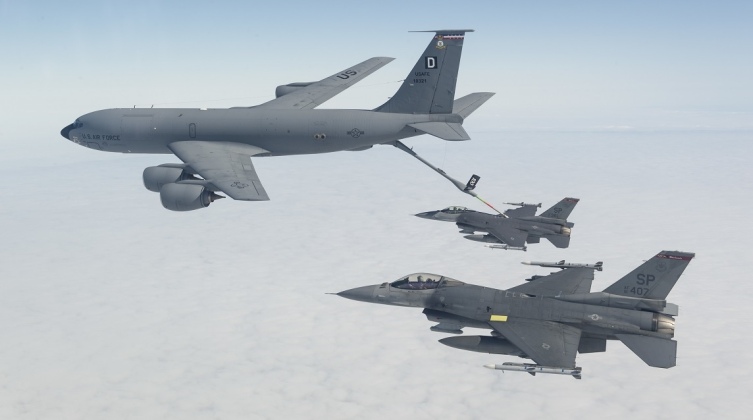
The timing of this acquisition is perfectly synchronized with the modernization of Poland’s fighter fleet. Poland has already committed 4.6 billion dollars to purchase 32 F-35A Lightning II aircraft, a deal signed in January 2020 that also includes 33 Pratt & Whitney F135 engines and extensive training packages. While the physical aircraft have begun rolling off assembly lines, they haven’t flown directly to Warsaw; instead, the first Polish F-35s were delivered to Ebbing Air National Guard Base in Arkansas in late 2024. This detachment allows Polish pilots and ground crews to master the platform in the United States, with the first Polish pilot taking to the skies in the Husarz in January 2025. The plan is for these fifth-generation fighters to touch down on Polish soil starting in 2026, initially deploying to the 32nd Tactical Air Base at Łask and subsequently to the 21st Tactical Air Base at Świdwin. By securing the AIM-120D-3 now, Warsaw ensures that when these stealth fighters arrive, they will be armed with a missile capable of fully exploiting the F-35’s advanced sensor suite.
The synergy between the F-35 and the AIM-120D-3 fundamentally alters the tactical geometry of air defense in Central Europe. The F-35 is not just a fighter; it is a flying data center, utilizing its active electronically scanned array (AESA) radar and distributed infrared sensors to soak up information from the battlespace. It can detect, classify, and track targets long before they are aware of its presence. When paired with the extended range of the AIM-120D-3, the F-35 can act as a forward-deployed stealth observer, slipping inside contested airspace to identify targets and then guiding missiles fired either from its own internal bays or from non-stealthy platforms like the F-16 flying safely behind it. This cooperative engagement capability means that a Russian Sukhoi or a cruise missile could be engaged by an F-16 Jastrząb based on targeting data silently beamed from an F-35 Husarz, creating a “silent sniper” scenario that is incredibly difficult for adversaries to counter. Furthermore, the F-16 fleet itself is undergoing a 3.8 billion dollar modernization to ensure it can keep up with these network-centric demands, bridging the gap between fourth and fifth-generation warfare.
Beyond the immediate tactical advantages, this purchase is a clear signal of Poland’s geopolitical trajectory and its intent to serve as a military heavyweight within NATO. With defense spending approaching 5 percent of its GDP, Warsaw is aggressively pursuing a multi-domain modernization strategy that includes M1A2 Abrams tanks, Apache helicopters, and integrated air defense systems. The AIM-120D-3 fits neatly into this puzzle, as it is also compatible with ground-based launchers like the NASAMS, offering the potential for a streamlined logistics chain where the same missile family protects the skies from both the air and the ground. By standardizing on this advanced munition, Poland aligns itself closely with key allies like Finland, Germany, and the United States, all of whom are integrating the D-3 variant. For Russian military planners, this development introduces a severe constraint on operations over the Baltic Sea and near NATO borders, as the airspace is now contested by a combination of stealth technology and long-range ballistics that Soviet-era legacy systems will struggle to match. Ultimately, the 500 million dollar investment announced by Minister Kosiniak-Kamysz is more than just a transaction; it is a definitive step toward a fully interoperable, high-tech NATO defense posture on the continent’s eastern frontier.
About The Author