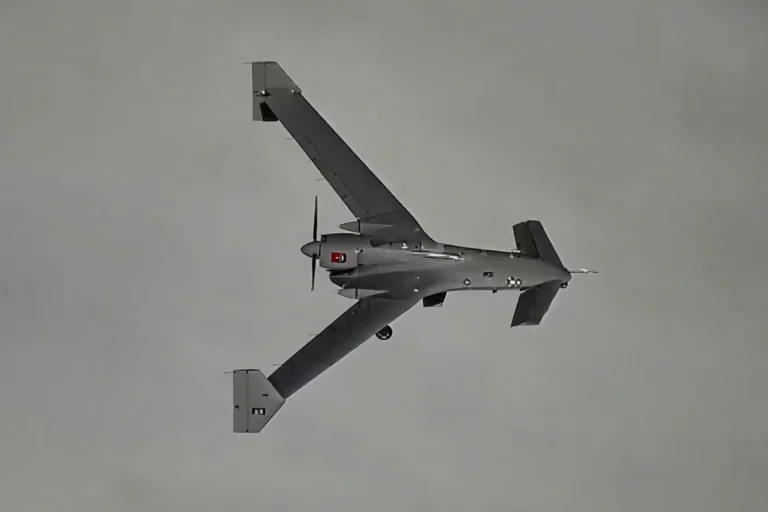
The People’s Liberation Army Air Force just dropped a jaw-dropping microfilm for its 76th anniversary, and the star of the show is the elusive GJ-11 Sharp Sword unmanned combat drone flying right alongside the mighty J-20 stealth fighter and a J-16D electronic warfare jet. This isn’t some CGI fantasy – it’s the first real public footage of an operational GJ-11 in action with these crewed beasts, hinting at China’s rapid push into manned-unmanned teaming that’s got military watchers buzzing.
Titled “Far-Reaching Dreams,” the short video kicks off with the GJ-11, callsign Xuanlong 08 (that’s “Mysterious Dragon” for the uninitiated), getting towed out of a hangar like it’s ready for business. Cut to takeoff, and suddenly we’re in the skies where Xuanlong 08 slots into formation with a J-20 dubbed Weilong 01 (“Mighty Dragon”) and the J-16D. The audio crackles with realism: a controller chimes in, “Weilong 01, Xuanlong 08 has arrived at position 6,” and the J-20 pilot coolly responds, “Weilong 01 received, cooperation with Xuanlong established.” It’s the kind of seamless coordination that screams future warfare.
What’s wild here is that this is a standard single-seat J-20 doing the dance – not the twin-seat J-20S variant everyone figured would handle the heavy lifting for MUM-T (that’s manned-unmanned teaming for short). We’ve seen graphics and older clips from 2022 on CCTV-7 showing the J-20S bossing around three GJ-11 “loyal wingmen,” but this fresh clip proves even the solo-pilot fifth-gen fighters like the J-20A or upcoming J-35A can play ball with drones. Sure, it’s mostly formation flying on display, no fancy mid-air data swaps or weapon handoffs, but it’s a clear signal: China’s not waiting for special variants to make this tech operational.
Diving deeper into the GJ-11 itself, this flying-wing wonder from Hongdu Aviation Industry Group (under the AVIC umbrella) has been shrouded in secrecy since its first flight back in 2013. It didn’t even go public until the 2019 National Day Parade in Beijing, where it rolled out as a symbol of China’s stealth ambitions. Think Dassault nEUROn or Russia’s S-70 Okhotnik-B – same low-observable vibe with internal weapons bays, radar-absorbent materials, and a shrouded exhaust to dodge heat-seeking missiles. It’s built for punching through contested airspace on strike or recon missions, and while exact specs are locked tighter than a vault, it’s been operational for years now.
This anniversary reveal marks the debut of actual flight footage for an in-service GJ-11, complete with those parade stripes on the J-20 from the September 3, 2025, event marking WWII’s 80th end. A mockup showed up there too, but nothing beats the real deal soaring. And get this: a naval version, the GJ-21, is already in testing for carrier ops on beasts like the Type 076, with sea trials slated for early 2026. China’s drone game is evolving fast, with more flying-wing UCAVs popping up across their lineup.
Over in the West, the U.S. Air Force is chasing similar dreams with their Collaborative Combat Aircraft program, pouring cash into General Atomics’ YFQ-42 and Anduril’s YFQ-44 as loyal wingmen for fighters. Lockheed Martin’s Vectis and Shield AI’s X-BAT could join the party later. But China’s clip feels like a flex – they’re not just talking MUM-T; they’re showing it with hardware that’s already flying missions.
Whether the GJ-11 was autonomous until the J-20 linked up or ground-controlled the whole time remains a mystery, adding to the intrigue. One thing’s clear: this integration of stealthy drones with fifth-gen fighters is reshaping air power, and China’s PLAAF is leading the charge in public demos. As tensions simmer in the Indo-Pacific, expect more of these “dreams” to turn into battlefield realities.
About The Author