The heat inside the exhibition halls at EDEX 2025 was palpable, but the real temperature was rising in the negotiation rooms where the future of Egypt’s tactical aviation was being decided. On the opening day of Cairo’s premier defense expo, Korea Aerospace Industries (KAI) made a move that was less about selling a product and more about proposing a partnership. They formally unveiled a comprehensive pitch for the FA-50 light fighter, framing the aircraft not merely as a piece of hardware, but as a catalyst for Egypt’s industrial ambitions. The offer is bold: a fleet of cost-efficient multirole jets backed by a substantial technology transfer package that would see the iconic “Made in Korea” stamp eventually replaced by “Assembled in Helwan.”
At its core, the FA-50 is a study in pragmatic evolution. Derived from the T-50 Golden Eagle supersonic trainer, the aircraft has shed its training wheels to become a genuine combat asset. Powered by a single General Electric F404 engine—the same reliable powerplant found in the legacy F/A-18 Hornet—the jet pushes roughly 17,700 pounds of thrust. This gives it a top speed touching Mach 1.5 and a service ceiling north of 50,000 feet. For the Egyptian Air Force, however, the most attractive spec isn’t the speed; it is the lineage. The FA-50 shares approximately 70% commonality with the F-16 Fighting Falcon. For a nation that has operated the Viper for decades, this translates to massive savings in logistics, pilot conversion training, and ground crew certification. It is, in essence, a “Baby Viper” that speaks the same language as the backbone of Egypt’s current fleet.
But KAI knows that nostalgia doesn’t win contracts; firepower does. The variant pitched to Cairo is armed to the teeth. Internal to the airframe is a three-barrel 20mm M197 cannon for close-in work, but the real lethality hangs off the seven external hardpoints. The jet is cleared for AIM-9 infrared missiles for dogfights and, crucially, the AIM-120 AMRAAM for beyond-visual-range engagements—a capability that elevates it from a nuisance to a genuine threat against hostile aircraft. For ground pounding, it carries a heavy loadout ranging from AGM-65 Mavericks and 70mm rocket pods to the sophisticated CBU-105 Sensor Fuzed Weapons. Perhaps most importantly for modern warfare, it integrates the full family of JDAM, JDAM-ER, and SPICE precision-guided bombs, targeted via advanced Sniper or Litening pods.
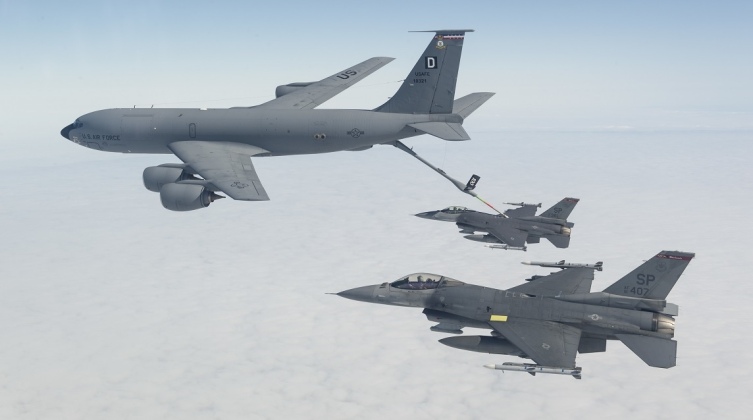
The configuration offered to Egypt mirrors the high-end FA-50PL standard recently purchased by Poland. This “Block 20” setup is a quantum leap over earlier models. It features the Raytheon PhantomStrike AESA radar, which provides vastly superior detection ranges and resistance to jamming compared to older mechanical sets. It also includes Link 16 datalinks for network-centric warfare, an air-to-air refueling probe to extend loiter time, and integration with modern high-off-boresight helmet-mounted sights. This suite gives the compact jet an all-weather strike capability that rivals much heavier, more expensive fighters, but at a fraction of the cost per flight hour.
KAI is selling Egypt on a “Three-Tier” operational concept that maximizes fleet efficiency. In peacetime, the FA-50 serves as the ultimate lead-in fighter trainer, bridging the gap between basic props and complex Rafales or F-16s. In times of heightened tension, it acts as a homeland defense interceptor, scrambling to protect key infrastructure with AMRAAMs while freeing up high-end air superiority fighters for deep strike missions. Finally, in a sustained conflict, it becomes a “bomb truck” workhorse, delivering cheap GPS-guided munitions against insurgent positions or armored columns in medium-threat environments, protected by its own electronic countermeasures and radar warning receivers. It is a model that has already been proven in the Philippines, Iraq, and Indonesia.
However, the clincher for Cairo likely isn’t what happens in the sky, but what happens on the ground. The deal under negotiation involves up to 100 aircraft. While the initial batch would arrive from South Korea to meet immediate needs, the plan calls for the bulk of the fleet—roughly 70 jets—to be assembled locally at the Arab Organization for Industrialization (AOI) complex in Helwan. KAI is offering a deep technology transfer that covers structural assembly, systems integration, and eventually depot-level maintenance. Both Seoul and Cairo are openly discussing Helwan becoming an export hub, supplying African and Arab neighbors with Egyptian-assembled FA-50s, building on AOI’s legacy of producing Alpha Jets and K-8E trainers.
This places the FA-50 in a fierce gladiatorial arena against other light fighters. It faces the Italian Leonardo M-346FA, a capable jet but one that lacks the FA-50’s supersonic speed and F-16 DNA. There is India’s Tejas Mk1A, which boasts impressive range and weaponry but suffers from a more complex supply chain and a lack of export history. Then there is the JF-17 Block III from Pakistan, a heavyweight in this class with its long-range PL-15 missiles and AESA radar. While the JF-17 is formidable, it carries political baggage for Arab partners who may be wary of shifting their strategic reliance too heavily toward Chinese technology standards.
Ultimately, the choice facing Egypt is strategic. The FA-50 offers a “Goldilocks” solution: a U.S.-compatible platform that integrates seamlessly with existing NATO-standard networks, carries proven Western weapons, and comes with a roadmap for industrial sovereignty. If the financing aligns and the technology transfer satisfies Egyptian demands, the FA-50 could transform from a visitor at EDEX 2025 to the new backbone of Arab air power, securing KAI’s position as the dominant player in the global light fighter market.
About The Author