In a groundbreaking development that underscores the deepening military ties between the United States and Iraq, the Iraqi Army Aviation Command has officially completed its acquisition of a full fleet of 15 Bell 505 Jet Ranger X helicopters. This milestone, achieved with the delivery of the final batch on October 16, 2025, marks a significant enhancement in Iraq’s aviation training capabilities, promising to revolutionize how the nation prepares its pilots for the challenges of modern warfare. The program not only bolsters Iraq’s defense infrastructure but also highlights the ongoing commitment to U.S.-Iraqi defense cooperation, a partnership that has evolved considerably since the post-2003 era. As regional tensions persist, including threats from remnants of ISIS and border security issues, this influx of advanced training aircraft arrives at a critical juncture, enabling Iraq to build a more self-reliant and professional air force.
The latest delivery, consisting of eight Bell 505 helicopters, took place at the Martyr Brigadier General Mohammed Alaa Air Base, as reported by the Iraqi News Agency (INA). This follows an initial shipment of seven aircraft in August 2024, bringing the total to 15. Iraqi officials, including Ministry of Defense spokesperson Maj. Gen. Tahseen al-Khafaji, have hailed the arrival as a “major boost” to the nation’s training infrastructure. The helicopters are set to form the cornerstone of pilot training at the Army Aviation College, where they will facilitate the development of a new generation of skilled aviators. In an era where aerial capabilities are paramount for reconnaissance, rapid response, and logistical support, this fleet represents a strategic investment in human capital, ensuring that Iraqi pilots are equipped with the tools to handle diverse operational scenarios.
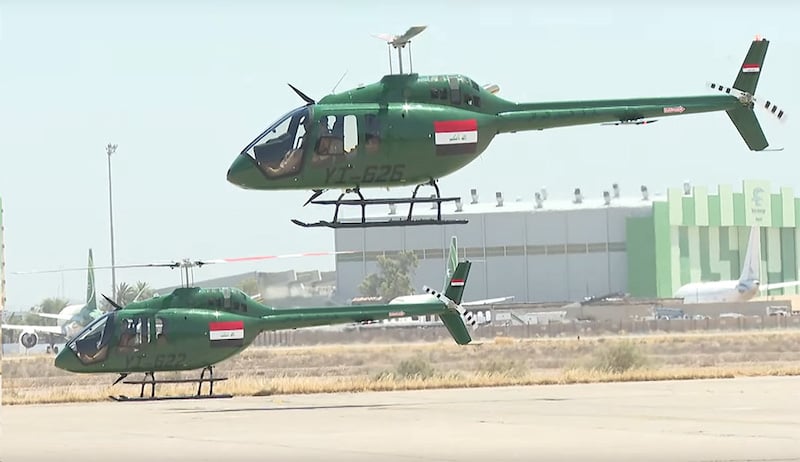
Iraqi Bell 505 helicopters in action during delivery.
At the heart of this program is the Bell 505 Jet Ranger X itself, a state-of-the-art light single-engine helicopter designed specifically for training, reconnaissance, and light utility roles. Powered by the reliable Safran Arrius 2R turboshaft engine, which delivers an impressive 505 shaft horsepower for takeoff, the aircraft incorporates dual-channel Full Authority Digital Engine Control (FADEC). This technology not only streamlines engine management but also significantly reduces the pilot’s workload, allowing trainees to focus on mastering flight fundamentals without the distractions of manual adjustments. The cockpit features the advanced Garmin G1000H integrated flight deck, complete with twin LCD screens, an Engine Indication and Crew Alerting System (EICAS), and a moving map display. This setup mirrors the avionics found in more sophisticated military platforms, providing a seamless transition for pilots advancing to larger helicopters or fixed-wing aircraft.
Performance-wise, the Bell 505 excels in versatility and efficiency. It boasts a typical cruise speed of around 125 knots, a practical range extending to approximately 300 nautical miles, and a service ceiling of nearly 18,600 feet. These specifications make it ideally suited for operations in Iraq’s varied terrain, from the arid deserts of the south to the mountainous regions in the north, where extreme temperatures and altitudes can pose significant challenges. The helicopter’s agile handling characteristics enable precise maneuvers, essential for training exercises such as confined-area landings, autorotations, and emergency procedures. Moreover, its ability to hover effectively both in and out of ground effect ensures reliability during pattern work and low-level operations, which are common in military training regimens.
One of the standout features for training purposes is the Bell 505’s configurable cabin. With seating for 1+4 (pilot plus four passengers), a flat cabin floor, and 18 cubic feet of baggage space, it allows for flexible setups including instructor-student-observer arrangements without the need for extensive modifications. This adaptability is crucial for progressive training, where instructors can guide students through various phases without logistical hurdles. The aircraft can also carry up to 2,295 pounds externally via a cargo hook, adding value for simulations involving sling loads or reconnaissance missions. Optional enhancements, such as Helicopter Terrain Awareness and Warning Systems (HTAWS) and synthetic vision technology, further elevate safety and situational awareness, aligning the Bell 505 with contemporary military standards. These features not only minimize risks during training but also keep operational costs manageable, making it an attractive choice for budget-conscious defense forces worldwide. Indeed, the Bell 505 has been adopted by several other militaries and law enforcement agencies for similar roles, attesting to its proven track record.
While the exact financial details of the helicopter purchase remain undisclosed by Baghdad, insights into the supporting ecosystem reveal a comprehensive U.S. commitment to Iraq’s rotary-wing capabilities. In late 2023, the U.S. State Department approved a potential $300 million Foreign Military Sales (FMS) package for contracted logistics support from Bell Helicopter. This was later formalized in a Federal Register notice, encompassing maintenance, spare parts, technical assistance, and field service representatives for a range of Bell platforms in Iraqi service. This includes not just the new 505s but also existing models like the Bell 407 variants, OH-58A/C Kiowa scouts, Bell 206B-3 JetRangers, and upgraded Huey II helicopters. Such integrated support ensures high fleet availability and longevity, critical for sustaining training operations over the long term.
Adding to this, earlier in October 2025, the U.S. Army announced an increase of $12.4 million to an existing contract for Bell 412EPX helicopters destined for Iraq. This adjustment signals a broader rotary-wing modernization effort, extending beyond mere training to encompass multi-role capabilities. The 412EPX, known for its robustness in transport and assault missions, complements the lighter 505 fleet, creating a layered aviation structure that can address everything from basic flight instruction to tactical deployments.
Final batch of Bell 505 Jet Ranger Xs arriving in Iraq.
The integration of the Bell 505 into Iraq’s Army Aviation Command establishes a structured pipeline for pilot development, from primary rotary-wing training to advanced tactical skills. Instructors can leverage the FADEC system’s protections to safely teach startup sequences, engine failures, and recovery techniques. As trainees progress, the glass cockpit facilitates instruction in instrument flying, navigation, night operations, and air-ground coordination. The helicopter’s agility and optional equipment, such as electro-optical/infrared (EO/IR) turrets, allow for realistic simulations of reconnaissance, medical evacuation (medevac), liaison duties, and convoy protection. Iraqi officials have positioned this fleet as a foundational step toward enhancing close air support integration, standardizing procedures that will benefit pilots transitioning to more advanced platforms like the Bell 407, 412, and the forthcoming Airbus H225M Caracals.
This acquisition fits into a larger narrative of Iraq’s defense strategy, which balances reliance on U.S. partnerships with diversification from other sources. In 2024, Iraq placed an order for 12 Airbus H225M multirole helicopters from Europe, aimed at expanding lift and assault capacities. Concurrently, engagements with NATO have intensified, with recent senior-level discussions focusing on institutional capacity building, knowledge exchange, and structured training programs. These efforts are particularly vital amid ongoing counter-ISIS operations, vulnerabilities along porous borders, and the imperative to professionalize the armed forces. The Bell 505 program, therefore, is not just about acquiring hardware; it’s about fostering a safer, more efficient training environment that maximizes the return on investment for high-end assets.
In essence, by completing this 15-aircraft fleet, Iraq is laying the groundwork for a resilient aviation force capable of meeting 21st-century demands. The collaboration with the U.S. through Bell Helicopter exemplifies how targeted investments in training can yield long-term security dividends, reducing dependency on foreign pilots and enhancing operational sovereignty. As the Middle East continues to navigate complex geopolitical dynamics, initiatives like this could prove pivotal in maintaining stability and deterrence.
About The Author