The deck of an aircraft carrier at night is often described as a ballet performed in a minefield, a high-stakes environment where precision meets raw power. On November 29, 2025, amidst the dark waters of the Indo-Pacific, that choreography took on a new and distinct form aboard the USS Tripoli. Under the amber glow of deck lighting, Aviation Boatswain’s Mate 2nd Class Arnitt Jones raised his wands to signal a Marine Corps F-35B Lightning II into position. The roar of the jet engine cutting through the humid sea air signaled more than just the launch of a routine sortie; it marked the operational maturity of a concept that is fundamentally reshaping American naval power in Asia.
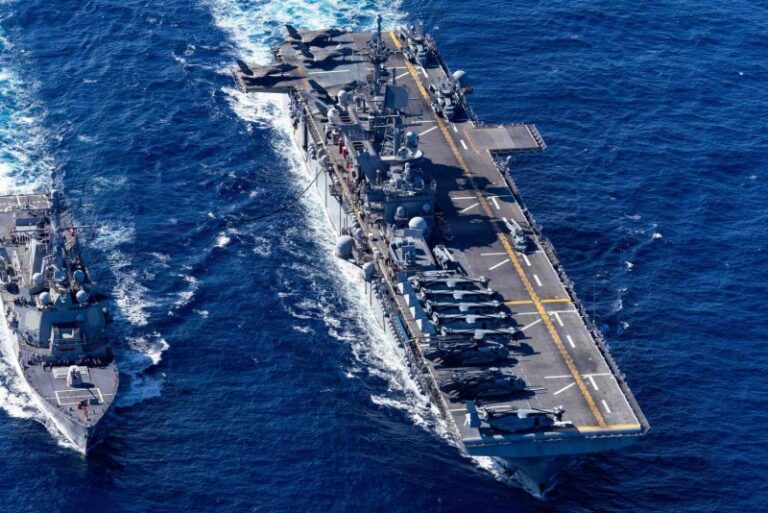
The USS Tripoli, an amphibious assault ship by classification but a small aircraft carrier in practice, was operating deep within the U.S. 7th Fleet area of operations. The aircraft belonged to Marine Fighter Attack Squadron 242 (VMFA-242), known as the “Bats.” Together, the ship and the squadron were demonstrating a capability that has moved swiftly from theoretical papers to the front lines: the “Lightning Carrier.” These nocturnal launches are not merely training exercises; they are the visible edge of a doctrinal shift designed to counter rising near-peer threats in the Pacific. By launching fifth-generation stealth fighters into the darkness from a platform other than a traditional nuclear supercarrier, the U.S. Navy is rewriting the rules of engagement.
To understand the significance of this event, one must look at the unique architecture of the USS Tripoli itself. Unlike traditional amphibious ships that feature a well deck at the waterline to launch hovercraft and landing boats, Tripoli was built with a singular focus on aviation. The well deck is gone. In its place, the ship boasts an enlarged hangar bay, expanded maintenance facilities, and significantly increased storage for aviation fuel and ordnance. This trade-off has transformed the vessel into a platform optimized for the F-35B, the short takeoff and vertical landing variant of the Joint Strike Fighter. In a surge configuration, Tripoli can embark around twenty of these advanced jets, effectively bringing the firepower of a light carrier to any flashpoint in the region.
The timing of these operations is critical. Having completed its transition to becoming a Japan-based forward-deployed asset in 2025, Tripoli has stepped into the role previously held by the USS America. The ship is now the primary big-deck amphibious platform in a region where the margin for error is razor-thin. The ability to conduct sustained night flight operations is a game-changer. Night ops complicate an adversary’s ability to track sortie rates and predict launch cycles. It denies the enemy the safety of darkness. When a ship like Tripoli can cycle stealth fighters around the clock, it maintains a persistent, lethal pressure that is difficult to counter.
This capability is the physical manifestation of “Distributed Maritime Operations,” a strategy the Navy has adopted to survive in the age of anti-access/area-denial (A2/AD) weapons. Military planners have long worried about the threat posed by China’s expanding arsenal of anti-ship ballistic missiles, such as the DF-21D and DF-26. Relying solely on massive, nuclear-powered aircraft carriers creates a concentration of risk—too many eggs in one very expensive basket. The Lightning Carrier concept mitigates this by dispersing airpower across multiple hulls. By placing fifth-generation fighters on amphibious assault ships, the U.S. multiplies its launch points, creating a dilemma for any potential adversary. A specialized ship like Tripoli, moving through the contested waters of the East or South China Seas, presents a mobile, elusive threat that is far harder to target than a static airbase.
The F-35B is the technological marvel that makes this strategy viable. Its unique ability to take off from Tripoli’s reinforced, heat-resistant flight deck in tight cycles allows it to operate where conventional fighters cannot. But the jet is more than just a striker; it is a flying sensor node. In the modern “kill web,” an F-35B launching at night does not just hunt targets; it absorbs data from the battlefield, fuses it, and transmits targeting solutions to Aegis destroyers, submarines, and land-based missile units like HIMARS. A single pilot flying a night sortie from Tripoli can effectively light up the battlespace for the entire joint force, providing situational awareness that was previously unimaginable.
VMFA-242’s integration with the ship highlights the seamless bond between the Navy and Marine Corps in this new era. The squadron, which achieved full operational capability in 2022, has spent years honing its skills in major exercises like Red Flag and Resolute Dragon. Their ability to operate from the austere, shorter deck of an amphibious ship at night proves that the F-35B is not just a boutique capability but a reliable workhorse. This reliability reassures allies such as Japan that the U.S. commitment to the region is backed by adaptable, cutting-edge hardware capable of operating in the most demanding conditions.
Strategically, the message sent by these night operations is unambiguous. In a potential crisis scenario, perhaps along the First Island Chain or surrounding Taiwan, a commander would not have to wait for a supercarrier strike group to arrive from Pearl Harbor or San Diego. The forward-deployed Tripoli, capable of launching stealth strikes, offers an immediate, flexible option for escalation control. It provides a way to project power without necessarily committing the full weight of a nuclear carrier, offering a middle ground that is both potent and survivable.
As the image of Aviation Boatswain’s Mate Jones signaling that jet into the pitch-black sky circulates through defense circles, it serves as a testament to a new reality. The era of the Lightning Carrier has arrived. It is no longer an experiment; it is a fully operational, night-capable instrument of power projection. In the vast, contested expanse of the Indo-Pacific, the USS Tripoli and its wing of F-35Bs stand as a warning that the U.S. Navy has evolved, becoming more dispersed, more elusive, and more dangerous in the dark.
About The Author