In the world of military aviation, where alliances can shift faster than a drone’s flight path, the latest news from Italy and Turkey feels like a game-changer. On November 5, 2025, during its third-quarter results presentation, Leonardo—the Italian aerospace giant—laid out some ambitious plans for a joint venture called LBA Systems. Teaming up with Turkey’s Baykar, they’re gearing up to produce some of the most talked-about unmanned combat aerial vehicles (UCAVs) right in the heart of Europe: the Bayraktar TB2, TB3, Akinci, and Kizilelma. This isn’t just about building drones; it’s a strategic fusion of Turkish ingenuity and Italian precision, aimed at dominating the European and global markets for next-gen unmanned tech.
Picture this: factories humming in three distinct Italian regions, each cranking out pieces of these stealthy, smart machines. It’s a move that’s got defense analysts buzzing, especially as Europe ramps up its push for autonomous systems amid rising geopolitical tensions. Let’s break it down—what these drones are, where they’ll be made, and why this partnership could redefine the future of aerial warfare.
The backbone of this operation is LBA Systems, a collaboration born from a March 2025 press conference where Baykar’s CEO Haluk Bayraktar and Leonardo’s Roberto Cingolani hinted at big things. Back then, they dropped subtle nods about customizing Baykar’s heavy-hitters like the Kizilelma and Akinci for European tastes. Fast forward to now, and Leonardo’s Q3 report spells it out: production sites locked in, regulatory hurdles in the works, and a clear eye on exports. This JV slots right into Leonardo’s “Large Scale Initiatives,” rubbing shoulders with heavyweights like the Leonardo-Rheinmetall military vehicles project and the Global Combat Air Programme (GCAP). It’s clear—Italy’s betting big on drones as the next frontier.
So, where’s all this manufacturing magic happening? Leonardo’s mapped out three key spots, each playing to regional strengths. Down in the sunny southeast, the Grottaglie plant—already a pro at crafting composite fuselage sections for Boeing’s 787 Dreamliner—will handle the composite manufacturing for the Kizilelma. This high-tech facility is perfect for the intricate, lightweight materials that make stealth drones tick. Up north in the Friuli Venezia Giulia region, Ronchi dei Legionari will be the hub for building and final assembly of the TB3, with a nod to reviving Leonardo’s own Mirach platform. And over on the northwest coast in Liguria, Villanova d’Albenga—a facility Baykar snapped up from the old Piaggio Aerospace—will focus on final assembly for the Akinci and the trusty TB2.
But it’s not all about assembly lines. Leonardo’s throwing in support infrastructure too. Turin, that engineering powerhouse, will lead on R&D, innovation, and certification, ensuring these birds meet Europe’s stringent safety and performance standards. Meanwhile, a site in Rome will dive into “multi-domain technologies,” blending drones with everything from space tech to AI-driven command systems. Cingolani called Ronchi a potential “cash-cow” for this drone category, and with good reason—these setups could pump out units for NATO allies and beyond, all while creating jobs and tech transfer in Italy.
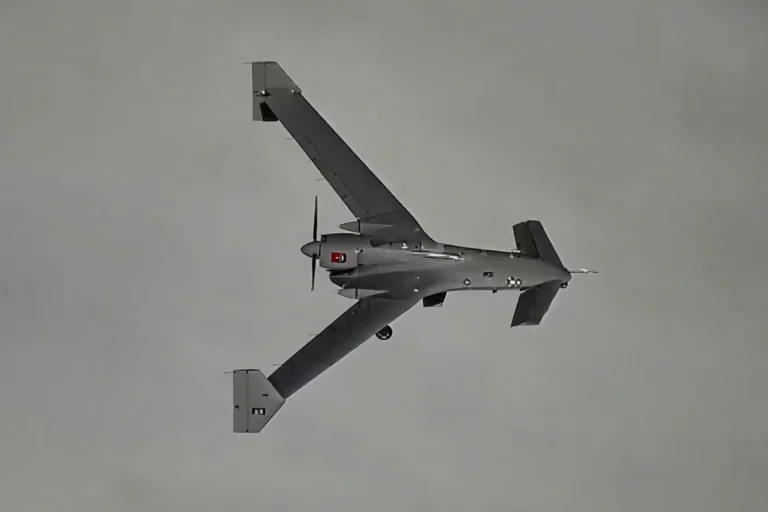
To really appreciate the stakes, you need to know these drones inside out. They’re not just toys; they’re proven battlefield game-changers. Start with the Bayraktar TB2, the poster child of modern drone warfare. This medium-altitude long-endurance (MALE) tactical UCAV has racked up over a million flight hours since entering service in 2014, serving everyone from the Turkish Armed Forces to Ukraine and Azerbaijan. Weighing in at a max takeoff weight (MTOW) of 700 kg, it cruises at altitudes up to 25,000 feet for 27 hours straight, packing a 150 kg payload of smart munitions like the MAM-L laser-guided missiles. It’s got triple-redundant avionics for autonomous ops, from taxiing to combat strikes, and it’s battle-tested in everything from ISR (intelligence, surveillance, reconnaissance) to precision attacks. Exports? Over 30 countries on the list, with recent nods from places like Kuwait and Japan.
Then there’s the TB3, the naval sibling stepping up the game for carrier ops. Unveiled in 2020, this beast is designed for short-runway takeoffs and landings on ships like Turkey’s TCG Anadolu. With folding wings, a reinforced landing gear, and a domestic engine pushing it to 130 km/h in tests, the TB3 boasts a 1,450 kg MTOW, 24-hour endurance, and six weapon stations for heavier loads than its TB2 predecessor. It’s got SATCOM for beyond-line-of-sight control, making it ideal for maritime strikes or overseas assaults. Baykar’s already eyeing integrations with Asian carriers, like Japan’s Izumo-class, proving its global appeal.
Bumping up the scale is the Akinci, a high-altitude long-endurance (HALE) powerhouse that punches like a fighter jet. Entered service in 2021, it tips the scales at 4,500 kg MTOW (up to 6,000 kg for the B variant), with two turbodiesel engines giving it 24+ hours aloft at 40,000 feet. Dual AI avionics handle real-time sensor fusion, and it’s loaded for bear: up to 1,350 kg payload across nine hardpoints, including SOM cruise missiles, MAM smart bombs, and even air-to-air options. Recent feats? A 20-hour flight crossing three countries, and live fires with LGK-82 guided kits. Exports are rolling—Indonesia just signed for nine with joint production—and it’s eyeing roles in electronic warfare and strategic strikes.
The crown jewel, though, is the Kizilelma—Baykar’s stealthy, jet-powered UCAV that’s straight out of sci-fi. Still in prototyping (PT-5 just flew with the MURAD-100A AESA radar boasting 200 km detection), it’s a low-observable beast with internal weapons bays for Gökdoğan BVR missiles and TEBER-82 bombs. Powered by turbofans like the AI-25TLT for subsonic speeds (future variants hit supersonic), it has a 35,000-foot ceiling, five-hour endurance, and carrier-capable design. Recent demos? Live bomb drops in October 2025 and EOTS integration for precision targeting. As Baykar’s CTO Selçuk Bayraktar puts it, it’s a “universal adjunct fighter” ready to team with manned jets like Turkey’s Kaan or Europe’s GCAP platforms.
Tying into this is Leonardo’s Mirach 100/5, the “high-performance reusable aerial target” that’s getting a revival. This subsonic (up to 900 km/h) drone simulates threats for training, with a 330 kg MTOW, 90-minute endurance, and 70 kg payload across five points. It handles 8g instantaneous loads, tows sub-targets, and feeds real-time data for missile quals—like Italy’s SAMP/T and Aster systems. Cingolani quipped it flies “more like a missile than a standard drone,” and the V2 upgrade adds new engines and avionics for longevity. In the LBA mix, it could evolve into hybrid training/strike tools.
At its heart, this partnership is about synergy. Baykar brings drone design prowess—affordable, combat-proven platforms—while Leonardo layers on European avionics, sensor fusion, C4I systems, and certification know-how. The result? “Europeanized” UCAVs tailored for NATO, with stealthy integrations like Leonardo payloads on the Kizilelma for collaborative combat aircraft (CCA) roles. Imagine a Kizilelma wingman to Eurofighter Tranche 5, denying airspace with AAMs or providing persistent AEW&C. It’s not just tech; it’s a template echoing the Turkish Aerospace-BAE Systems tie-up, pooling resources to meet exploding demand for loyal wingmen.
Regulatory green lights are the next hurdle—Leonardo’s pushing hard with Italian authorities, including the Ministry of Defence. Cingolani’s optimistic: “As soon as issues are fixed, next year we’ll deliver the first products.” Upgrades at Villanova are underway, blending Piaggio’s legacy with Baykar’s vision. And with space tech on the horizon, this could spill into satellite-linked swarms.
Why now? Europe’s waking up to drone dominance—Ukraine’s shown what TB2s can do against tanks, and threats from the East demand affordable autonomy. For Turkey, it’s export gold; for Italy, industrial revival and strategic depth. LBA Systems isn’t just building drones—it’s forging a transcontinental powerhouse, one composite panel at a time. Keep an eye on 2026; that’s when we might see the first Italian-made Kizilelma slicing the skies
About The Author