The U.S. Air Force’s Alaskan Command conducted a high-intensity joint force simulation in the Gulf of Alaska on December 9 under Operation TUNDRA MERLIN, featuring F-35A fighter jet operations. The exercise evaluated precision maritime strike coordination and underscored the role of fifth-generation aircraft in strengthening U.S. homeland defense across the Arctic.
U.S. Air Force Alaskan Command, operating under U.S. Northern Command, conducted a high-intensity joint force simulation in the Gulf of Alaska on December 9, 2025, as part of Operation TUNDRA MERLIN, according to a Department of War release. The exercise integrated F-35A Lightning II fighter jets into precision maritime strike scenarios, validating joint command-and-control performance, combat readiness, and Arctic operational reliability.
Operation TUNDRA MERLIN focused on multi-domain coordination across air and maritime forces, in partnership with U.S. Strategic Command, U.S. Indo-Pacific Command, the U.S. Coast Guard Arctic District, and the Alaska Air National Guard. The scenario used real Arctic weather conditions to simulate standoff strikes against hostile maritime targets, highlighting rapid cross-command control handovers, persistent endurance, and integrated strike sequencing.
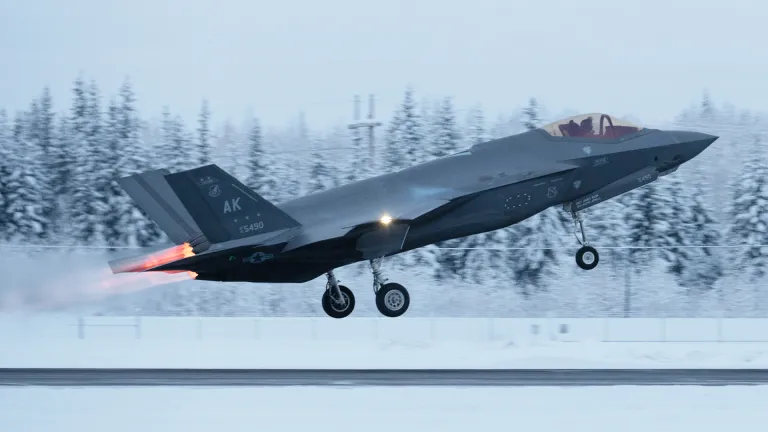
The participation of F-35A Lightning II jets from the 354th Fighter Wing demonstrated the tactical adaptability of fifth-generation aircraft in sub-zero temperatures. Equipped with advanced thermal management, specialized fuel systems, and internal de-icing capabilities, the F-35 maintained full mission performance. Its composite airframe reduced cold-weather stress, while its sensor fusion, low-observable design, and multi-spectral targeting systems provided decisive advantages in visibility-restricted, radar-challenged Arctic environments.
Operating from Eielson Air Force Base, F-35s conducted escort missions and combat air patrols supporting two B-52 Stratofortress bombers executing long-range simulated maritime strikes. The fighters also integrated into the targeting and threat-identification loop using Distributed Aperture and Electro-Optical Targeting Systems, sharing real-time data across platforms in a region where satellite and radar access is limited. The jets were additionally evaluated for rapid sortie generation under Arctic ramp conditions, where ice, wind chill, and mechanical stress create operational hazards.
Alaska’s strategic geography continues to anchor U.S. power projection and homeland defense. Located between the Asia-Pacific and Arctic regions, the state provides direct access to the Western Pacific and the Northern Approaches to North America. The Alaskan Theater of Operations hosts critical early-warning radars, missile-defense nodes, and the North Warning System. Growing Russian and Chinese naval activity in the Bering Sea and Arctic Circle has increased the importance of exercises like TUNDRA MERLIN to test real-world interdiction, surveillance, and joint command execution in one of the world’s harshest environments.
Simulated targeting support for the bomber missions was provided by U.S. Navy elements and the U.S. Coast Guard Cutter Kimball, while KC-135 Stratotankers from the 168th Wing conducted aerial refueling. An HC-130J Combat King II aircraft maintained personnel-recovery readiness. The 611th Air Operations Center controlled the exercise before passing bomber command to the 613th AOC under USINDOPACOM, demonstrating seamless interoperability across combatant command boundaries.
With diminishing Arctic sea ice opening new maritime corridors and foreign military presence expanding, Operation TUNDRA MERLIN reflects a shift in U.S. defense posture. The Arctic is now viewed as a forward-operating domain requiring continual vigilance, integrated deterrence, and rapid response capability. The exercise served as both a validation of joint interoperability and a rehearsal for future conflict scenarios involving Arctic maritime incursions. As Alaska becomes an increasingly vital launch point for U.S. power projection across hemispheres, Arctic readiness is emerging as a cornerstone of homeland defense strategy.
About The Author