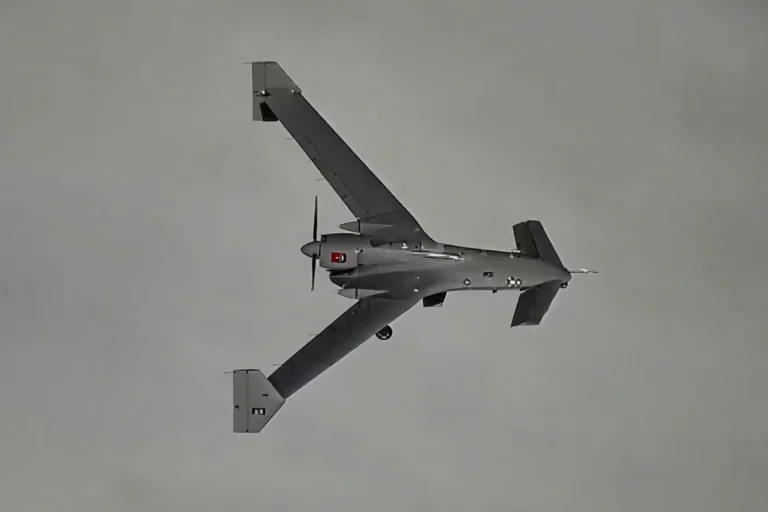
In a groundbreaking development that’s set to reshape the European defense landscape, Italian aerospace giant Leonardo has unveiled ambitious plans to team up with Turkish drone manufacturer Baykar for co-producing a range of unmanned aerial vehicles (UAVs) right on Italian soil. Announced during Leonardo’s third-quarter and nine-month 2025 results presentation on November 5, 2025, this collaboration involves setting up final assembly lines for several of Baykar’s flagship models, including the TB2, TB3, Akinci, and the cutting-edge jet-powered Kizilelma combat drone. Through their joint venture called LBA Systems, the two companies aim to create a robust EU-based supply chain, blending Baykar’s battle-tested drone technology with Leonardo’s expertise in European certification, sensor integration, and advanced weaponry. This isn’t just about building drones—it’s about forging a new era of accessible, compliant, and export-ready unmanned systems for Europe and beyond.
The partnership comes at a pivotal time when demand for UAVs is skyrocketing, driven by ongoing global conflicts and the need for versatile aerial platforms that can handle everything from surveillance to precision strikes. Baykar, a family-owned Turkish firm led by the Bayraktar brothers, has made waves internationally with its drones, particularly the TB2, which has proven its mettle in real-world scenarios like the Ukraine conflict and operations in Libya and Azerbaijan. These drones are known for their affordability, reliability, and quick deployment, but entering the stringent European market has its challenges, especially with regulations around airspace integration and export controls. That’s where Leonardo steps in, leveraging its deep roots in Italy’s defense industry to add layers of certification and customization that make these platforms more appealing to EU and NATO allies.
Under the LBA Systems umbrella, the collaboration is structured around five key pillars: serial production and final assembly of the drones, manufacturing of composite aerostructures, engineering and certification processes, multi-domain command-and-control systems, and long-term sustainment services. This holistic approach means they’re not just assembling kits shipped from Türkiye; they’re integrating high-end European tech to create hybrids that meet local standards. For instance, Leonardo’s sensors, electronic warfare systems, and weapon interfaces will be married with Baykar’s airframes, potentially enhancing capabilities like real-time data sharing and autonomous operations. The goal is to produce drones that are fully certificable under European Aviation Safety Agency (EASA) rules and compatible with U-space airspace management, which is crucial for operating in crowded European skies.
To make this vision a reality, the production and development efforts are spread across several Italian locations, each playing to its strengths. Starting in the north, Ronchi dei Legionari—a historic hub for Italian drone activities where Leonardo has long produced the Mirach target drones—will handle the final assembly of the TB3, Baykar’s naval variant designed for operations from ships like aircraft carriers or amphibious vessels. This site will also focus on integrating sensors and armaments on-site, turning it into a one-stop shop for ready-to-deploy naval UAVs.
Moving westward to Villanova d’Albenga in Liguria, this facility—recently brought under Baykar’s wing through their acquisition of Piaggio Aerospace on June 30, 2025—will become the assembly base for the TB2 and Akinci models. The TB2 is Baykar’s tactical workhorse, a medium-altitude long-endurance (MALE) drone famous for its laser-guided munitions and endurance of over 24 hours. The Akinci, on the other hand, is a heavier hitter, capable of carrying larger payloads and performing high-altitude reconnaissance. By localizing production here, the partnership aims to transform Liguria into a European epicenter for these combat-proven platforms, reducing dependency on overseas supply lines and speeding up delivery times for potential customers.
Further inland, Turin takes on the critical role of engineering and certification. As a center for aerospace innovation, it’ll interface directly with European regulators to ensure these drones comply with safety and operational standards. This is no small feat—getting UAVs certified for civilian and military use in Europe involves rigorous testing for everything from collision avoidance to cybersecurity. Meanwhile, Rome will host a state-of-the-art multi-domain innovation center, emphasizing command-and-control (C2) systems, intelligence, surveillance, and reconnaissance (ISR) networking, autonomy, and secure data links. This hub could pioneer advancements in how drones integrate into broader military networks, perhaps even linking with satellite systems or ground forces for seamless operations.
Down south in Grottaglie, Apulia, the focus shifts to advanced composites and the assembly of the Kizilelma, Baykar’s jet-powered unmanned combat aerial vehicle (UCAV). Drawing on Grottaglie’s expertise in carbon fiber and composite manufacturing—honed through projects like Boeing’s Dreamliner components—this site will produce the lightweight structures needed for high-performance drones. The Kizilelma is particularly exciting; it’s a supersonic UCAV designed as a “loyal wingman” to manned fighters, capable of autonomous dogfighting, suppression of enemy air defenses, and teaming with next-generation aircraft like the Global Combat Air Programme (GCAP), which Italy is co-developing with the UK and Japan. By bringing this tech to Italy, Leonardo is positioning Europe to compete in the fast-evolving world of jet-powered drones, moving beyond propeller-driven models to something that can keep pace with modern jets.
What makes this alliance so compelling are the synergies between the two companies. Baykar brings a track record of rapid innovation— they’ve gone from concept to combat deployment in record time—and a massive production scale, with hundreds of drones already in service worldwide. Leonardo, with its vast experience in defense electronics and systems integration, adds the polish needed for the European market: think advanced radars, electro-optical sensors, and precision-guided weapons that can be swapped in modularly. This setup not only shortens supply chains but also creates jobs across Italy, from skilled engineers in Turin to technicians in Grottaglie, building political and economic support for the venture.
On the strategic front, this deal has ripple effects far beyond Italy and Türkiye. Geopolitically, it strengthens ties between two NATO members, offering a counterbalance to reliance on U.S. or Chinese drone tech. For Europe, it means a sovereign supply chain less vulnerable to export restrictions from outside the bloc, which is crucial amid sanctions and trade tensions. Militarily, integrating these drones into NATO operations could enhance distributed sensing—where swarms of UAVs provide real-time battlefield intel—and integrated fires, allowing for coordinated strikes across air, land, and sea. The Kizilelma’s loyal-wingman role, in particular, aligns with future warfare concepts, where unmanned systems take on risky tasks to protect human pilots.
Economically, while specific investment figures haven’t been disclosed, the focus is on upgrading existing facilities rather than building from scratch, which keeps costs manageable. No firm orders from the Italian Ministry of Defence have been announced yet, and the joint venture still awaits regulatory approval. However, with Baykar’s platforms already popular globally, an EU-certified version could tap into a hungry market. European nations looking to bolster their ISR and strike capabilities—perhaps for border security, disaster response, or counter-terrorism—might find these Italian-built drones an attractive option, especially with local maintenance and upgrades.
Looking ahead, this partnership could redefine how Europe approaches unmanned systems. By combining Baykar’s agile development with Leonardo’s regulatory savvy and industrial muscle, LBA Systems is poised to deliver a pipeline of UAVs that’s scalable, interoperable, and ready for export. If everything aligns—approvals, upgrades, and initial contracts—Italy could emerge as a drone powerhouse, bridging tactical UAVs with advanced UCAVs under a unified European framework. It’s a smart play in a world where air dominance increasingly depends on unmanned tech, and it underscores how international collaborations can drive innovation while addressing shared security needs.
About The Author