In a strategic move that’s bolstering America’s security footprint in the Southern Hemisphere, U.S. Marine Corps F-35B Lightning II fighter jets took to the skies on October 28, 2025, operating from a classified location within the U.S. Southern Command (USSOUTHCOM) area. This isn’t just routine training—it’s a clear demonstration of the United States’ dedication to tackling transnational threats head-on, fostering stronger ties with partner nations, and ensuring robust protection for the homeland through cutting-edge airpower. As global challenges like drug trafficking and organized crime continue to evolve, deployments like this highlight how the U.S. military is adapting to maintain dominance in key regions.
The operations involved F-35B jets conducting various flight missions in the USSOUTHCOM zone, which spans the Caribbean, Central America, and South America. According to statements from the U.S. Department of Defense (formerly referred to as the Department of War in some contexts), these activities are integral to ongoing initiatives aimed at disrupting criminal networks that pose risks to U.S. interests. By integrating advanced aircraft into the mix, the Marines are enhancing surveillance, reconnaissance, and deterrence efforts, all while building interoperability with allied forces in the region.
At the heart of this deployment is the F-35B, the short-takeoff and vertical-landing (STOVL) variant of the renowned Joint Strike Fighter program. This beast of an aircraft is tailor-made for the Marines’ expeditionary style of warfare, allowing it to operate from amphibious assault ships, makeshift forward bases, or even short, unprepared airstrips. Imagine a jet that can lift off vertically like a helicopter but packs the punch of a fifth-generation fighter—that’s the F-35B in a nutshell. Its versatility means it can be deployed quickly to hotspots without relying on long, vulnerable runways, making it ideal for the vast and often remote expanses under USSOUTHCOM’s watch.
What really sets the F-35B apart are its state-of-the-art systems. It’s equipped with the AN/APG-81 active electronically scanned array (AESA) radar, which provides unparalleled detection capabilities for air and ground targets. Then there’s the Distributed Aperture System (DAS), a network of sensors that gives pilots a 360-degree view around the aircraft, even allowing them to “see” through the plane’s floor. Add in advanced sensor fusion technology, and you’ve got a platform where data from multiple sources is seamlessly integrated, giving pilots god-like situational awareness. This isn’t just about flying fast and dropping bombs; it’s about gathering intelligence in real-time, sharing it across joint forces, and striking with pinpoint accuracy.
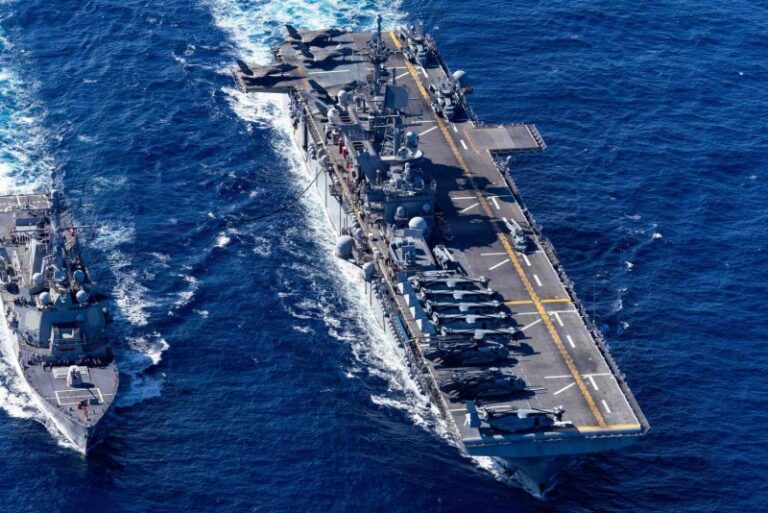
In the context of USSOUTHCOM’s missions, the F-35B’s stealth features and electronic warfare capabilities shine brightly. The region is rife with maritime routes exploited by narcotics traffickers, smugglers, and other illicit groups. These jets can slip into contested or denied airspace undetected, monitor shipping lanes, and engage threats if needed. They’re not operating in isolation either—they sync up with other U.S. assets like the Navy’s P-8A Poseidon maritime patrol aircraft for long-range surveillance, the E-2D Hawkeye for airborne early warning, and even Aegis-equipped destroyers for integrated air and missile defense. This creates a multi-layered security net that covers air, sea, and land domains, ensuring continuous monitoring over thousands of square miles of ocean.
The deployment aligns with broader directives from the Department of Defense and the White House, emphasizing persistent presence to deter aggression and respond to crises. Think about it: in an area prone to natural disasters, humanitarian emergencies, and security threats, having rapid-response airpower on hand can make all the difference. For instance, these F-35B operations support multinational efforts like Operation Martillo, a collaborative initiative involving the U.S. and partner nations to intercept drug shipments and dismantle criminal organizations. By participating in joint exercises and patrols, the Marines aren’t just protecting U.S. borders—they’re helping build capacity among allies, sharing tactics, and fostering trust that strengthens regional stability.
A spokesperson for USSOUTHCOM emphasized the symbolic and practical value of these missions, stating that they underscore America’s unwavering commitment to deterrence and partnership in Latin America and the Caribbean. “Each flight operation is a step toward a more secure hemisphere,” they noted, highlighting how the presence of advanced fighters like the F-35B reassures allies and sends a strong message to potential adversaries.
Looking deeper, this isn’t a one-off event; it’s part of a larger shift in U.S. military strategy toward more agile, tech-forward operations. The F-35 program, despite its controversies over costs and development timelines, has matured into a game-changer for joint forces. With over 1,000 F-35s delivered worldwide as of 2025, the B-variant specifically empowers the Marines to project power from the sea, integrating seamlessly with amphibious ready groups. In USSOUTHCOM, where fixed bases are limited and threats are asymmetric, the F-35B’s ability to deliver precision strikes—whether with laser-guided bombs, air-to-air missiles, or even future hypersonic weapons—provides commanders with flexible options to address everything from counter-narcotics to counter-terrorism.
Moreover, the aircraft’s network-centric design promotes interoperability not just within U.S. branches but with international partners. Countries in the region, such as Colombia, Brazil, and Mexico, often collaborate on security operations, and the F-35B’s data-sharing capabilities can enhance those efforts. For example, real-time intel from an F-35B sortie could be relayed to a partner nation’s coast guard, enabling quicker interdictions of suspicious vessels.
As we move into an era where great-power competition intersects with transnational challenges, deployments like this F-35B operation in USSOUTHCOM illustrate how the U.S. is prioritizing homeland defense through forward-leaning postures. It’s not about invasion or occupation; it’s about presence, prevention, and partnership. With climate change potentially exacerbating migration and resource conflicts in the region, and criminal networks growing more sophisticated, having fifth-generation airpower at the ready ensures the U.S. can respond effectively while minimizing risks to personnel.
In essence, the U.S. Marine Corps’ use of the F-35B in Southern Command isn’t just about flexing military muscle—it’s a smart, integrated approach to safeguarding the homeland by addressing threats at their source. As these operations continue, they reinforce the idea that airpower remains a critical pillar of American security strategy in an increasingly interconnected world.
About The Author