In a clear and resounding declaration of its growing naval prowess, the Republic of Korea (ROK) Navy recently concluded its first-ever fleet-level maritime maneuver exercise, a three-day wargame that dramatically showcased its cutting-edge capabilities in the East and South Seas. This landmark drill, held from November 9 to 11, 2025, not only commemorated the Navy’s 80th anniversary but also underscored South Korea’s unwavering commitment to bolstering its maritime defenses and projecting its strategic influence across vital regional waters. The exercise, spearheaded by the newly established Task Fleet Command, gathered an impressive array of seven warships and three aircraft, meticulously rehearsing a comprehensive suite of missions ranging from anti-ship and anti-submarine warfare to advanced air defense and ballistic-missile tracking.
The formal establishment of the Task Fleet Command on February 1, based strategically at Jeju, marks a pivotal moment in the evolution of the ROK Navy. This command consolidates ten formidable destroyers and four essential auxiliary vessels, forming the Navy’s premier mobile striking arm. Crucially, it operates free from the geographic constraints that traditionally define the responsibilities of the 1st, 2nd, and 3rd Fleets, allowing for unparalleled operational flexibility and reach. Seoul proudly positions this command as the maritime pillar of its innovative “three-axis” deterrence concept. This multi-layered strategy is meticulously designed to support the “Kill Chain” pre-emptive strike architecture, the robust “Korea Air and Missile Defense (KAMD),” and the formidable “Korea Massive Punishment and Retaliation (KMPR)” doctrine – all aimed squarely at countering North Korea’s escalating missile threats.
The composition of the exercise formation itself was a direct reflection of this vital mission. Leading the charge was the magnificent ROKS Jeongjo the Great, the cutting-edge KDX-III Batch II Aegis destroyer, making its presence felt even before its first official operational deployment. This emphasized the Navy’s firm intent to position this advanced warship as the flagship and central command hub of the fleet from day one. Alongside, the earlier, yet still incredibly potent, Sejong the Great-class ships, ROKS Yulgok Yi I and ROKS Seoae Ryu Seong-ryong, sailed with distinction. Providing crucial support were the Chungmugong Yi Sun-sin-class destroyers, ROKS Wang Geon and ROKS Gang Gam-chan, complemented by the Cheonji-class fast combat support ships, ROKS Cheonji and ROKS Daecheong, ensuring the task group’s sustained endurance.
At the heart of South Korea’s future sea-based missile shield stands the ROKS Jeongjo the Great. This impressive 170-meter, roughly 11,000-ton destroyer is equipped with the very latest Aegis Baseline 9.C2 “KII” combat system, seamlessly integrated with the powerful AN/SPY-1D(V) radar. This sophisticated pairing endows it with unparalleled processing power and sensor fidelity, enabling it to detect and track ballistic missiles at extreme ranges and, critically, to share these vital tracks across allied networks. Its mixed vertical-launch battery is a testament to its formidable offensive and defensive capabilities, combining 48 Mk 41 cells, ready for SM-2 missiles today and poised for SM-3/SM-6 in the near future, with 80 indigenous Korean VLS cells. Even deeper KVLS-II modules are sized for heavier land-attack and potentially ballistic missiles, directly feeding into the nation’s Korea Air and Missile Defense framework and the long-range strike leg of the three-axis strategy.
Supporting the Jeongjo the Great, the Batch I Sejong the Great-class ships continue to rank among the most heavily armed surface combatants afloat. These vessels, ranging from approximately 7,600 tons standard to 11,000 tons fully loaded, boast an formidable arsenal of 128 VLS cells, split between Mk 41 and KVLS. This allows them to deploy a versatile mix of SM-2 area-air-defense missiles, Red Shark ASROC for anti-submarine warfare, Hyunmoo land-attack cruise missiles, and advanced Korean surface-to-air rounds. This firepower is further augmented by a 127 mm gun, 16 potent Haeseong anti-ship missiles, RAM, a Goalkeeper CIWS (Close-In Weapon System), and ample hangar space for two ASW helicopters. During the exercise, the ROKS Seoae Ryu Seong-ryong’s combat information center impressively conducted simulated intercepts against a notional North Korean aircraft and anti-ship missile salvo, launching paired virtual SM-2s in a scenario specifically designed to stress timing, track management, and deconfliction within the complex Aegis picture.
Providing the crucial outer screen were the ROKS Wang Geon and ROKS Gang Gam-chan from the Chungmugong Yi Sun-sin class. These roughly 150-meter destroyers are capable of speeds up to 30 knots and carry a 32-cell Mk 41 VLS for SM-2, eight Harpoon anti-ship missiles, a RAM launcher, Goalkeeper CIWS, a 127 mm gun, and twin triple torpedo tubes. Their combat capabilities are supported by hull sonar, a towed array, and an updated Korean combat system currently undergoing modernization. In a real-world wartime scenario, ships of this class would likely form the critical anti-submarine warfare screen, actively prosecuting contacts, while the more advanced KDX-III class concentrates its efforts on air and missile defense and precision strike operations.
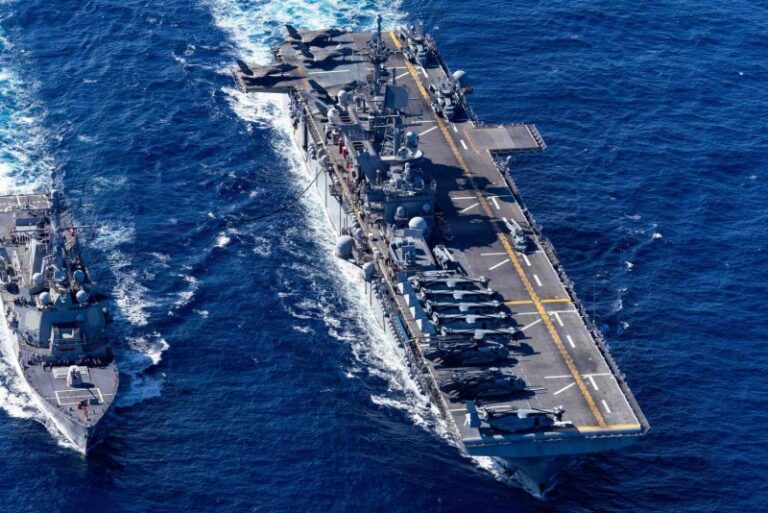
Endurance for the task group was provided by the reliable Cheonji-class support ships, ROKS Cheonji and ROKS Daecheong. Measuring approximately 133 meters in length and exceeding 9,000 tons fully loaded, these vessels boast an impressive capacity to carry roughly 4,800 tons of fuel, ammunition, and stores. Their design allows them to resupply two combatants simultaneously alongside, while also efficiently conducting vertical replenishment from their stern flight decks. Over the rigorous three-day exercise, the task group expertly maneuvered across both the East and South Seas without the need to return to port, definitively validating the command’s capability to sustain a missile-defense-capable surface force on station around the clock, a critical aspect of blue-water operations.
The wargame was explicitly utilized by the Navy to meticulously rehearse how this formidable formation would operate in a combat scenario. The Aegis destroyers and their escorts engaged in live 127 mm gunnery, practiced multi-ship air-defense engagements, conducted realistic ASW prosecutions, and executed intensive ballistic-missile detection and tracking drills. The ships fluidly shifted between various tactical formations, including column, line-abreast, diamond, and arrowhead. In a particularly symbolic moment, all seven ships formed a tight diamond around the logistics pair, directly mimicking a U.S. carrier strike group screen. This was a deliberate and forward-looking gesture, nodding to Seoul’s ambitious plans for a 30,000-ton “Korean-style” carrier and envisioning a future where this powerful Task Fleet provides comprehensive protection for high-value aviation assets at sea.
The timing of this exercise was especially poignant. Just days before the ships embarked on their mission, North Korea conducted another provocativelaunch, firing a short-range ballistic missile from Taegwan County that traveled approximately 700 kilometers into the East Sea. This marked its second ballistic test since President Lee Jae-myung took office. The Task Fleet drill, with its heavy emphasis on ballistic-missile tracking and simulated intercepts, was clearly scripted as a direct and potent reply. It served as a visible and undeniable demonstration that South Korea possesses the capability to seamlessly fuse its advanced Aegis sensors, national C4I (Command, Control, Communications, Computers, and Intelligence) systems, and airborne assets into a layered and highly effective response to SRBM (Short-Range Ballistic Missile) salvos. Simultaneously, it showcased its retained ability to execute precision strikes against command nodes and transporter-erector-launchers (TELs) should such orders be issued.
Beyond the immediate deterrence message to Pyongyang, the exercise also pointed towards a future of tighter trilateral missile-defense cooperation. These very same Korean destroyers, now rigorously training as a national task group, regularly steam alongside their counterparts – U.S. Arleigh Burke-class ships and Japanese Maya-class destroyers – in crucial ballistic-missile defense drills such as “Freedom Edge.” These exercises are designed to integrate Aegis ships, fifth-generation fighters, and maritime patrol aircraft into shared BMD (Ballistic Missile Defense), ASW, and air-defense architectures across the region. By convincingly proving its capability to operate as a coherent, Aegis-led fleet in its home waters, the ROK Navy is effectively rehearsing the vital role it will play within a wider U.S.–Japan–ROK sensor-to-shooter network, enhancing collective security across the Western Pacific.
Seoul’s strategic planners are also keenly observing the rapid expansion of China’s fleet. Pentagon and congressional assessments now unequivocally describe the People’s Liberation Army Navy (PLAN) as the largest in the world, boasting over 370 battle-force ships today, with projections of 395 by 2025 and an astonishing 435 by 2030. Much of this growth is concentrated in major surface combatants that will increasingly patrol the Yellow and East China Seas. Chinese warships and coast guard cutters already conduct “gray-zone” operations – actions that fall below the threshold of armed conflict – in and near South Korea’s exclusive economic zone hundreds of times a year, challenging long-standing norms and steadily eroding operational space, particularly in the Yellow Sea. A mobile, heavily armed Task Fleet that possesses the flexibility to swing east towards the Pacific or west towards these contested waters is Seoul’s sophisticated and multi-faceted answer to this twin pressure: the persistent ballistic missile threat from North Korea and the burgeoning naval expansion and assertive maritime activities of China. This historic exercise, therefore, marks not just a new chapter for the ROK Navy, but a powerful display of a rising naval force determined to protect its interests in a dynamically shifting regional power balance.
About The Author