In a move that underscores the aggressive and strategic nature of South Korea’s burgeoning defense industry, Seoul is preparing to transfer its first-ever operational submarine to Poland at no cost. According to reports from the Korea Times on November 26, 2025, the ROKS Jang Bogo (SS-061), the pathfinder of the Republic of Korea Navy’s undersea force, is slated for transfer to Warsaw by late 2025. This gesture is far more than a simple donation of surplus hardware; it is a calculated component of South Korea’s bid to secure Poland’s lucrative “Orka” submarine procurement program, a contract that could reshape the naval balance in the Baltic Sea.
A Historic Farewell and a New Beginning
The ROKS Jang Bogo holds a hallowed place in South Korean naval history. Commissioned in 1993, it was the first vessel of its class, symbolizing the nation’s transition from a coastal defense force to a blue-water navy. On November 19, 2025, the submarine concluded its thirty-four-year career with a final ceremonial voyage at the Jinhae Naval Base. In an emotional tribute, both the submarine’s first and final captains were on board as the fleet sounded their whistles in a final salute.
However, retirement for the Jang Bogo does not mean the scrap yard. Defense officials in Seoul have confirmed that while administrative approvals are still being processed, the intent is to repurpose the vessel to support defense exports. By transferring the submarine to Poland, South Korea offers Warsaw an immediate solution for crew training and operational continuity—a critical asset for a navy looking to rebuild its submarine capabilities from the ground up.
The Machine Beneath the Waves
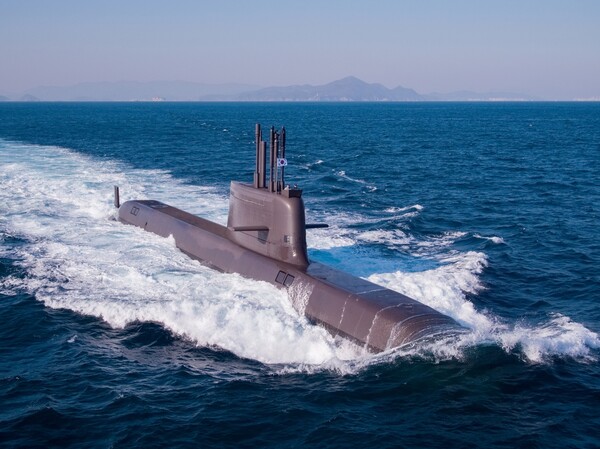
Despite its age, the Jang Bogo remains a capable platform, thanks to a philosophy of rigorous maintenance and modernization. Based on the German Type 209-1200 design, the vessel displaces approximately 1,200 tons on the surface and carries a crew of roughly thirty. Over three decades, it has clocked 633,000 kilometers—enough to circle the globe fifteen times—participating in high-level international exercises like RIMPAC and Pacific Reach.
Crucially, the submarine being offered to Poland is not the same ship that entered the water in the early 1990s. Through varying modernization cycles, the hull has been cut and re-welded to facilitate the replacement of engines, batteries, and combat systems. The current configuration includes the Atlas Elektronik ISUS combat management system and upgraded sonar suites, including towed arrays for low-frequency detection. Armed with 533mm torpedo tubes capable of firing the German SUT and South Korean “White Shark” torpedoes, as well as Sub-Harpoon anti-ship missiles on select units, the Jang Bogo represents a mature, lethal platform that can effectively bridge the gap until new-build submarines arrive.
The “Orka” Prize: A High-Stakes Competition
The context of this donation is the Orka program, Poland’s ambitious initiative to acquire up to four new submarines to replace its solitary, Soviet-era Kilo-class vessel. The program, estimated to be worth nearly $6 billion, demands not just hardware, but a comprehensive package involving technology transfer, local industrial participation, and long-term sustainment.
South Korea is facing stiff competition from established European heavyweights. Germany’s ThyssenKrupp Marine Systems (TKMS), Italy’s Fincantieri, and Sweden’s Saab are all vying for the contract, leveraging their geographic proximity and the European Union’s preference for intra-bloc defense spending. To counter this, South Korean shipbuilders Hanwha Ocean and HD Hyundai Heavy Industries are offering aggressive packages centered on the KSS-III class submarine—a larger, heavier platform capable of firing ballistic missiles.
The transfer of the Jang Bogo serves as a sweetener to the South Korean bid. It addresses one of Poland’s most immediate problems: the “capability gap.” Building new submarines takes years. By providing an operational boat immediately, South Korea allows the Polish Navy to begin training crews and maintaining submarine proficiency now, rather than waiting for the first new hull to hit the water in the late 2020s or early 2030s.
Deepening the Warsaw-Seoul Axis
This potential transfer is the latest chapter in a rapidly deepening defense partnership between Poland and South Korea. Since the Russian invasion of Ukraine in 2022, Poland has emerged as the largest customer for South Korean arms in Europe, signing multi-billion dollar deals for K2 Black Panther tanks, K9 Thunder howitzers, and FA-50 light combat aircraft.
These deals have created a framework of industrial cooperation that South Korea hopes to leverage for the submarine contract. The proposal includes establishing maintenance, repair, and overhaul (MRO) centers in Poland, which would service not only the Polish fleet but potentially other users of South Korean or Type 209 submarines in the region.
Strategic Implications
For Warsaw, accepting the Jang Bogo would be a pragmatic decision. It aligns with their requirement for a “bridge solution” to keep their submarine service alive while the Orka procurement is finalized. It also allows Polish sailors to gain experience on Western-standard systems that share lineage with potential future platforms.
For Seoul, the move is symbolic of its arrival as a top-tier defense exporter. Donating a capital ship to a NATO member nation demonstrates confidence in their hardware and a willingness to invest in long-term geopolitical relationships. While the final decision on the Orka program rests on a complex mix of technical, financial, and political factors, the offer of the Jang Bogo ensures that South Korea remains a formidable contender against its European rivals. As the submarine awaits its administrative clearance, it stands ready to trade the warm waters of the Pacific for the chill of the Baltic, carrying with it the ambitions of a nation determined to become a global arsenal of democracy.
About The Author