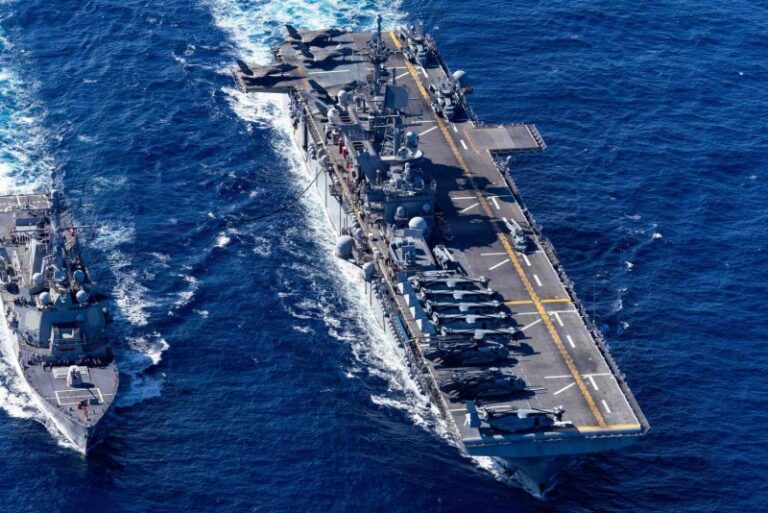
On December 1, 2025, the turquoise waters of St. Thomas in the U.S. Virgin Islands played host to a visitor of unprecedented scale and significance. The arrival of the USS Gerald R. Ford (CVN-78), the world’s largest and most technologically advanced aircraft carrier, marks a distinct turning point in American military posture within its own hemisphere. While port calls in the Caribbean are routine for the U.S. Navy, deploying a Ford-class supercarrier to the region is anything but. This maneuver signals a sharp recalibration of U.S. security priorities, driven by escalating diplomatic friction with Venezuela and a recognition that the “defense of the Homeland” now requires a heavy-hitting presence close to shore.
The carrier’s presence falls under the banner of Operation Southern Spear, a mission traditionally associated with U.S. Southern Command’s (SOUTHCOM) efforts to interdict transnational criminal networks and stem the flow of narcotics. However, the Navy’s rhetoric surrounding this deployment suggests that drug busts are merely a secondary objective. Rear Admiral Paul Lanzilotta, commanding the strike group, has explicitly framed the operation as a priority for “the defense of our Homeland.” This specific choice of words indicates that Washington no longer views the Caribbean solely through the lens of law enforcement. Instead, the region is being reassessed as a strategic defensive buffer where instability—specifically the current crisis radiating from Caracas—could pose direct threats to U.S. territories and borders.
The decision to park the pinnacle of American naval aviation in the U.S. Virgin Islands serves as a formidable message of deterrence. In a theater typically patrolled by Coast Guard cutters and smaller destroyers, the arrival of CVN-78 changes the calculus entirely. The Ford is not just a ship; it is a floating fortress capable of projecting power that rivals the air forces of entire nations. As the lead ship of its class, it integrates cutting-edge radar systems, electronic warfare suites, and decoy capabilities designed to counter sophisticated air, surface, and subsurface threats. When accompanied by its strike group—which includes guided-missile destroyers equipped with the Aegis combat system—the Ford creates an impenetrable bubble of security. This “layered defense” capability ensures that the U.S. can track and neutralize threats ranging from rogue aircraft to advanced missile systems, providing a level of situational awareness previously absent from the region.
The path the USS Gerald R. Ford took to get here further underscores the global nature of this strategic pivot. After departing Norfolk in June 2025, the carrier strike group spent months conducting high-intensity operations across the Atlantic. It operated above the Arctic Circle, asserting control in the freezing north, and participated in NATO’s “Neptune Strike” vigilance activities in the Mediterranean. The strike group’s subsequent transit through the Strait of Gibraltar and westward across the Atlantic represents a reallocation of high-end naval power from the European theater to the Americas. It is a clear indication that while threats in Europe and the Arctic remain, the U.S. military is unwilling to leave its southern flank exposed during a time of heightened unpredictability.
The security landscape of the Caribbean has become markedly complex in recent years, evolving into a crossroads of geopolitical rivalry and fragile governance. Beyond the headlines of transnational crime, the region is grappling with the political collapse in Haiti and, more pressingly, the entrenched and often hostile posture of the Venezuelan government. Intelligence reports and military analysts have long warned of external powers—often implied to be adversaries like Russia or China—leveraging these regional crises to expand their influence or conduct military activities in America’s backyard. In this context, the Ford is not merely hunting smugglers; it is standing guard against opportunistic hostile actions and ensuring that the Caribbean does not become a soft underbelly for U.S. defense.
Ultimately, the USS Gerald R. Ford’s visit to St. Thomas is a deliberate geopolitical signal. It reassures regional partners of American commitment while drawing a line in the sand for potential adversaries. By placing its most valuable naval asset in the U.S. Virgin Islands, Washington is demonstrating that it treats the Caribbean as a critical component of its national defense architecture. As Operation Southern Spear continues, the sight of the Ford on the horizon serves as a reminder that the United States is prepared to employ its full military weight to preserve stability, uphold international law, and protect its citizens from the emerging threats of a volatile world.
About The Author