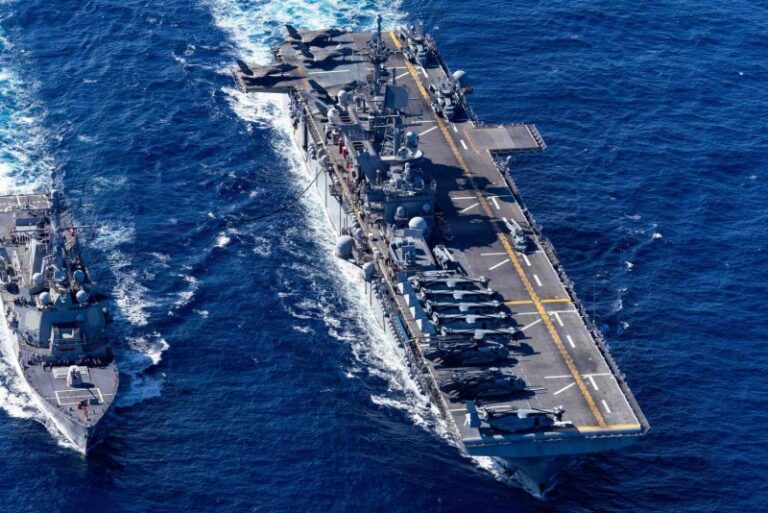
In a move brimming with geopolitical, geostrategic, and military significance, open-source naval trackers reported on November 13, 2025, the presence of two formidable US Navy warships – the destroyer USS Stockdale (DDG-106) and the guided-missile cruiser USS Gettysburg (CG-64) – operating less than fifty kilometers off the Venezuelan coast. Naval OSINT (Open-Source Intelligence) accounts across social media and specialized ship-tracking websites, which serve maritime traffic much like Flightradar24 does for aviation, meticulously plotted both vessels within Venezuela’s Exclusive Economic Zone (EEZ) but critically outside its territorial waters. This precise positioning coincides directly with the United States’ announcement of the commencement of its “Southern Spear” mission, an initiative focused on deploying additional forces in the Caribbean to actively combat narco-terrorist and transnational criminal networks. Given their potent Tomahawk cruise-missile capabilities and their undeniable proximity to Caracas and Venezuela’s key coastal infrastructure, this deployment is not merely a routine presence operation; it is an operationally significant posture with immediate and profound implications for the region.
The current disposition of the USS Stockdale and USS Gettysburg places them within a particularly sensitive maritime corridor directly off the Venezuelan mainland. OSINT plots vividly described the two ships sailing in a coordinated formation, moving from west to east. They were observed skirting the islands of Aruba and Curaçao before stabilizing their positions roughly fifty kilometers off the coast of Falcón state and less than fifty nautical miles from the vital port of La Guaira, which serves the Caracas area. At various points during their transit, their recorded positions placed them approximately ninety-six kilometers from Caraballeda in Vargas state and a mere thirty-nine kilometers southeast of the Los Roques archipelago. Both warships were consistently tracked at speeds in the region of 16–17 knots, a velocity that is highly consistent with a controlled, deliberate transit into a pre-planned operating box rather than a casual or undirected passage through the area. While these vessels remain in international waters, their active operation inside Venezuela’s EEZ means that substantial portions of the country’s northern littoral – encompassing the wider Caracas metropolitan area and numerous critical military installations – now lie squarely within practical Tomahawk striking distance. In such a configuration, the ships transcend mere presence; they are strategically positioned such that, if political authorities in Washington were to issue the order, they possess the capability to rapidly transition from surveillance and deterrence to executing precision strikes.
At the operational heart of this assertive posture is the USS Gettysburg, a Ticonderoga-class guided-missile cruiser. This class of warship is purpose-built to function as both an advanced air-defense flagship and a formidable long-range strike platform. The Gettysburg is equipped with the renowned Aegis combat system and a high-capacity vertical launch system (VLS), enabling it to carry a versatile mix of surface-to-air missiles for defense, anti-submarine weapons, and, most notably in this context, Tomahawk land-attack cruise missiles. From its station in the waters north of Venezuela, Tomahawk missiles launched by the cruiser could reach an extensive array of fixed targets across northern Venezuela. These potential targets could include vital air-defense radar sites, critical coastal surveillance facilities, command-and-control nodes, and infrastructure specifically alleged by US authorities to be linked to narcotics trafficking. The inherent combination of long range, precision guidance, and the ability to fire multiple missiles in a coordinated salvo makes the Gettysburg an indispensable asset for any initial phase of a potential operation. This could range from strikes limited to specific “narco” targets to broader actions aimed at degrading elements of the Venezuelan integrated air-defense system. Concurrently, the cruiser’s sophisticated sensor suite and advanced command facilities allow it to effectively coordinate air-defense coverage and maintain comprehensive maritime situational awareness for other US units deployed in the Caribbean under the Southern Spear mission, including any nearby carrier or amphibious groups.
Complementing the cruiser’s capabilities is the USS Stockdale, an Arleigh Burke-class Flight IIA destroyer. This multi-role combatant adds both further Tomahawk capacity and a robust protective shield around the entire force. As an Aegis-equipped vessel, the Stockdale seamlessly integrates anti-air, anti-surface, and anti-submarine warfare capabilities within a single, highly capable platform. It fields its own bank of vertical launch cells, also capable of firing Tomahawk land-attack missiles. In practical terms, this means the Stockdale can actively contribute to a combined strike package against selected targets ashore while simultaneously providing layered air-defense coverage for the Gettysburg and for other high-value units operating in the vicinity. This dual role is particularly critical in the constrained maritime space off Venezuela, where any crisis scenario would likely necessitate not only the intricate management of air and missile threats but also the imperative need to maintain continuous surveillance of coastal activity, military aviation movements, and the potential presence of asymmetric actors at sea. Together, the cruiser and the destroyer form a compact but extraordinarily capable surface strike group, possessing the collective capacity to deliver a significant number of Tomahawk missiles within an extremely short time window. This capability dramatically compresses the decision and reaction time available to Venezuelan authorities in the event of any escalation.
This notable deployment unfolds against the broader backdrop of the “Southern Spear” mission. Under this framework, the United States has articulated its current military build-up in the Caribbean as part of a wider, concerted effort to dismantle deeply entrenched narco-terrorist and transnational criminal networks operating throughout the region. While official communication from Washington has primarily emphasized maritime interdiction operations and the neutralization of drug-carrying vessels, the deliberate choice to position Tomahawk-armed warships within Venezuela’s EEZ strongly suggests that Washington wishes to preserve a far wider spectrum of military options. One frequently discussed scenario involves cruise-missile strikes directed against specific sites explicitly designated as supporting narcotics trafficking or providing protection to these networks. Such targets could include clandestine airstrips, illicit storage facilities, or critical communications hubs. A more expansive, albeit potentially escalatory, option could entail degrading key elements of Venezuela’s air-defense and command structure to ensure complete freedom of action for any subsequent air or maritime operations.
From a nuanced geopolitical and geostrategic perspective, the sheer presence of the Gettysburg and Stockdale so close to Venezuelan shores constitutes a dense and unequivocal signal to multiple audiences. For Caracas, it serves as a stark reminder that key political and military centers of gravity lie within direct reach of US sea-based precision weapons, critically, even without the requirement for overflight by manned aircraft. This operational reality significantly complicates Venezuelan defense planning, as it must now meticulously account for the possibility of low-warning cruise-missile attacks originating from the sea, flying at low altitude, and capable of targeting critical nodes across a wide geographical area. For neighboring states, this deployment illustrates both the potential benefits and inherent risks of hosting or facilitating US operations: it simultaneously reinforces US security commitments against criminal networks but also brings major naval assets and the potential dynamics of conflict much closer to their own sovereign waters. For external powers that have cultivated diplomatic and economic ties with Caracas, the operation functions as a powerful reminder that the United States retains the capability to rapidly concentrate high-end naval forces in the Caribbean, even while simultaneously maintaining significant commitments in other global theaters. Militarily, by operating within the EEZ but remaining beyond territorial waters, Washington shrewdly combines the legal freedom of navigation with a posture of overt pressure, maintaining political control over escalation while making unambiguously clear that the conditions for rapid action are already in place.
The net result of this intricate interplay is that the simultaneous presence of the USS Gettysburg and USS Stockdale off Venezuela is both a concrete operational posture and a potent strategic message. Two Tomahawk-capable surface combatants, strategically positioned less than fifty kilometers from the coast and continuously monitored in real-time by an increasingly sophisticated network of naval OSINT platforms, provide the United States with a credible and immediate ability to launch precision strikes against selected targets inside Venezuela with minimal notice. Concurrently, their deployment under the overarching banner of Southern Spear is precisely intended to signal to Caracas, to regional partners, and to influential outside actors that Washington is unequivocally prepared to leverage sea-based power to shape the security environment in the Caribbean, all while meticulously operating within the established legal framework of international waters. Whether these imposing warships remain instruments of deterrence and coercive diplomacy or ultimately become active participants in a military operation will hinge entirely on political decisions that have not yet been publicly disclosed. What remains undeniably clear, however, is that their current position, formidable capabilities, and the overarching context of their mission have already fundamentally altered the strategic balance along Venezuela’s northern coastline and will undoubtedly continue to profoundly influence calculations on all sides as this volatile situation continues to evolve.
About The Author